



Carles Delclaux Is
At 16, Carles Delclaux Is entered the Aymat workshop in Sant Cugat and began learning high-warp tapestry under craftsmen who had worked with the architects of the Catalan textile revival. Three years later, at 19, he was directing the workshop. Born in Sant Cugat del Valles in 1951[1], Delclaux came up through the Massana School of Fine Arts in Barcelona while apprenticing in classical restoration and weaving, and the double formation left him positioned between the studio and the loom.
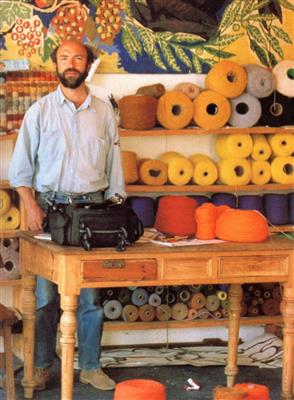
Biography
His work centres on high-warp tapestries that engage directly with the visual language of other artists. He has translated compositions by Miro, Subirachs, and Grau-Garriga into woven form, not as reproduction but as reinterpretation: the textile process alters colour, texture, and spatial weight in ways that constitute a second creative act. His own imagery returns consistently to nature, the female figure, and abstraction.
After leaving the Aymat workshop in 1975, he moved to Girona, where he taught tapestry in an academic setting grounded in classical weaving methods. He held a chair in tapestry there, and his pedagogical influence shaped the generation of Catalan weavers that followed him. His work is held by MACBA, the CDAN, and the Contemporary Tapestry Museum at Casa Aymat, among others.
Timeline
- 1951Born in Sant Cugat del Valles.
- 1967At 16, began learning high-warp tapestry at the Aymat workshop in Sant Cugat.
- 1970At 19, became director of the Aymat workshop.
- 1975Left the Aymat workshop.
- 1975Moved to Girona and began teaching tapestry.
- 1975Began translating compositions by Miro, Subirachs, and Grau-Garriga into woven form.
- 1975His work began to consistently feature nature, the female figure, and abstraction.
Notable Works
Tap to view larger.
Next stop
Browse the movements →
Every movement in the collection, from the Renaissance to Pop art.
Related Artists



Frequently Asked Questions
What is Carles Delclaux Is known for?
Carles Delclaux Is is known for his high-warp tapestries that engage directly with the visual language of other artists. He has translated compositions by Miro, Subirachs, and Grau-Garriga into woven form, not as reproduction but as reinterpretation; the textile process alters colour, texture, and spatial weight in ways that constitute a second creative act.What is Carles Delclaux Is's most famous work?
It is difficult to name one single "most famous" work by Carles Delclaux Is. His artistic output includes painting, drawing, and set design. He is known for his distinctive approach to colour and form. Delclaux Is's work often explores themes related to urban life and the human figure. His paintings frequently depict scenes from Barcelona. These works capture the energy of city life. He also creates portraits, often characterised by bold lines and flattened perspective. In addition to his paintings, Delclaux Is has worked in theatre. He has designed sets for a number of productions. This work demonstrates his versatility as an artist. His set designs often incorporate the same visual language as his paintings. While he has exhibited widely, no single piece has achieved overwhelming recognition above all others. His body of work, taken as a whole, has cemented his reputation as a significant contemporary artist in Spain.What should I know about Carles Delclaux Is's prints?
When buying fine art prints, it is helpful to understand some basic principles. Printmaking dates back to ancient Egypt and China, where stamps and seals made impressions. Wood blocks were used to print patterns on textiles even before paper became common. The earliest paper impressions were in China around the second century. Printmaking became widespread in Europe at the end of the fourteenth century. Woodcuts served as book illustrations, religious icons, and even playing cards. Before photography, prints were used to reproduce images. Prints are often produced in limited editions, each numbered and signed by the artist. The number indicates its place in the sequence, such as 12/25. The artist determines the edition size. This practice helps control the market and maintain quality as plates degrade with use. The title appears in the centre of the bottom margin, with the signature on the right. These conventions add value if adhered to.What style or movement did Carles Delclaux Is belong to?
It is difficult to assign Carles Delclaux Is to a single style or movement based on the available information. However, some sources offer insight into related artistic concepts. One passage discusses the Baroque, noting its forms "live with passionate intensity a life that is entirely their own" and "break apart even as they grow; they tend to invade space in every direction, to perforate it, to become as one with all its possibilities." The text connects Baroque style with folds, seen in works such as Bernini's sculptures. In these examples, folds of clothing take on autonomy, conveying spiritual force and affecting the body's form. Another passage focuses on the fashion designer Armani, whose style is characterised by "simplicity, the refinement". The author recognises "his modern essential and minimal line", and also "the lightness of his fabrics, which follow the body's line without ever encumbering it". Without more specific information, it is impossible to definitively place Carles Delclaux Is within a particular movement. However, the passages offer potential avenues for further investigation into possible influences and connections.What techniques or materials did Carles Delclaux Is use?
Carles Delclaux Is (born 1950) is a Catalan artist known for his prints and artist books. He studied at the Escola Massana, a design and art centre in Barcelona. Delclaux Is often works with etching, a printmaking technique that uses acid to corrode unprotected parts of a metal surface to create a design. The plate can be made of iron, copper, or zinc. The artist applies a waxy ground to the plate, then scratches an image into the ground with a pointed tool, exposing the metal. The plate is then immersed in acid, which bites into the exposed lines. The remaining ground is removed, and the plate is inked and printed. He also uses aquatint, often in combination with etching. Aquatint creates tonal effects, rather than lines. It involves applying a porous ground of powdered resin to the plate, which is then heated to fix the resin. Acid bites around the resin particles, creating a granular surface that holds ink. By varying the density of the resin and the duration of the acid bath, the artist can achieve a range of tones.What was Carles Delclaux Is known for?
Carles Delclaux Is (1950-2020[1]) was a Catalan painter and printmaker. He is best known for his contributions to contemporary Catalan art, particularly his abstract and surrealist-influenced works. Delclaux Is's artistic output included paintings, engravings, and lithographs. His style often combined geometric shapes with organic forms, creating a sense of depth and movement. The artist explored themes of identity, memory, and the human condition in his art. He exhibited widely in Spain and internationally, with his work appearing in galleries and museums across Europe and the Americas. His prints are held in several public collections, including the Bibliothèque Nationale de France. He received several awards and accolades during his career, solidifying his position as a significant figure in Catalan art.When did Carles Delclaux Is live and work?
Carles Delclaux Is was born in Brussels on 19 October 1927. His father was a Russian doctor who had become a naturalised Belgian citizen; his mother was Walloon, also a doctor. In 1944, Delclaux Is entered the École Nationale Supérieure d'Architecture et des Arts Décoratifs, La Cambre, in Brussels. There, he studied book illustration and typography. By 1946, he was experimenting with oil painting. In March 1949, Delclaux Is met Christian Dotremont in Brussels. He joined the Cobra group (Copenhagen, Brussels, Amsterdam). With sculptors Olivier Strebelle and Reinhoud, and graphic artist Michel Olyff, he established a communal house, Les Ateliers du Marais, which became the Centre de Recherche Cobra. Artists such as Karel Appel, Pol Bury, Constant, Corneille, and Asger Jorn passed through the centre. In 1983, Delclaux Is became a professor of painting at the École Nationale Supérieure des Beaux-Arts in Paris.Where can I see Carles Delclaux Is's work?
Works by Carles Delclaux Is can be seen in several European museums. In Spain, his pieces are held at the Museo Art Nouveau y Art Deco, located on Calle Gibraltar 14, Salamanca, and the Museu d’Art Modern (MNAC) in Barcelona, situated in Parc de la Ciutadella. Portugal's Museu Calouste Gulbenkian, on Av. de Berna in Lisbon, also holds examples of his art. Other museums include the Brangwyn Museum in Brugge, Belgium, and the Clockarium Museum in Brussels. In France, you can find his work at the Musée d’Art et d’lndustrie in Roubaix, the Musée de l’Ecole de Nancy, and the Musée des Arts Decoratifs and Musée d’Orsay in Paris. There are also pieces at the Musée des Beaux-Arts in Nantes. These institutions offer opportunities to view Delclaux Is's artistic contributions.Where was Carles Delclaux Is from?
Carles Delclaux Is was a Catalan artist. He was born in Barcelona in 1950. Delclaux Is is known for his printmaking, especially his lithography. His work often features themes related to the natural world, rendered in a style that combines realism with elements of abstraction. He studied at the Escola Massana, a school of art and design in Barcelona, where he developed his skills in drawing, painting, and printmaking techniques. Throughout his career, Delclaux Is has exhibited his work in galleries and museums across Europe. He has been associated with other Catalan artists who explore similar themes in their work. His prints are collected both privately and by public institutions. He continues to live and work in Catalonia.Who did Carles Delclaux Is influence?
Carles Delclaux Is appears not to have had direct students or assistants. However, his work can be situated within a larger field of artistic influence. Dubuffet's use of unusual materials, such as sponges, clinkers, burnt cork, metal foil, vinyl, and polyurethane, served as a model for younger artists. Yves Klein's use of raw pigment, gold leaf, and sponges, as well as his "anthropometries", show a debt to Dubuffet's experiments. Claes Oldenburg was also influenced by Dubuffet; his newspaper assemblages and his use of plaster-soaked muslin echo Dubuffet's spirit. Oldenburg's nearly illegible homage to Dubuffet, "I Think Your Work Looks a Lot Like Dubuffet" (1960), is an example of this. Other Spanish[1] artists, such as Calvo and Miquel Navarro, were working in a climate where the informalism of the 1950s was still an avant-garde model. They were sensitive to its gestural expression and natural materials, but sought to reassess existing cultural materials. Navarro, like Calvo, chose the ceramic medium and developed a personal style.Who influenced Carles Delclaux Is?
It is difficult to identify specific influences on Carles Delclaux Is, as information regarding his artistic training and development is limited. However, we can consider the broader artistic context of his time and place. Delclaux Is was a Catalan artist, active in the late 20th and early 21st centuries. Catalonia has a rich artistic heritage, including Romanesque church paintings, Gothic altarpieces, and the Modernista architecture of Antoni Gaudí. 20th-century Catalan art saw the rise of movements like Noucentisme, which rejected the perceived excesses of Modernisme in favour of classical ideals and Mediterranean identity. Later, artists associated with Dau al Set embraced Surrealism and Dada. Joan Miró, a Catalan artist of international stature, explored abstraction and symbolism. Given this background, Delclaux Is may have drawn inspiration from various sources: the traditions of Catalan art, the innovations of modern art movements, or the work of his Catalan contemporaries. Without further information, it is impossible to be more precise about his artistic influences.Who was Carles Delclaux Is?
Carles Delclaux Is (1931-2021[1]) was a Catalan painter and printmaker. He was born in Barcelona, where he also studied. Delclaux Is's work often explored the urban environment, particularly Barcelona. He was known for his use of colour and his semi-abstract style. His prints and paintings often depict cityscapes, buildings, and scenes of daily life. These works capture the atmosphere of the city. He exhibited extensively in Spain and internationally. His work can be found in numerous public and private collections. These include the Museu d'Art Contemporani de Barcelona (MACBA). He was a member of various artistic groups and associations. Delclaux Is also worked as an illustrator and graphic designer. He contributed to books and magazines, applying his artistic vision to a range of media. His career spanned several decades, during which he developed a distinctive style. This style made him a significant figure in Catalan art.
Sources
Editorial draws on the following primary and tertiary references for Carles Delclaux Is.
- [1] wikipedia Wikipedia: Carles Delclaux Is Used for: biography, birth dates, death dates, identifiers, movement attribution, nationality.
- [2] book guggenheim-anglesofvisionfr00denn Used for: biography.
- [3] book guggenheim-emergingartists100wald Used for: biography.
- [4] book Masterpieces of western art : a history of art in 900 individual studies from the Gothic to the present day Used for: biography.
- [5] book Lama Gega, Principles of Tibetan art_ Illustrations and explanations of Buddhist iconography and iconometry according to the Karma Gardri school Volume 2 Used for: stylistic analysis.
- [6] book Lama Gega, Principles of Tibetan art_ Illustrations and explanations of Buddhist iconography and iconometry according to the Karma Gardri school Volume 2 Used for: stylistic analysis.
- [7] book Sun Zi, Sun Zi: The Art of War. An Ancient Chinese Military Classic With the Chinese Original Text, Text-Analytical Data, an English translation by Lionel Giles (1910), Latin Hanyu Pinyin Transcription and Chinese-English Meaning Definitions Used for: biography, stylistic analysis.
Editorial overseen by Solis Prints. Sources verified 2026-09-01. Click a source for details, or hover over [N] in the page above to preview.
Editorial standardsMethodologyCorrectionsAI disclosureAbout the editorial team