



Bertold Löffler
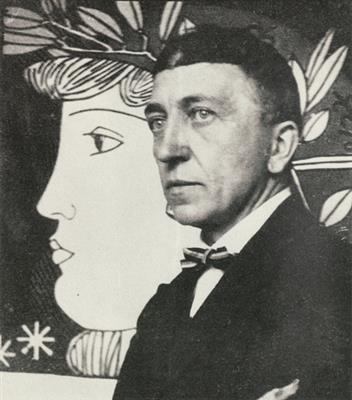
His name is attached to approximately 1,000 majolica tiles lining the walls of the Cabaret Fledermaus in Vienna. Löffler co-designed those tiles with Michael Powolny under the banner of Wiener Keramik, the ceramics studio they co-founded, and when the cabaret opened on 19 October 1907[1] it was described as the Wiener Werkstätte's purest expression of the Gesamtkunstwerk: the total work of art, in which no surface could be left unadorned.
Biography
Born in Nieder-Cranowitz (now Chranowice, Czech Republic) in 1874[1], Löffler studied in Vienna before becoming professor in the Painting and Drawing Department at the Kunstgewerbeschule, the city's school of applied arts. His position there placed him at the centre of Viennese modernism: he worked alongside Josef Hoffmann and Koloman Moser, contributed to Wiener Werkstätte commissions, and taught a generation of designers at a moment when Austrian applied art was remaking itself.
Among his students was Oskar Kokoschka, whom Löffler would later describe as a "little mimosa" who needed to stop imitating his classmates and find his own voice. He permitted students to take paid commissions from the Wiener Werkstätte, an unusual policy that gave Kokoschka the opportunity to produce his early postcards and illustrated work. Löffler also assigned his students to design costumes for Group XIII of the 1908[1] Imperial Jubilee Procession, a large public spectacle marking Emperor Franz Joseph's anniversary.
His own graphic and decorative work made him one of the more recognisable figures in Viennese Jugendstil, known for poster design and the integration of ornament with a flat, linear aesthetic drawn from folk tradition and the Secession. He continued teaching and working in Vienna until his death in 1960[1].
Timeline
- 1874Born in Nieder-Cranowitz (now Chranowice, Czech Republic).
- 1900Became professor in the Painting and Drawing Department at the Kunstgewerbeschule in Vienna.
- 1900Worked alongside Josef Hoffmann and Koloman Moser, contributing to Wiener Werkstätte commissions.
- 1907Co-designed approximately 1,000 majolica tiles with Michael Powolny for the Cabaret Fledermaus in Vienna, under the Wiener Keramik banner.
- 1907Co-founded Wiener Keramik, a ceramics studio, with Michael Powolny.
- 1908Assigned his students to design costumes for Group XIII of the Imperial Jubilee Procession.
- 1960Died in Vienna at the age of 86.
Notable Works
Tap to view larger.
Next stop
Browse the movements →
Every movement in the collection, from the Renaissance to Pop art.
Related Artists


Frequently Asked Questions
What is Bertold Löffler known for?
Bertold Löffler is known for his graphic and decorative work in Viennese Jugendstil. He was recognised for poster design and the integration of ornament with a flat, linear aesthetic, which drew from folk tradition and the Secession.What is Bertold Löffler's most famous work?
It is difficult to name Bertold Löffler's single "most famous work" with certainty. Without specific references to Löffler's oeuvre, it is difficult to assess his notability. However, one can look to the general context of the Viennese art scene in which he worked. The early 20th-century art world in Vienna was one of diverse styles and movements. The city was home to the Vienna Secession, a group of artists who rejected the conservative academic art establishment. Figures such as Gustav Klimt, were central to this movement. Works from this period include paintings such as "The Kiss" and "Adele Bloch-Bauer I". These paintings are well known for their decorative style and use of gold leaf.What should I know about Bertold Löffler's prints?
Bertold Löffler (1874[1]-1960[1]) was an Austrian artist known for his association with the Wiener Werkstätte (Vienna Workshop). He joined this collective of artists and designers in 1907[1], contributing to its output until 1916. Löffler's prints often feature bold colours and simplified forms, typical of the Wiener Werkstätte style. His subjects included animals, figures, and decorative patterns. These designs appeared on various items, such as postcards, posters, and ceramics. He created many popular postcard designs. Löffler also worked as a graphic artist and ceramicist. He taught at the Vienna School of Arts and Crafts, influencing a generation of Austrian artists. His work aimed to bring art into everyday life, a central tenet of the Wiener Werkstätte. He is recognised for his contributions to Austrian decorative arts and graphic design during the early 20th century.What style or movement did Bertold Löffler belong to?
It is difficult to assign Bertold Löffler to one specific style. The artistic movements of the late 19th and early 20th centuries were complex, with artists often drawing from multiple sources. One way to consider Löffler's place is in relation to the broader modernist movement. Modernism was characterised by a search for new forms of expression, a rejection of academic traditions, and a focus on individual experience. Some scholars characterise it as an artistic chaos out of which a single direction will ultimately appear. Another way to approach the question of style is to consider the concept of "repose". Some have argued that style and repose are synonyms; that repose is the same as style, and style the same as repose. Ultimately, style in art is a matter of weighted preferences. It is a tendency, and we may discern a tendency globally without being able in any individual case to pin it down.What techniques or materials did Bertold Löffler use?
Bertold Löffler (1874[1]-1960[1]) was an Austrian artist and designer associated with the Wiener Werkstätte. He is known for his diverse output, which included ceramics, posters, postcards, and children's books. Löffler's ceramic work often featured bright colours and bold outlines. These pieces included figures of animals and people, and decorative objects such as vases and bowls. He used a variety of ceramic techniques, including slip-casting and hand-painting. In his graphic work, Löffler employed woodcuts and linocuts, which allowed for strong, graphic designs with clear lines and flat areas of colour. His poster designs often incorporated lettering as a key element. He also produced watercolour illustrations, particularly for his children's books, which display a lighter, more fluid style. Löffler's versatility across different media is a defining characteristic of his artistic practice.What was Bertold Löffler known for?
Bertold Löffler, active in the early 20th century, is best known for his association with the Wiener Werkstätte (Vienna Workshop). This collective of artists and designers aimed to unite art and craft. Löffler's work spanned various media. He designed ceramics, posters, postcards, and children's books. His style often incorporated bold colours and simplified forms. Many of his designs feature playful, almost cartoonish figures. These designs reflect an interest in folk art and popular culture. His ceramic figures, in particular, display a distinctive style. They often depict characters from Viennese life, such as street vendors and performers. These figures are characterised by their simple shapes, bright glazes, and humorous expressions. Löffler's designs contributed to the Werkstätte's distinctive aesthetic. He captured the spirit of Vienna at the turn of the century.When did Bertold Löffler live and work?
Bertold Löffler (1874[1]-1960[1]) was an Austrian artist, active primarily in Vienna. He is best known for his contributions to the Wiener Werkstätte, an association of artists and designers founded in 1903[1]. Löffler studied at the Academy of Fine Arts Vienna under Christian Griepenkerl and Franz Rumpler. He joined the Wiener Werkstätte in 1906 and worked there until 1916. His output included a range of media: ceramics, postcards, posters, and children's books. His style often featured bold outlines and flat areas of colour. After his time with the Wiener Werkstätte, Löffler continued to work as a freelance artist. He taught at the Vienna School of Applied Arts from 1922 to 1935. Löffler's work saw a revival of interest in the late 20th century, and examples of his designs are now held in museum collections. He died in Vienna in 1960.Where can I see Bertold Löffler's work?
Bertold Löffler's work can be viewed in several museums, primarily in Europe and North America. In the United States, notable locations include the Charles Hosmer Morse Museum of American Art (Winter Park, Florida), the Los Angeles County Museum of Art (Los Angeles), the Metropolitan Museum of Art (New York), the Minneapolis Institute of Arts, the Museum of Modern Art (New York), the Virginia Museum of Fine Arts (Richmond), and the Wolfsonian at Florida International University (Miami Beach). In the United Kingdom, Löffler's pieces are held at the Bakelite Museum (Williton), the Brighton Museum & Art Gallery, the Geffrye Museum (London), the Manchester Art Gallery, the National Museums of Scotland (Edinburgh), and the Victoria & Albert Museum (London). In continental Europe, see the Bauhaus Archive Design Museum (Berlin), the Bauhaus Dessau Foundation, the Bröhan-Museum (Berlin), the Kunstgewerbe Museum of Decorative Arts (Berlin), the MAK Austrian Museum of Applied Art/Contemporary Art (Vienna), the Museum beim Markt (Karlsruhe), and the Museum für Kunst und Gewerbe (Hamburg).Where was Bertold Löffler from?
Bertold Löffler was an Austrian artist. He was born in what is now the Czech Republic, in the town of Nový Jičín, on 29 September 1874[1]. At that time, the town was part of the Austro-Hungarian Empire and was known by its German[1] name, Neutitschein. Löffler is best known for his association with the Wiener Werkstätte (Vienna Workshops), a community of artists and designers founded in 1903[1], and his work reflects the aesthetic of the Vienna Secession movement. He joined the Wiener Werkstätte in 1906, and he taught at the Kunstgewerbeschule (School of Applied Arts) in Vienna. His work included ceramics, graphic design, toys, and posters. Löffler's style often incorporated bold colours and simplified forms, reflecting the influence of modernism. He died in Vienna on 22 March 1960[1].Who did Bertold Löffler influence?
Bertold Löffler taught at the Wiener Kunstgewerbeschule (Vienna School of Arts and Crafts). Alfred Zoff, an Austrian artist, studied at the Vienna Akademie der bildenden Künste (Academy of Fine Arts). He later attended the Grossherzogliche Kunstschule (Grand Ducal School of Art) in Karlsruhe. Zoff's style, characterised by bold colours and broad brushwork, developed during his time in Karlsruhe. He was influenced by the Barbizon School, and his later works show the impact of Claude Monet's colour schemes and compositions. Zoff's "Harbour of Nieuwpoort" (1910[1]/12) bears similarities to Monet's "The Seine at Rouen" (1874[1]). Olga Wisinger-Florian, a student of Schindler, found inspiration and stimulus in Monet's compositions. Her garden and flower pictures show Monet's influence, without diminishing her own style. Wisinger-Florian employed impasto application, often with a palette knife, and strong colours. Her "Flowering Poppies" (1895/1900) can be seen as an Austrian response to Monet's poppy field paintings.Who influenced Bertold Löffler?
Bertold Löffler, an Austrian artist, absorbed influences from various sources. The painter Claude Monet provided stimuli relating to motifs and technique, as well as on the compositional level. Monet's pictures became a source of inspiration for Austrian artists such as Gustav Klimt, Heinrich Kiihn, Carl Moll, and Emil Jakob Schindler. These artists all preserved their own individual characteristics, absorbing only those elements of Monet’s work that conformed to their own objectives. As Hermann Bahr noted, they all pursued the aim of “painting in keeping with their convictions” and strove to give expression to the uniqueness of each individual and the individuality of the entire age. They aimed to avoid being mere copiers. Olga Wisinger-Florian's work, such as 'Pergola near Mentone', also reflects the artistic environment of the time.Who was Bertold Löffler?
Bertold Löffler (1874[1]-1960[1]) was an Austrian artist, ceramicist, and designer. He is best known for his contributions to the Wiener Werkstätte (Vienna Workshop), an association of artists and designers founded in 1903[1]. Löffler joined the Wiener Werkstätte in 1906, and his work there encompassed a range of media. He designed posters, postcards, ceramics, toys, and other decorative objects. His style often incorporated bold colours and simplified forms, reflecting the influence of Expressionism and other modern art movements. His association with the Werkstätte ended in 1912. Later, Löffler taught at the Vienna School of Applied Arts. His work is now held in museum collections, and he is recognised as an important figure in the development of Austrian design in the early 20th century.
Sources
Editorial draws on the following primary and tertiary references for Bertold Löffler.
- [1] wikipedia Wikipedia: Bertold Löffler Used for: biography, birth dates, death dates, identifiers, movement attribution, nationality.
- [2] book Judith Miller, Art Deco (Collector's Guides) Used for: biography.
- [3] book Elizabeth Otto & Patrick Rössler, Bauhaus Women Used for: biography.
- [4] book R. Bruce Elder, Cubism and Futurism_ Spiritual Machines and the Cinematic Effect (Film and Media Studies) Used for: stylistic analysis.
- [5] book Starr Figura, German Expressionism: The Graphic Impulse Used for: biography.
- [6] book guggenheim-expger00neug Used for: biography.
- [7] book Husslein-Arco, Agnes, editor; Koja, Stephan, editor; Law, Rebecca (Translator), translator; McInnes, Robert (Translator), translator; Somers, Nick, translator; Monet, Claude, 1840-1926. Paintings. Selections; Österreichische Galerie Belvedere, h Used for: biography.
- [8] book Bauhaus-Archiv Berlin Museum für Gestaltung, Stiftung Bauhaus Dessau, and Klassik Stiftung Weimar (editor), Modell Bauhaus_ A Conceptual Model. 1919-2009 Used for: stylistic analysis.
- [9] book Bauhaus-Archiv Berlin Museum für Gestaltung, Stiftung Bauhaus Dessau, and Klassik Stiftung Weimar (editor), Modell Bauhaus_ A Conceptual Model. 1919-2009 Used for: stylistic analysis.
- [10] book Anne-Marie O'Connor, The Lady in Gold Used for: biography.
Editorial overseen by Solis Prints. Sources verified 2026-10-15. Click a source for details, or hover over [N] in the page above to preview.
Editorial standardsMethodologyCorrectionsAI disclosureAbout the editorial team