



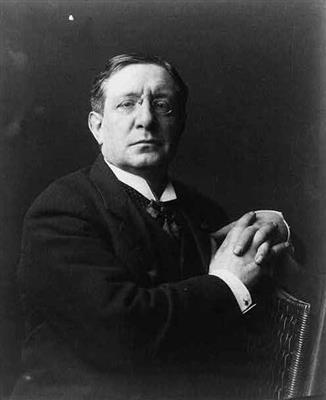
Biography
His work is associated with Orientalism[1] and academic art.
Timeline
- 1845Born Jean-Joseph Benjamin-Constant in Paris on 10 June.
- 1872Travelled to Morocco, remaining there for two years.
- 1876His work, "The Entrance of Mahomet II into Constantinople", won him a Salon medal.
- 1880Began to focus on large mural commissions.
- 1893Elected to the Institut de France.
- 1896Received the Medal of Honour at the Paris Salon for "Mon fils André".
- 1902Died in Paris on 26 May.
Notable Works
Tap to view larger.
Next stop
Browse the movements →
Every movement in the collection, from the Renaissance to Pop art.
Related Artists



Frequently Asked Questions
What is Benjamin Constant known for?
Benjamin-Constant is known for his Orientalist paintings, particularly those depicting scenes from Morocco. Later in his career, he received commissions for large murals, including work in the Hôtel de Ville in Paris and the Boston Public Library.What is Benjamin Constant's most famous work?
It is difficult to identify Benjamin Constant's single "most famous work" definitively. His artistic output included a variety of subjects and styles, making it challenging to pinpoint one piece that overshadows all others. However, based on available information, several paintings can be considered among his more recognised creations. These include *The Barque of Dante*, completed in 1822, which resides at the Musée du Louvre in Paris. Other notable works are *The Massacre at Chios* (1824, also at the Louvre), *Liberty Leading the People* (1830, Musée du Louvre), *The Women of Algiers* (1834, Musée du Louvre), and *Sultan of Morocco* (1845[1], Musée des Augustins, Toulouse). The fame and recognition of an artwork can fluctuate over time, influenced by exhibitions, critical attention, and public interest. While one piece might be prominent at a particular moment, another could gain prominence later. Therefore, while the listed paintings are significant examples of Constant's work, declaring one as definitively his "most famous" requires more comprehensive art-historical analysis.What should I know about Benjamin Constant's prints?
Benjamin Constant (1845[1]-1902[1]) was a French[1] painter and printmaker, known for his Orientalist and historical subjects. When considering Constant's prints, it's helpful to understand some basic terminology. A 'vintage print' means one produced around the time the negative was taken. A 'period print' is one made within approximately 10 to 15 years after. If the printing date is unknown or later, it is termed an 'old print'. An 'original print' is one the artist made or directly supervised. A 'facsimile' is a print made by re-photographing a print or using the original negative, with the print base and processing as close as possible to a vintage print. The market typically values prints executed by the artist more highly. For example, a photograph by Imogen Cunningham printed by herself was worth more than one printed by a laboratory, even if signed.What style or movement did Benjamin Constant belong to?
Benjamin Constant (1845[1]-1902[1]) was active during a period dominated by Romanticism. This movement, arising as economic liberalism took hold, saw artists expressing subjective feelings and individual personalities. It was, in some ways, a reaction against the increasing mechanisation and depersonalisation of life during the Industrial Revolution. Romanticism involved a deep sense of community, with artists engaging in mutual philosophising, critique, and discussion. They found meaning in relationships and collaborated on periodicals, lectures, and propaganda. Around 1824, French[1] Romantics began to coalesce into a more unified group, coinciding with a shift in public opinion towards liberalism. By 1827, Romanticism moved away from being exclusively clerical and monarchistic. Victor Hugo's preface to his play Cromwell that year proposed Romanticism as the liberalism of literature. The Salon exhibited works by Romantic painters like Delacroix, Devéria, and Boulanger, marking the emergence of a broad movement embracing French intellectual life.What techniques or materials did Benjamin Constant use?
Benjamin Constant's painting techniques involved a careful consideration of materials, as the choice of material determined the nature of the finished work. The possibilities, as well as the limits, of a material became a determining factor in the genesis of the art. Some painters sought to recapture the techniques of past masters, such as Titian, Rubens, Rembrandt, and Velazquez. The secret traditions of the great techniques of the Renaissance were considered "mysteriously lost" about the beginning of the eighteenth century. However, even if modern painters rediscovered the lost secrets of the ancient painters, they still could not duplicate their works in modern times, because they did not possess the exact medium used in those times. Even oils, essences, and gums differed. The materials used by an artist have a causality; they have possibilities and limits.What was Benjamin Constant known for?
Jean-Joseph Benjamin Constant (1845[1]-1902[1]) was a French[1] painter and printmaker, best known for his Orientalist scenes and portraits. Constant studied at the École des Beaux-Arts in Paris, under Alexandre Cabanel. His early work was influenced by the academic style, but he soon developed an interest in Orientalism[1], a genre that depicted scenes from the Middle East and North Africa. Constant travelled to Morocco and Spain, where he found inspiration for his paintings. He became known for his depictions of exotic subjects, such as harems, battles, and religious ceremonies. His work often featured rich colours, detailed costumes, and dramatic lighting. In addition to his Orientalist paintings, Constant was also a successful portrait painter. He painted portraits of many prominent figures of his time, including Queen Victoria and Pope Leo XIII. Constant also taught at the Académie Julian in Paris, where he influenced a generation of young artists.When did Benjamin Constant live and work?
Jean-Joseph Benjamin Constant (1845[1]-1902[1]) was a French[1] painter and printmaker, best known for Orientalist scenes and portraits. He was born in Paris on 10 June 1845[1]. Constant studied at the École des Beaux-Arts in Paris, under Alexandre Cabanel. He first exhibited at the Paris Salon in 1869. His early paintings showed dramatic historical subjects, for example, *Hamlet et le Roi* (1869). In the 1870s, Constant travelled to Spain and Morocco. These trips shifted his artistic focus to Orientalist themes. He painted scenes of North African life and culture, which brought him considerable recognition. His Orientalist works often feature rich colours and detailed depictions of architecture and costumes. Later paintings included grand decorative projects and society portraits. Constant received several awards during his career, including a gold medal at the Exposition Universelle in 1889. He taught at the Académie Julian, where his students included many artists from Europe and North America. Constant died in Paris in 1902.Where can I see Benjamin Constant's work?
Benjamin Constant (1845[1]-1902[1]) was a French[1] painter and etcher, known for Orientalist and academic paintings. His paintings are held in numerous public collections. These include the Musée d'Orsay in Paris, which holds his 1888[1] painting "Le Lendemain d'une Victoire à la Mecque" (The Day After a Victory in Mecca). Another major work, "L'Entrée de Mahomet à la Mecque" (The Entry of Muhammad into Mecca), is in the collection of the Musée des Beaux-Arts in Nantes. Several works are located in the United Kingdom. The collection of the National Trust holds Constant's painting of Mrs. Leopold Albu. The Towneley Hall Art Gallery and Museum in Burnley owns "Samson and Delilah". In North America, the Metropolitan Museum of Art in New York City holds Constant's "Justice in the Harem". The Montreal Museum of Fine Arts has his painting "The Favourite of the Emir". These collections provide opportunities to view significant examples of Constant's artistic output.Where was Benjamin Constant from?
Benjamin Constant was born in Paris in 1845[1]. He came from a family with connections to the French[1] intellectual and political spheres. His full name was Jean-Joseph Benjamin Constant. Constant studied at the École des Beaux-Arts in Paris. There, he worked in the studio of Alexandre Cabanel. He is often described as French; however, some sources identify him as a naturalised French citizen of Swiss origin. Constant's family was originally from Switzerland, and he maintained close ties to the country throughout his life. He travelled extensively in Morocco and Spain. These travels had a considerable effect on his artistic output. He became known for his Orientalist paintings, which often depicted scenes from North Africa and the Middle East. Constant died in Paris in 1902[1]. He had a successful career as a painter and teacher. His work can be found in many major museums around the world.Who did Benjamin Constant influence?
It is difficult to identify specific individuals who were directly influenced by Benjamin Constant. However, some art historians have discussed Constant's broader impact on painting and his relationship to other artists. Courbet's avant-garde approach had a long-term effect. Artists such as Cézanne, Nolde, Pollock, de Kooning, Kline, and Richter all owe something to him. Courbet put painting at the centre of his public persona with The Studio of the Painter at the Pavilion of Realism exhibition in 1855[1]. Richter's work, like Courbet's, defies traditional conventions and art historical categories. Richter's November is similar in scale and ambition to Courbet's Burial at Ornans. The connections between Courbet's use of the palette knife and Richter's technique of layering present compelling parallels. De Kooning claimed Courbet as a point of reference. He stated that Courbet could walk in a forest and see something concretely, just the way it is, and be obsessed by the bark on a tree. His painting is not tradition or nature or style, but there it is.Who influenced Benjamin Constant?
Although direct influences on Benjamin Constant's art are not well documented, the philosopher Jean-Jacques Rousseau had a broad effect on 19th-century European art and literature. Rousseau's ideas appear in the works of Goethe, Balzac, Stendhal, Flaubert, Tolstoy, Proust, and Thomas Mann. Rousseau's impact stems from his emphasis on personal experience. Before Rousseau, writers rarely spoke directly about themselves. Afterward, self-observation and self-admiration became common literary themes. Goethe stated that his works were 'fragments of a great confession', an idea that originated with Rousseau. This focus on the self led to the development of the 'novel of disillusionment', where characters struggle with the conflict between their dreams and middle-class life. Rousseau's pessimistic view of history and belief in the corruption of the present also shaped 19th-century thought. By the end of the 1700s, very few thinkers had avoided Rousseau's ideas.Why are Benjamin Constant's works important today?
Benjamin Constant (1845[1]-1902[1]) was a French[1] painter known for his Orientalist scenes and portraits. His works offer insight into the artistic and cultural interests of the late 19th century. Constant's paintings reflect the fascination with the Orient that was prevalent in Europe at the time; this makes them valuable as historical documents. They allow us to analyse the way the West perceived and represented other cultures. Constant's academic style, while not as fashionable today, demonstrates the technical skill and artistic conventions valued in his era. His paintings provide examples of the period's aesthetic preferences and artistic training. By studying Constant's art, we gain a better understanding of the art world and cultural attitudes of his time. His influence can be seen in the works of artists who followed, making him a significant figure in the development of modern art.
Sources
Editorial draws on the following primary and tertiary references for Benjamin Constant.
- [1] wikipedia Wikipedia: Benjamin Constant Used for: biography, birth dates, death dates, identifiers, movement attribution, nationality.
- [2] book Ward, James O.;, Hidden in Plain Sight Used for: biography.
- [3] book Allison Lee Palmer, Historical Dictionary of Neoclassical Art and Architecture Used for: stylistic analysis.
- [4] book Palmer, Allison Lee, Historical Dictionary of Neoclassical Art and Architecture Used for: stylistic analysis.
- [5] book Masterpieces of western art : a history of art in 900 individual studies from the Gothic to the present day Used for: biography.
- [6] book Post-impressionism : cross-currents in European painting Used for: biography.
- [7] book Michael Wyatt, The Cambridge Companion to the Italian Renaissance (Cambridge Companions to Culture) Used for: biography.
- [8] book Titian, Susanna Biadene, Mary Yakush, Italy) Palazzo Ducale (Venice, National Gallery of Art (U. S.), Terisio Pignatti, Titian, Prince of Painters _ [Palazzo Ducale, Venice, 2 June - 7 October 1990 ; National Gallery of Art, Washington, 28 Octo Used for: stylistic analysis.
- [9] book Bernard Denvir, World of Art_ Post-Impressionism Used for: biography.
Editorial overseen by Solis Prints. Sources verified 2026-10-14. Click a source for details, or hover over [N] in the page above to preview.
Editorial standardsMethodologyCorrectionsAI disclosureAbout the editorial team