



Aura Hertwig
Hertwig practised photography as a fine art before most critics were prepared to accept it as such. Born in Poznan in 1861[1], she began working in Berlin around 1900[1], making portraits of the painters, architects, and writers who formed the cultural life of Wilhelmine Germany. Lovis Corinth and Gerhart Hauptmann were among her early subjects, and she later photographed writers from Vienna's literary circles.
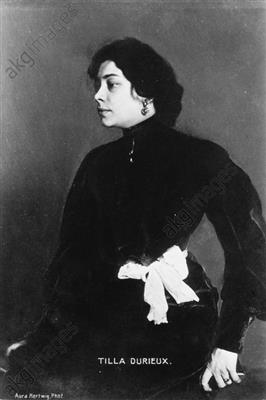
Biography
Her technique was deliberately soft-focused. Working in photogravure, she favoured the atmospheric blur associated with Pictorialism, and her work was compared by contemporaries to the painterly prints of the French photographer Robert Demachy. This was photography that wanted to be mistaken for charcoal drawing. Melancholie (c. 1900[1], photogravure, 19.5 x 19.5 cm), now in the J. Paul Getty Museum, shows the hazy romantic tonality that defined her approach at its height.
In 1911[1] she married the artist Carl Alexander Brendel and moved with him to Buschmuhle, near Frankfurt an der Oder, where she continued to work until her death in 1944[1]. The Getty collection holds a group of her prints from the peak years around 1900, and her portraits survive as an unusually direct record of the Berlin cultural world she moved through at the turn of the century.
Timeline
- 1861Born in Poznan.
- 1900Began working as a photographer in Berlin, aged 39, creating portraits of painters, architects, and writers.
- 1900Created "Melancholie", a photogravure showcasing her hazy, romantic style.
- 1911Married the artist Carl Alexander Brendel at 50.
- 1911Moved to Buschmuhle, near Frankfurt an der Oder, with her husband.
- 1944Died in Buschmuhle, near Frankfurt an der Oder, at 83.
Notable Works
Tap to view larger.
Next stop
Browse the movements →
Every movement in the collection, from the Renaissance to Pop art.
Related Artists

Frequently Asked Questions
What is Aura Hertwig known for?
Aura Hertwig is known for her fine art photography, particularly her portraits of cultural figures in Berlin and Vienna. She photographed people such as Lovis Corinth and Gerhart Hauptmann.What should I know about Aura Hertwig's prints?
Aura Hertwig's prints are photographic. Prints created through photographic techniques present specific preservation challenges, as some processes used in past decades have proven susceptible to colour changes over time. Platinum and silver gelatin prints are considered more robust, but precautions should still be taken. It is advisable to avoid direct sunlight and to frame them using museum glass. Acid-free paper is recommended for storage. Even with these measures, chemical deterioration of the paper may occur over time, potentially leading to brittleness or small cracks. Within the art market, a distinction is drawn between an original print and a reproduction. An original print is conceived by the artist as a print and executed solely as a print, often in a numbered and signed edition. Each print is created individually from a plate or other matrix. A reproduction, on the other hand, is a copy of a work originally created in another medium, such as painting or watercolour, and is typically produced using photo-mechanical means.What style or movement did Aura Hertwig belong to?
Aura Hertwig's artistic output aligns with non-objective painting, a style that rejects representational subject matter. This approach emphasises pure form, colour, and composition to evoke spiritual and emotional responses. Non-objective art seeks to move beyond the depiction of recognisable objects, instead exploring the intrinsic qualities of visual elements. The intention is to create works that are appreciated for their aesthetic qualities and their capacity to inspire intuition and contemplation. Some practitioners believed that non-objective paintings could promote order, rhythm, and balance in life, influencing viewers on a subconscious level. This style contrasts with movements like Cubism and Futurism, which, while abstracting from reality, still maintained a connection to representational forms. The rise of photography and mass media diminished the need for representational art, leading some artists to explore non-objective expression as a means of conveying spiritual and emotional content.What techniques or materials did Aura Hertwig use?
Aura Hertwig's artistic practice involved a range of techniques centred on glass work. She employed sandblasting, a method akin to tombstone carving, to create images on flashed glass. This type of glass features a thin coating of colour, often black or red, over a milk glass base. The sandblasting process required careful preparation. Hertwig would cover the glass with a stencil, then cut out the design, exposing areas to the abrasive force of the sandblaster. This would grind away the coloured coating, revealing the white glass underneath. By adjusting the duration of sandblasting, she could achieve different effects, from a dull grey to a deep relief. In addition to sandblasting, Hertwig sometimes used glass painters' colours, which were permanently fixed by firing in a kiln. She acknowledged the limitations of this medium, but valued the intensity of colour and the precision it offered. Her work with these materials allowed for a unique interplay of form and colour.Where can I see Aura Hertwig's work?
Aura Hertwig's work, because it relates to Art Deco and the Bauhaus movement, may be seen at a number of museums internationally. In Germany, these include the Bauhaus Archive-Museum für Gestaltung (Berlin), the Bauhaus Dessau Foundation (Dessau), the Bröhan-Museum (Berlin), the Kunstgewerbe Museum of Decorative Arts (Berlin), the Museum beim Markt (Karlsruhe), and the Museum für Kunst und Gewerbe (Hamburg). Elsewhere in Europe, her work may be seen at the MAK Austrian Museum of Applied Art/Contemporary Art in Vienna, Austria. In the United States, museums that sometimes exhibit similar works include the Charles Hosmer Morse Museum of American Art (Winter Park, Florida), the Los Angeles County Museum of Art, the Metropolitan Museum of Art (New York), the Minneapolis Institute of Arts, the Museum of Modern Art (New York), the Virginia Museum of Fine Arts (Richmond), and the Wolfsonian at Florida International University (Miami Beach). In Canada, the Royal Ontario Museum (Toronto) may hold relevant examples. In the United Kingdom, try the Bakelite Museum (Williton), the Brighton Museum & Art Gallery, the Geffrye Museum (London), the Manchester Art Gallery, the National Museums of Scotland, and the Victoria & Albert Museum (London).Who influenced Aura Hertwig?
Aura Hertwig was influenced by Gertrud Grunow, a teacher at the Bauhaus. Grunow's theories centred on synaesthesia; this is a connection between different sensory phenomena, such as the "audibility" of colours. Grunow's theories also involved body movement. Émile Jaques-Dalcroze, who developed eurhythmics, was an important influence. Grunow attended one of Jaques-Dalcroze's summer courses in 1908[1]. Jaques-Dalcroze created a method of learning and experiencing music through movement, which placed importance on body awareness and hearing. His aim was to develop the ability to express music as movement in space. Grunow believed sounds relate to movement. She thought a tone achieves its most harmonic vibrancy when one assumes a posture corresponding to that tone. The assignment of sounds to colours and postures is described by the principle of Grunowian harmonization theory.Why are Aura Hertwig's works important today?
Aura Hertwig's works can be seen as part of a broader interest in abstract art. Some observers felt that abstract art contained a rhythmic element that could influence modern life in areas from commerce to medicine. Hilla Rebay, for example, wrote and taught about the spiritual dimensions and essences in abstract works. She felt that the perfection of balance was especially outstanding. Rebay's watercolours and collages, in particular, showed a finesse of design and texture. After World War II, the Bauhaus became a symbol for modernism. The Bauhaus artists contributed to this popularisation, but they also opposed its trivialisation. The Bauhaus name was increasingly applied to a wide range of enterprises and commodities, many with no real connection to the school itself. Despite this exploitation, there is renewed interest in the ethical values associated with the Bauhaus principles. This is not a return to functionalism, but an instance of an exemplary attitude.What was Aura Hertwig's art style?
Aura Hertwig's photographic style was deliberately soft-focused. She worked in photogravure and favoured the atmospheric blur associated with Pictorialism; contemporaries compared her work to the painterly prints of Robert Demachy.How did Aura Hertwig die?
Aura Hertwig died in 1944[1] at the age of 83.
Sources
Editorial draws on the following primary and tertiary references for Aura Hertwig.
- [1] wikipedia Wikipedia: Aura Hertwig Used for: biography, birth dates, death dates, identifiers, movement attribution, nationality.
- [2] book Dorling Kindersley, Artists: Inspiring Stories of the World's Most Creative Minds Used for: biography.
- [3] book Elizabeth Otto & Patrick Rössler, Bauhaus Women Used for: biography, stylistic analysis.
- [4] book Patrick Rössler (editor), Herbert Bayer, Graphic Designer _ From the Bauhaus to Berlin, 1921–1938 Used for: biography.
- [5] book Husslein-Arco, Agnes, editor; Koja, Stephan, editor; Law, Rebecca (Translator), translator; McInnes, Robert (Translator), translator; Somers, Nick, translator; Monet, Claude, 1840-1926. Paintings. Selections; Österreichische Galerie Belvedere, h Used for: biography.
- [6] book Bauhaus-Archiv Berlin Museum für Gestaltung, Stiftung Bauhaus Dessau, and Klassik Stiftung Weimar (editor), Modell Bauhaus_ A Conceptual Model. 1919-2009 Used for: biography, stylistic analysis.
- [7] book Bauhaus-Archiv Berlin Museum für Gestaltung, Stiftung Bauhaus Dessau, and Klassik Stiftung Weimar (editor), Modell Bauhaus_ A Conceptual Model. 1919-2009 Used for: stylistic analysis.
- [8] book Landauer, Susan, The not-so-still life : a century of California painting and sculpture Used for: biography.
Editorial overseen by Solis Prints. Sources verified 2026-10-15. Click a source for details, or hover over [N] in the page above to preview.
Editorial standardsMethodologyCorrectionsAI disclosureAbout the editorial team