



Augustus Edwin Mulready
- genre painting
Augustus Edwin Mulready carried a famous name with more weight than ease. His grandfather, William Mulready (1786-1863[1]), had been among the most admired genre painters of the early Victorian era. His grandmother Elizabeth was a landscape painter and sister of the watercolourist John Varley, and his father William Junior was a portrait painter and restorer. Where his grandfather had worked in rustic domestic comedy, the younger Mulready turned his attention to the streets of London and their poorest inhabitants.
Biography
Born in Kensal Green on 23 February 1844[1], he studied at the South Kensington Schools before entering the Royal Academy Schools in 1861[1], aged seventeen, under the patronage of John Callcott Horsley. He began exhibiting at the RA in 1863, continuing until 1880.
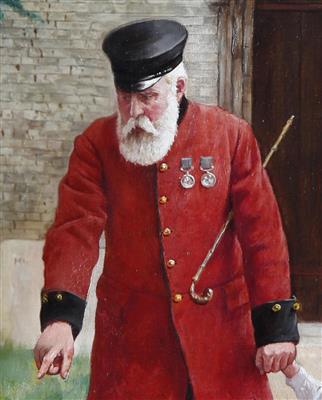
His subjects were London's street children: crossing sweepers, flower sellers, boys sheltering in doorways. The treatment avoided the cloying register that afflicted much Victorian genre painting[1]. Homeless by Night (1892[1]), now in the Atkinson Art Gallery in Southport, and A Naturalist's Window (1879), in the Walker Art Gallery in Liverpool, hold their subjects with directness and without theatrical pathos. Hard Times (1877) takes a similarly clear-eyed approach to childhood poverty in the city.
Mulready had a brief association with the Cranbrook Colony of artists between 1870[1] and 1874, though he shared little stylistically with its older members. He married Maria in 1874 and died on 15 March 1904[1].
Timeline
- 1844Born in Kensal Green on 23 February. His grandfather was William Mulready, a genre painter.
- 1861At 17, he entered the Royal Academy Schools under the patronage of John Callcott Horsley.
- 1863Began exhibiting at the Royal Academy.
- 1870Began a brief association with the Cranbrook Colony of artists.
- 1874Ended his association with the Cranbrook Colony of artists.
- 1874Married Maria.
- 1877Painted "Hard Times".
- 1879Painted "A Naturalist's Window", now in the Walker Art Gallery in Liverpool.
- 1880Stopped exhibiting at the Royal Academy.
- 1892Painted "Homeless by Night", now in the Atkinson Art Gallery in Southport.
- 1904Died on 15 March.
Notable Works
Tap to view larger.
Next stop
Browse the movements →
Every movement in the collection, from the Renaissance to Pop art.
Related Artists



Frequently Asked Questions
What is Augustus Edwin Mulready known for?
Augustus Edwin Mulready is known for his paintings of London's street children. His work includes subjects such as crossing sweepers, flower sellers, and boys sheltering in doorways, and his treatment of these subjects avoided sentimentality.What should I know about Augustus Edwin Mulready's prints?
Augustus Edwin Mulready (1843-1904[1]) was a painter of genre scenes; he was also part of a family of artists. His uncle was William Mulready, RA. Prints of paintings by Mulready were common in the Victorian era. The printsellers' catalogues and advertisements of the period reveal some information about them. Print publishers often exhibited the painting to gain subscribers for the engraving; this allowed them to estimate the size of the print edition. Prints were expected to be large enough to fill a wall. Dimensions were governed by the original painting. Engravers often had to reduce a work to make the print. Once framed, the print represented an imposing addition to a Victorian drawing room. Examples of prints declared to the Printsellers’ Association include: *A Little Duchess*, engraved in mezzotint by G. H. Every, published by T. Agnew in 1884[1]; *Love Birds*, engraved in mezzotint by T. L. Atkinson, published by A. Tooth in 1885; and *Lingering Autumn*, an etching by T. Chauvel, published by A. Tooth in 1892.What style or movement did Augustus Edwin Mulready belong to?
Augustus Edwin Mulready was a British[1] painter of the Victorian era, and he is best known for his contributions to genre painting[1]. This style, which gained popularity in the 17th century, focuses on scenes from everyday life. The French critic Quatremère de Quincy first used the term 'genre' to describe these scenes in 1791; however, the term likely carried this meaning from the mid-18th century. Before this, 'history painting' was used to record noble acts (religious, mythological, historical), while 'les genres' referred to other subjects like still lifes. Genre painting particularly flourished in Britain, with artists creating scenes that often promoted middle-class values such as family, domesticity, and hard work. These paintings aimed to evoke emotional responses and were marketed as a democratic art form accessible to everyone, regardless of education. Mulready’s work fits into this tradition, capturing ordinary moments and reflecting the social context of his time.What techniques or materials did Augustus Edwin Mulready use?
Augustus Edwin Mulready's painting technique involved applying half tints, allowing the ground to show through layers of colour. He would clear away excess paint using cuttlefish, then add further layers with yellows and delicate lakes. One observer noted that Mulready's choice of paints was not always ideal, as he sometimes incorporated vivid pigments intended for the background into the flesh tones. Emerald green and Prussian blue, for example, might appear unexpectedly in his rendering of skin. J.M.W. Turner, a slightly earlier British[1] artist, offers a point of comparison. Turner began as a watercolourist, developing techniques that he later used in oil paint. He favoured light-toned, absorbent surfaces and became skilled in applying optical greens and blacks. Turner also used white primings for many of his oils, especially in the first decade of the 1800s. These absorbent surfaces allowed him to see the final colour of the paint quickly and to develop compositions rapidly.What was Augustus Edwin Mulready known for?
Augustus Edwin Mulready (1843-1904[1]) was a painter known for genre scenes. Genre painting depicts scenes from daily life. This type of work became popular with the growing middle class, who were interested in seeing contemporary life represented in art. Genre paintings often aimed to elicit emotional responses, rather than intellectual ones, in viewers. English artists such as David Wilkie (1785-1841) were driving forces in this area. Wilkie created detailed character studies in his genre paintings. Mulready, like Wilkie, focused on the lives of everyday people, rather than historical or mythological subjects. His paintings offered glimpses into home life and told stories that could be understood by a wide audience. The British[1] excelled in narrative painting, particularly scenes of home life. At the International Exhibition in Paris in 1855[1], narrative painting was seen as specifically British.When did Augustus Edwin Mulready live and work?
Augustus Edwin Mulready (1843-1904[1]) was a painter known for genre scenes, often featuring children. He came from an artistic family; his father was William Mulready, a Royal Academician. Augustus Edwin followed in his father's footsteps, attending the Royal Academy Schools. Mulready exhibited at the Royal Academy, as well as other venues such as the New Watercolour Society, and the Society of British[1] Artists. His paintings often depicted scenes of everyday life, with a focus on anecdotal details and sentimental themes. He also worked as a teacher; one account recalls his patient instruction and criticisms during a class visit. Though he achieved some recognition during his lifetime, he is less well known than his father.Where can I see Augustus Edwin Mulready's work?
It may be possible to view work by Augustus Edwin Mulready in person at several museums. These include the Brighton Museum & Art Gallery, located in the Royal Pavilion Gardens in Brighton. Another is the Geffrye Museum, situated on Kingsland Road in London. Additionally, the Manchester Art Gallery, found on Mosley Street in Manchester, may hold pieces by the artist. The National Museums of Scotland, specifically the Royal Museum on Chambers Street in Edinburgh, is another potential location. Finally, the Victoria & Albert Museum, located on Cromwell Road in London, could also have examples of Mulready's work available for viewing. Checking their websites or contacting them directly is recommended to confirm current holdings and exhibition schedules.Where was Augustus Edwin Mulready from?
Augustus Edwin Mulready's biography is not easily summarised. He came from a family of artists, and his family history is complex. One anecdote relates an encounter where the speaker attempted to discuss a connection between Mulready and a Mr Varley. Mulready reacted with great annoyance, stating that Varley "had no right to make the statement you speak of, and you, sir, have no excuse for taxing my attention with it". While this passage does not directly address Mulready's place of origin, it hints at the sensitivities surrounding his family connections and perhaps a desire to distance himself from certain associations. Further research is needed to establish his exact birthplace and family background.Who did Augustus Edwin Mulready influence?
Augustus Edwin Mulready taught at art schools, and his methods influenced students directly. One former student recalled Mulready's patient instruction and careful criticisms. The student observed Mulready's painting technique, noting his use of colour and layering. However, the student also felt Mulready's choice of paints was not beneficial as an example to the young, because he used vivid pigments indiscriminately. Beyond direct instruction, the broader Pre-Raphaelite movement, with which Mulready was associated, impacted many artists. Arthur Hughes was described as a steady disciple of the Pre-Raphaelites. Henry Holiday painted in a Pre-Raphaelite style and later worked in stained glass under the influence of Burne-Jones. John Melhuish Strudwick, who had been a studio assistant to Burne-Jones, developed a style derived from mythological and allegorical subjects. Sir Frank Dicksee helped to bring the Pre-Raphaelite style into the twentieth century. John William Waterhouse turned an early neoclassicism into a more Pre-Raphaelite style.Who influenced Augustus Edwin Mulready?
Augustus Edwin Mulready, like many artists, drew inspiration from various sources. One account mentions a visit from a Mr Mulready (presumably William Mulready, a painter and likely a relative) to an art class. The students regarded this as a fortunate occasion. The visitor offered patient and instructive remarks. However, another passage suggests a degree of dissatisfaction with the available instruction. The writer sought a perfect guide, someone who stirred complete sympathy. Many artists seemed trite, substituting prettiness for beauty. This suggests that Augustus Edwin Mulready may have been seeking something beyond the conventional art instruction of the time. The Pre-Raphaelites, including Holman Hunt and Millais, were significantly influenced by prints. They copied prints and objects, studied illustrated magazines, and even earned a living making copies of existing works. This love of prints may have been shared by Mulready.Who was Augustus Edwin Mulready?
Augustus Edwin Mulready (1843-1904[1]) was a British[1] genre painter. He came from an artistic family; his father, William Mulready, was a well-regarded painter, and he was related to the Varley family of watercolourists. Mulready is best known for his paintings of children, often in sentimental or anecdotal situations. He exhibited at the Royal Academy, the British Institution, and other major venues. While some instructors at the school where Mulready taught were celebrated, Mulready's instruction was still valued by the students. One student recounted how Mulready patiently offered instruction each evening. His relationship with some contemporaries could be difficult. One anecdote recounts a misunderstanding with a visitor regarding Mulready's connection to the Varley family, which resulted in the visitor becoming "his declared enemy".Why are Augustus Edwin Mulready's works important today?
Augustus Edwin Mulready (1843-1904[1]) was an English genre painter and illustrator. Although not as well known as some of his contemporaries, his works are important for several reasons. Mulready's illustrations appeared in publications during a period when wood-engraved illustration was experiencing a resurgence. This Pre-Raphaelite style influenced later artists, such as Laurence Housman and Charles Ricketts, and contributed to the Private Press movement. These presses produced limited editions of poetry and literature, based on Pre-Raphaelite models of tasteful design. Mulready also taught art. One student recounted Mulready's patient instruction and helpful criticism. The student, seeking information about a connection between Mulready and an artist named Varley, inadvertently offended Mulready. This anecdote provides insight into Mulready's character and the social dynamics within the art world of the time. His detailed genre paintings offer a glimpse into Victorian society. They document everyday life and reflect the artistic trends of the late 19th century.
Sources
Editorial draws on the following primary and tertiary references for Augustus Edwin Mulready.
- [1] wikipedia Wikipedia: Augustus Edwin Mulready Used for: biography, birth dates, death dates, identifiers, movement attribution, nationality.
- [2] book Lucinda Hawksley, Lizzie Siddal Used for: biography.
- [3] book Masterpieces of western art : a history of art in 900 individual studies from the Gothic to the present day Used for: biography.
- [4] book Post-impressionism : cross-currents in European painting Used for: biography, stylistic analysis.
- [5] book Post-impressionism : cross-currents in European painting Used for: biography, stylistic analysis.
- [6] book Pre-Raphaelitism and the Pre-Raphaelite Brotherhood (2 Volumes) Used for: biography.
Editorial overseen by Solis Prints. Sources verified 2026-10-07. Click a source for details, or hover over [N] in the page above to preview.
Editorial standardsMethodologyCorrectionsAI disclosureAbout the editorial team