



Auguste Toulmouche
- genre painting
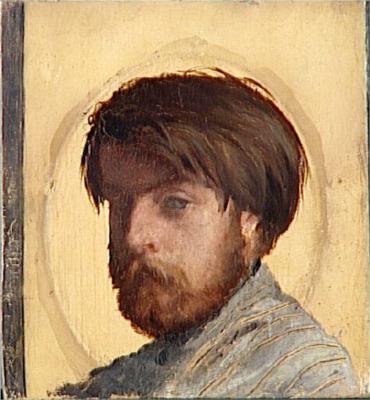
Auguste Toulmouche built his career on a single subject: Parisian women in interiors. Over four decades of regular Salon submissions, he painted them reading letters, examining themselves in mirrors, trying on new dresses, and, in his most frequently reproduced canvas, sitting with studied reluctance before a wedding bouquet (*The Hesitant Fiancée*, 1866[1], now in the Musée d'Orsay). The formula was reliable and the execution was meticulous: critics of the period singled out his rendering of silk and lace as among the most technically accomplished in French[1] academic painting.
Biography
Born in Nantes in 1829[1], Toulmouche studied at the École des Beaux-Arts under Thomas Couture, painter of *Romans of the Decadence*. It was through family connections that the young Claude Monet, arriving in Paris in 1862[1], came to Toulmouche's studio and was directed on to Charles Gleyre's atelier, where Monet met Renoir, Sisley, and Bazille. That brief intersection with Impressionism's future is now the most-cited fact in Toulmouche's biography, which says something about how thoroughly the academic tradition he represented was superseded by the movement it inadvertently helped to launch.
Toulmouche was awarded the Légion d'honneur and produced work that remained commercially popular throughout his lifetime. Later critics placed him alongside Jean Béraud and Raffaelli as painters whose primary interest lies in the period record they provide: precise documentation of the clothes, furnishings, and domestic arrangements of bourgeois Parisian life in the Second Empire and early Third Republic. He died in Paris in 1890[1].
Timeline
- 1829Born in Nantes.
- 1862Claude Monet visited Toulmouche's studio in Paris and was directed to Charles Gleyre's atelier.
- 1866Painted "The Hesitant Fiancée".
- 1890Died in Paris at the age of 61.
Notable Works
Tap to view larger.
Next stop
Browse the movements →
Every movement in the collection, from the Renaissance to Pop art.
Auguste Toulmouche prints
Hand-finished archival prints from Auguste Toulmouche's body of work.


Related Artists



Take Auguste Toulmouche home.
See all Auguste Toulmouche prints →Frequently Asked Questions
What is Auguste Toulmouche known for?
Auguste Toulmouche is known for his paintings of Parisian women in interiors. He regularly submitted these works to the Salon for over four decades, painting women reading letters, looking in mirrors, and trying on dresses.What should I know about Auguste Toulmouche's prints?
Auguste Toulmouche's paintings were reproduced as prints, using various techniques to reach a wider audience. These included etching, mezzotint, and photogravure. The Printsellers’ Association played a role in the print market, certifying the authenticity of print publications. They used stamps to mark different states and editions. Artist Proofs had no engraved title, while Lettered Proofs had a lightly engraved title. Proofs before letters lacked a title but included the names of the artist and engraver. Publishers issued artist's proofs of photogravures, adopting the hierarchical language of rarity used for engravings. They also produced collections of reproductions, such as "Portefeuille d'Amateur". These strategies aimed to establish the status of photo-mechanical reproductions within the art market. Hybrid print forms emerged, combining hand-work and technology. Reproductive etching was used for large, expensive reproductions. Some etchings were combined with photogravure to transfer minute details from the original painting. These hybrid forms catered to the demands of the print market.What style or movement did Auguste Toulmouche belong to?
Auguste Toulmouche was a 19th-century French[1] painter who might be associated with genre painting[1], or possibly with a compromise between Realism and academic painting. Genre painting, which gained popularity in the 17th century, depicts scenes from everyday life. By the 19th century, this style was seen as modern, as it drew directly from contemporary life. Some artists used genre scenes to portray peasant life, setting contemporary events against a background that would not become dated. Alternatively, Toulmouche's work could be viewed as an attempt to reconcile Realism with the established preference for history painting. Academic painters sometimes sought a middle ground, idealising the human form while still acknowledging the spirit of their age. They might set their subjects outside a specific time by depicting traditional peasant activities or religious observances. This approach allowed them to avoid the fleeting fashions of modern life.What was Auguste Toulmouche known for?
Auguste Toulmouche (1829[1]-1891) was a French[1] painter, best known for his depictions of elegant Parisian women in domestic settings. A native of Nantes, he studied under Charles Gleyre, a Swiss artist who taught many later Impressionists. Toulmouche's paintings often portrayed fashionable women in moments of leisure or contemplation, within well-appointed interiors. These works, popular during the Second Empire, reflected the values and tastes of the Parisian bourgeoisie. His attention to detail in costume and setting, combined with a smooth, polished finish, contributed to their appeal. Although he achieved considerable success during his lifetime, Toulmouche's style later fell out of favour with the rise of Impressionism and other avant-garde movements. Some critics viewed his work as sentimental or superficial, compared to the more radical approaches of his contemporaries. Nevertheless, his paintings offer a glimpse into the lives and fashions of 19th-century Parisian society.Where can I see Auguste Toulmouche's work?
Auguste Toulmouche's paintings are held in various museum collections, primarily in France and the United States. In France, his work can be viewed at the Musée des Beaux-Arts in Nantes, the Musée d’Orsay and the Musée du Louvre in Paris, and the Musée des Beaux-Arts in Rouen. Other French[1] museums holding his paintings include the Musée des Beaux-Arts in Dijon, Musée des Beaux-Arts in Lille, Musée des Beaux-Arts in Nancy, Musée des Beaux-Arts Jules Cheret in Nice, Musée des Beaux-Arts in Orléans, Musée des Augustins in Toulouse, and Musée Crozatier in Le Puy. In the United States, collections can be found at the Metropolitan Museum of Art in New York, the Los Angeles County Museum of Art (LACMA), the Minneapolis Institute of Arts, and the Virginia Museum of Fine Arts in Richmond. These institutions offer opportunities to study Toulmouche's artistic output.Where was Auguste Toulmouche from?
Auguste Toulmouche was a French[1] artist. Details of his early life are scarce in the available resources, but other French artists of the era can provide context. For example, Henri de Toulouse-Lautrec, known for his paintings and innovative lithographs, came from an aristocratic family near Albi. Despite physical challenges from childhood accidents, Toulouse-Lautrec pursued art, studying under Bonnat and Cormon, and later immersing himself in Montmartre's artistic community. Similarly, Gaston La Touche rose to prominence in French painting during the late 19th century, celebrated for his skill with colour and appealing subject matter. La Touche created easel paintings, pastels, and large-scale decorations, often depicting Breton peasants or scenes inspired by 18th-century France. Another artist, Albert Marquet, was born in Bordeaux in 1875[1]. His early talent led him to move to Paris and attend the École des Arts Décoratifs in 1890[1].Who did Auguste Toulmouche influence?
It is difficult to identify specific artists who were directly influenced by Auguste Toulmouche. However, some connections can be drawn through shared interests and stylistic similarities with other painters of the period. Gaston La Touche, for example, rose to prominence in French[1] painting during the late nineteenth century. La Touche, like Toulmouche, exploited the then current vogue for both Brittany and the eighteenth century. He created easel paintings, pastels, and large-scale decorative schemes for places such as the Senate and the Palais du Luxembourg. These works often depicted pious Breton peasants alongside scenes of entertainment, all presented with a nostalgic quality. La Touche was not alone in his interest in the eighteenth century; painters such as Chabas, Le Sidaner and Blanche also explored this era in their work. La Touche's handling of light and colour has been compared to that of Besnard.Who was Auguste Toulmouche?
Auguste Toulmouche (1829[1]-1890[1]) was a French[1] painter known for his genre scenes of fashionable women in domestic settings. Born in Nantes, France, Toulmouche received his artistic training from Charles Gleyre, a Swiss artist who also taught Renoir, Monet, and Sisley. Toulmouche debuted at the Paris Salon in 1848[1] and gained recognition during the 1850s. His paintings often depicted scenes of bourgeois life, focusing on the elegance and leisure of women in opulent interiors. These works proved popular with collectors, and Toulmouche enjoyed commercial success throughout his career. He received several awards, including medals at the Salons of 1852, 1861, and 1878. Though his style aligned with academic painting, some critics, including Émile Zola, considered his work superficial.Why are Auguste Toulmouche's works important today?
Auguste Toulmouche (1829[1]-1890[1]) was a French[1] painter known for his depictions of elegant women in domestic settings. Though not as widely recognised as some of his contemporaries, his works offer insights into the social values and artistic preferences of the Second Empire. Toulmouche's paintings often present a view of bourgeois life, showing fashionable interiors and the leisure activities of women. These works reflect the period's emphasis on decorum, beauty, and material comfort. His paintings also demonstrate academic artistic training; they provide examples of the techniques and styles that were popular in the mid-19th century. By studying Toulmouche's art, one can learn about the prevailing tastes of the time, as well as the expectations and roles assigned to women in that society. While artistic tastes have changed, Toulmouche's paintings remain as historical documents, showing a specific time and place.What was Auguste Toulmouche's art style?
Critics of the period noted Auguste Toulmouche's meticulous rendering of silk and lace. Later critics placed him alongside Jean Béraud and Raffaelli as painters whose primary interest lies in the period record they provide, documenting the clothes, furnishings, and domestic arrangements of bourgeois Parisian life.How did Auguste Toulmouche die?
Auguste Toulmouche died in 1890[1] at the age of 61.
Sources
Editorial draws on the following primary and tertiary references for Auguste Toulmouche.
- [1] wikipedia Wikipedia: Auguste Toulmouche Used for: biography, birth dates, death dates, identifiers, movement attribution, nationality.
- [2] book prepress2, AC Post-Impressionism 4C.qxp Used for: biography, stylistic analysis.
- [3] book Neoclassicism and romanticism : architecture, sculpture, painting, drawings, 1750-1848 Used for: biography.
- [4] book Post-impressionism : cross-currents in European painting Used for: biography, stylistic analysis.
- [5] book Post-impressionism : cross-currents in European painting Used for: biography, stylistic analysis.
Editorial overseen by Solis Prints. Sources verified 2026-10-05. Click a source for details, or hover over [N] in the page above to preview.
Editorial standardsMethodologyCorrectionsAI disclosureAbout the editorial team