



Alessandro Milesi
- genre painting
In 1890[2], a painting of Venetian everyday life won Alessandro Milesi a gold medal at the Boston International Exhibition, confirming that the market for sympathetic, well-observed scenes of gondoliers, fishwives, and middle-class Venetians extended well beyond Italy. Milesi had been building that reputation since the early 1880s, and he kept building it until his death in 1945[2] at the age of 89.
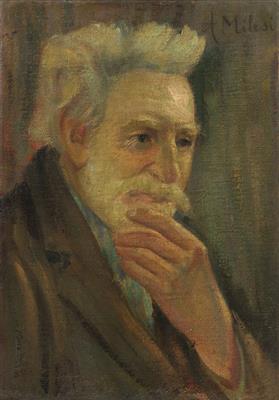
Biography
Born in Venice in 1856[2], he trained at the Academy of Fine Arts under Napoleone Nani from 1869[2] to 1874, following his master to Verona before returning to Venice in 1876. His early exhibitions at the national shows in Milan (1881) and Venice (1887) established him within the tradition of Giacomo Favretto, who had revived Venetian genre painting[2] with warm observation of canal-side life. Later, Milesi absorbed the looser brushwork of Ettore Tito and Cesare Laurenti, giving his work more tonal variety without abandoning its accessible subject matter.
La traversata (also known as La partenza del marinaio, now at the Fondazione Cariplo) and Market Scene in Venice (Brooklyn Museum) are among the public-collection works that show his range: the domestic farewell, the busy waterfront. He participated in the Venice Biennale from its founding edition in 1895[2] through to 1935 and had a solo show there in 1912.
Portraits of writers, musicians, and actors filled out his later career. His longevity ensured his work spanned Venetian naturalism, the Belle Epoque, and the years of Fascism, yet his subject matter remained essentially constant throughout: the city, its water, and the people who worked on both.
Timeline
- 1856Born in Venice, Italy
- 1869Began training at the Academy of Fine Arts under Napoleone Nani
- 1874Followed his master to Verona
- 1876Returned to Venice
- 1881Exhibited at the national show in Milan
- 1887Exhibited at the national show in Venice
- 1890Won a gold medal at the Boston International Exhibition
- 1895Participated in the Venice Biennale
- 1912Had a solo show at the Venice Biennale
- 1935Last participation in the Venice Biennale
- 1945Died at the age of 89
Notable Works
Tap to view larger.
Where to See Alessandro Milesi
1 museum worldwide.
-
3 works
Gallerie d'Italia – Milano
Milan, Italy
Tue–Sun 9:30–19:00, closed Mondays · €12 adults

Next stop
Browse the movements →
Every movement in the collection, from the Renaissance to Pop art.
Related Artists



Frequently Asked Questions
What is Alessandro Milesi known for?
Alessandro Milesi is known for his paintings of Venetian everyday life, including scenes of gondoliers, fishwives, and middle-class Venetians. His painting of Venetian everyday life won a gold medal at the Boston International Exhibition in 1890[2]. He also painted portraits of writers, musicians, and actors.Who was Alessandro Milesi?
Alessandro Milesi was a Venetian artist, born in 1856[2], who painted scenes of everyday Venetian life. He trained at the Academy of Fine Arts under Napoleone Nani from 1869[2] to 1874, following his master to Verona before returning to Venice in 1876. He continued to paint until his death in 1945[2] at the age of 89.What was Alessandro Milesi's art style?
Milesi's early work aligned with the tradition of Giacomo Favretto, known for warm observation of canal-side life. Later, he absorbed the looser brushwork of Ettore Tito and Cesare Laurenti, which gave his work more tonal variety. His subject matter remained constant throughout his career, focusing on the city, its water, and the people who worked on both.How did Alessandro Milesi die?
Alessandro Milesi died in 1945[2] at the age of 89.
Sources
Editorial draws on the following primary and tertiary references for Alessandro Milesi.
- [1] museum Gallerie d'Italia – Milano Used for: museum holdings.
- [2] wikipedia Wikipedia: Alessandro Milesi Used for: biography, birth dates, death dates, identifiers, movement attribution, nationality.
- [3] book Masterpieces of western art : a history of art in 900 individual studies from the Gothic to the present day Used for: biography.
- [4] book Post-impressionism : cross-currents in European painting Used for: biography.
- [5] book Post-impressionism : cross-currents in European painting Used for: biography.
Editorial overseen by Solis Prints. Sources verified 2026-10-07. Click a source for details, or hover over [N] in the page above to preview.
Editorial standardsMethodologyCorrectionsAI disclosureAbout the editorial team