

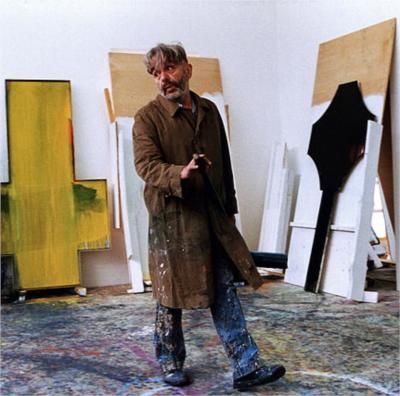
Arnulf Rainer
- Surrealism
- Viennese Actionism
Arnulf Rainer arrived at the Akademie der Bildenden Kunste in Vienna and walked out after a single day. He had done the same at the Hochschule fur Angewandte Kunst the year before. When he and Maria Lassnig travelled to Paris to meet Andre Breton, Breton showed as little interest in Rainer's work as Freud had shown in Breton's on his own earlier pilgrimage to Vienna.
Biography
The rejection suited him. Working through the 1950s at Galerie St. Stephan, the most significant avant-garde gallery in Austria at the time, Rainer developed what he called the Overpaintings: a sustained practice of covering existing images with layers of near-monochromatic paint, applied to works by Sam Francis, Georges Mathieu, Emilio Vedova, and Victor Vasarely, as well as to his own canvases. He described the process as "the passion for gradual shrouding into darkness, the drowning of the image." Between 1954[3] and 1975 the series grew into one of the most unusual bodies of work in postwar European painting.
In 1968[3] he began photographing himself in automated photo booths at Vienna's West Railway Station, grimacing for the flash. These images became the basis for the Face Farces series from 1970: photographs of his own facial contortions revised with colour and graphic intervention, linking portraiture to psychotic states. By 1973 he was painting directly with fingers, feet, and hands. Twenty such body-language works appeared at Documenta 7 in 1982, the same year his Hiroshima series toured fifteen European museums.
A major retrospective, Death and Sacrifice, opened at the Centre Georges Pompidou in Paris in 1984[3]. MoMA and the Guggenheim began collecting his work shortly after. He was appointed Professor at the Academy of Fine Arts in Vienna in 1981 and received the Max-Beckmann Prize from the city of Frankfurt that same year.
Timeline
- 1929Born in Austria.
- 1949Entered the Akademie der Bildenden Kunste in Vienna, but left after one day.
- 1950Left the Hochschule fur Angewandte Kunst after one day, having entered the previous year.
- 1950Travelled to Paris with Maria Lassnig to meet Andre Breton.
- 1950Began developing the Overpaintings at Galerie St Stephan in Vienna.
- 1968Began photographing himself in automated photo booths at Vienna's West Railway Station.
- 1970Started the Face Farces series, revising photographs of his facial contortions.
- 1973Began painting directly with fingers, feet, and hands.
- 1981Appointed Professor at the Academy of Fine Arts in Vienna and received the Max-Beckmann Prize from Frankfurt.
- 1984A major retrospective, Death and Sacrifice, opened at the Centre Georges Pompidou in Paris.
Notable Works
Tap to view larger.
Where to See Arnulf Rainer
1 museum worldwide.
-
 1 works
Harvard Art Museums
Cambridge, United States
Tue–Sun 10:00–17:00, closed Mondays · Free
Next stop
Surrealism →
Explore the artists and ideas of Surrealism.
Related Artists


Frequently Asked Questions
What is Arnulf Rainer known for?
Arnulf Rainer is known for his Overpaintings, a series of existing images covered with layers of near-monochromatic paint. He is also known for his Face Farces series, which involved photographs of his own facial contortions revised with colour and graphic intervention.Who was Arnulf Rainer?
Arnulf Rainer is an artist who, after brief stints at Akademie der Bildenden Kunste and Hochschule fur Angewandte Kunst, developed the Overpaintings, a series of images covered with near-monochromatic paint. He also photographed himself making grimaces in photo booths, which he then revised with colour and graphic interventions for his Face Farces series.What was Arnulf Rainer's art style?
Arnulf Rainer's drawings often feature a curved, arched forehead. These drawings sometimes came into being when he was in a drunken stupor or under the influence of drugs.When was Arnulf Rainer born?
Arnulf Rainer was born in 1929[3].
Sources
Editorial draws on the following primary and tertiary references for Arnulf Rainer.
- [1] museum Harvard Art Museums Used for: museum holdings.
- [2] museum Victoria and Albert Museum Used for: museum holdings.
- [3] wikipedia Wikipedia: Arnulf Rainer Used for: biography, birth dates, death dates, identifiers, movement attribution, nationality.
- [4] book guggenheim-berriarei00bilb Used for: biography, stylistic analysis.
- [5] book Masterpieces of western art : a history of art in 900 individual studies from the Gothic to the present day Used for: biography, stylistic analysis.
- [6] book Jule, Walter, Precarious Balance Used for: biography, stylistic analysis.
Editorial overseen by Solis Prints. Sources verified 2026-09-23. Click a source for details, or hover over [N] in the page above to preview.
Editorial standardsMethodologyCorrectionsAI disclosureAbout the editorial team