



Antonio Cabral Bejarano
Antonio Cabral Bejarano founded a painting dynasty in Seville. He, his sons, and his grandsons collectively produced thousands of paintings documenting the architecture, customs, and street life of the city across the nineteenth century. The studio was, for several generations, the most productive painting workshop in Andalusia.
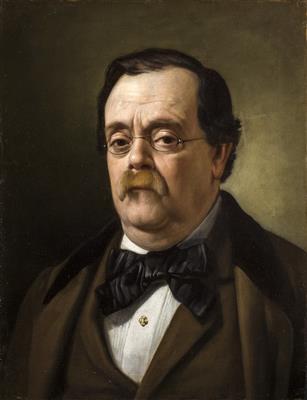
Biography
Born in Seville in 1798[1], Cabral Bejarano studied at the Real Academia de Bellas Artes de Santa Isabel de Hungría. He became conservator of the Alcázar of Seville, a position giving him intimate access to one of Spain's most spectacular architectural complexes. His paintings of the Alcázar's interiors, patios, and gardens are among the most detailed visual records of the palace.
He specialised in architectural views, genre scenes of Sevillian life, and religious paintings for local churches. His technique combined academic conventions with a documentary precision suited to the architectural subjects that were his strongest material.
Cabral Bejarano died in Seville in 1861[1]. His sons Manuel and Rafael continued the family practice, painting the same city their father had documented.
Timeline
- 1798Born in Seville.
- 1814Began studies at the Real Academia de Bellas Artes de Santa Isabel de Hungría.
- 1820Became conservator of the Alcázar of Seville.
- 1820Began painting detailed views of the Alcázar's interiors, patios, and gardens.
- 1820Specialised in genre scenes of Sevillian life.
- 1820Produced religious paintings for local churches.
- 1861Died in Seville. He was 63.
Notable Works
Tap to view larger.
Next stop
Romanticism →
Explore the artists and ideas of Romanticism.
Related Artists


Frequently Asked Questions
What is Antonio Cabral Bejarano known for?
Antonio Cabral Bejarano is known for his architectural views, genre scenes of Sevillian life, and religious paintings. He also served as conservator of the Alcázar of Seville, giving him access to paint detailed visual records of the palace.What should I know about Antonio Cabral Bejarano's prints?
Antonio Cabral Bejarano was a Spanish[1] painter who lived from 1798[1] to 1861[1]. When considering purchasing a print, it is helpful to understand the different types of prints available. Original prints, such as woodcuts, engravings, or lithographs, are produced by hand by the artist. The artwork is created directly on the plate, woodblock, or screen. Each print is considered an original because the artist creates the artwork specifically to be a print. These are sold through specialist galleries, frame shops, and fine art galleries. Offset reproductions, also known as posters or image prints, are created by photochemical means. There are no physical limits on the number of prints that can be made, though publishers may limit quantities to increase value. Giclée prints are fine art prints made using inkjet technology. Canvas transfers involve transferring the image onto canvas, giving it the appearance of a painting. When buying prints, it is important to know the terminology used. A vintage print is made around the time the negative was taken, while a period print is made within 10 to 15 years. A modern print is printed recently from the original negative. An original print is made by the artist or under their supervision.What style or movement did Antonio Cabral Bejarano belong to?
Antonio Cabral Bejarano was active during the 19th century, a period when Romanticism[1] was the dominant artistic movement. Romanticism emerged in the late 18th century and continued through the first half of the 19th. It represented a shift away from the more controlled and morally focused Neoclassical styles. Romantic artists valued wildness and emotional expression. They rejected fixed rules about beauty and subject matter, embracing a creative outlook and a way of life centred on feeling. Romanticism favoured the revival of many styles, not just one. Neoclassicism can be viewed as its initial phase, retaining influence throughout the 1800s, although it came to represent conservative taste. The Enlightenment inadvertently paved the way for Romanticism by liberating not only reason but also emotion. This led to a surge of emotionalism that lasted for much of the early 19th century.What was Antonio Cabral Bejarano known for?
Antonio Cabral Bejarano, a 19th-century Spanish[1] painter, is best known for his costumbrista scenes of Andalusian life. These works often depicted local customs, festivals, and traditions, providing a glimpse into the daily life of the region. Romanticism[1], which overlapped with and then succeeded Neoclassicism, appeared in the later years of the 18th century, first in England and Germany, and then spread across the rest of Europe and into the Americas in the 19th century. Romanticism was multifaceted and included a more impassioned expression of human emotion than found in Neoclassicism. Romanticism is also characterised by an interest in exoticism, found in Orientalising art and Egyptian revival, among others. We also find a nostalgic interest in bygone eras in Romanticism, including a general interest in Medievalism and a more focused interest in the Gothic age. Bejarano's paintings frequently feature bullfighting, religious processions, and scenes of everyday life in Seville and other Andalusian cities. His attention to detail in costume and setting, combined with a sense of narrative, made his works popular with both local audiences and foreign visitors interested in Spanish culture.Where can I see Antonio Cabral Bejarano's work?
To view works by Antonio Cabral Bejarano, consider visits to museums in Spain, Portugal, France, and Belgium. The Museo Art Nouveau y Art Deco, located on Calle Gibraltar in Salamanca, Spain, holds relevant pieces. Another option is the Museu Calouste Gulbenkian in Lisbon, Portugal. In Barcelona, Spain, the Museu d’Art Modern (MNAC) may also have artwork by Bejarano. For those travelling further afield, the Brangwyn Museum in Brugge, Belgium, and the Clockarium Museum in Brussels, Belgium, are possibilities. Several museums in France also feature relevant works. These include the Musée d’Art et d’Industrie in Roubaix, the Musée de l’Ecole de Nancy, and the Musée des Arts Décoratifs in Paris. Lastly, the Musée des Beaux-Arts in Nancy could be another place to view Bejarano's art. Always check museum websites for current exhibitions.Who did Antonio Cabral Bejarano influence?
It is difficult to say exactly who Antonio Cabral Bejarano influenced. However, we can consider the influences of artists who came before him, and who might have informed his artistic style. According to Palomino, Diego Velázquez was influenced by Luis Tristán, a painter from Toledo, who was himself a follower of El Greco. Velázquez found Tristán's paintings agreeable because Tristán followed a similar path in the singularity of his thinking and the liveliness of his ideas. Velázquez declared himself Tristán's follower and abandoned his master's manner. Tristán's art seemed pulled in two contradictory directions. He took compositional and spatial cues from El Greco; he also sometimes painted in a naturalist, tenebrist style that closely recalled Caravaggio. It is possible that Velázquez may have come to know the work of Caravaggio through Tristán. At some point, likely on his return from Italy, Tristán passed through Seville. It is certainly possible that he met Francisco Pacheco and the young Velázquez at this time.Who influenced Antonio Cabral Bejarano?
It is difficult to say with certainty who influenced Antonio Cabral Bejarano. However, Diego Velázquez learned about contemporary Italian painting through works by various artists brought to Seville. These included Ribera and Baglione, both early followers of Caravaggio, along with artists such as Guido Reni and Lanfranco, who were not as closely associated with Caravaggio. Velázquez was particularly drawn to the paintings of Luis Tristán, a painter from Toledo and a disciple of El Greco. Tristán's art displayed two distinct tendencies: compositional and spatial cues taken from El Greco, and a naturalist, tenebrist style reminiscent of Caravaggio. Tristán's approach did not merge these elements into a new expressive form. Despite this, he is now being reconsidered as a possible source through which the young Velázquez might have encountered the work of Caravaggio. It is possible that Tristán, upon his return from Italy, passed through Seville and met Pacheco and the young Velázquez, sharing his knowledge of contemporary Italian painting.Why are Antonio Cabral Bejarano's works important today?
Antonio Cabral Bejarano was a painter active in Seville during the 19th century. He specialised in costumbrismo, a popular style that depicted everyday life and regional customs. While not considered an innovator, his works offer a valuable record of Andalusian society during a period of significant change. Costumbrista paintings, like those by Bejarano, captured traditions, costumes, and social interactions that were already beginning to fade due to modernisation. They provide insights into the values, beliefs, and social structures of the time. These paintings are important historical documents that visualise a specific cultural moment. Bejarano's art also connects to a broader European interest in regionalism and local colour during the 19th century. As national identities solidified, there was a simultaneous fascination with preserving and celebrating regional differences. Bejarano's paintings contributed to this movement by documenting and promoting Andalusian identity. His works are appreciated today for their historical and cultural value, offering a glimpse into a world that has largely disappeared.What was Antonio Cabral Bejarano's art style?
Antonio Cabral Bejarano's technique combined academic conventions with a documentary precision. This approach was well-suited to the architectural subjects that were his strongest material.How did Antonio Cabral Bejarano die?
Antonio Cabral Bejarano died in 1861[1] at the age of 63.
Sources
Editorial draws on the following primary and tertiary references for Antonio Cabral Bejarano.
- [1] wikipedia Wikipedia: Antonio Cabral Bejarano Used for: biography, birth dates, death dates, identifiers, movement attribution, nationality.
- [2] book Elizabeth Gilmore Holt; Project Muse, A Documentary History of Art, Volume 2 _ Michelangelo and the Mannerists, The Baroque and the Eighteenth Century Used for: biography.
- [3] book Elizabeth Gilmore Holt; Project Muse, A Documentary History of Art, Volume 2 _ Michelangelo and the Mannerists, The Baroque and the Eighteenth Century Used for: biography.
- [4] book Elizabeth Gilmore Holt; Project Muse, A Documentary History of Art, Volume 2 _ Michelangelo and the Mannerists, The Baroque and the Eighteenth Century Used for: biography.
Editorial overseen by Solis Prints. Sources verified 2026-10-15. Click a source for details, or hover over [N] in the page above to preview.
Editorial standardsMethodologyCorrectionsAI disclosureAbout the editorial team