



Antoni Tapies
Antoni Tàpies mixed sand, marble dust, and earth into his paint and scratched through the surface with his fingers. His canvases, produced from the late 1940s, are walls: thick, encrusted surfaces scored with crosses, letters, and graffiti-like marks that turn painting into something closer to archaeology than composition.
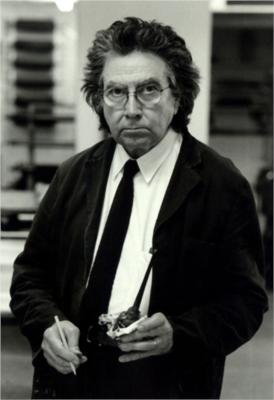
Biography
Born in Barcelona in 1923[1], Tàpies studied law briefly before abandoning it for art. He was largely self-taught, influenced by Klee, Miró, and Surrealist automatism. In 1948[1], he co-founded the Dau al Set group, Catalonia's first post-war avant-garde collective.
His mature work builds surfaces from non-traditional materials: paint mixed with powdered marble, chalk, clay, and found objects. The surfaces are incised, scratched, and marked with symbols suggesting both pre-literate communication and urban graffiti. The cross, the letter T, and the four bars of the Catalan flag recur obsessively.
Tàpies became the most internationally visible Catalan artist since Miró. He won the Golden Lion at the Venice Biennale in 1993[1] and exhibited at Documenta, the Guggenheim, and the Reina Sofía. The Fundació Antoni Tàpies in Barcelona was established in 1984. He died in Barcelona in 2012[1].
Timeline
- 1923Born in Barcelona, Spain
- 1940Briefly studied law before abandoning it for art
- 1948Co-founded Dau al Set group, Catalonia's first post-war avant-garde collective
- 1949Began creating his signature thick, encrusted surfaces
- 1984Fundació Antoni Tàpies established in Barcelona
- 1993Won the Golden Lion at the Venice Biennale
- 2012Died in Barcelona, Spain
Notable Works
Tap to view larger.
Next stop
Browse the movements →
Every movement in the collection, from the Renaissance to Pop art.
Related Artists


_%E2%80%93_LOC.jpg)


Frequently Asked Questions
What is Antoni Tapies known for?
Antoni Tàpies is known as one of the most celebrated post-war Spanish artists from Catalonia, bringing together culture and politics. He mixed sand, marble dust, and earth into his paint; he also scratched through the surface with his fingers.What is Antoni Tapies's most famous work?
Antoni Tapies, born in Barcelona in 1923[1], is considered a significant post-war Spanish artist. He began his artistic career after abandoning law studies in 1946[1]. His early work showed the impact of Miró, Klee, Ernst, and Oriental philosophy. Although it is difficult to name one single "most famous" work, Great Painting (Gran pintura), from 1958, is a characteristic example. It uses mixed media on canvas and is noted for its austere, earthy colours and rough, encrusted surface. The Guggenheim Museum has exhibited it multiple times. Another important work is Grey Ochre (1958), held in the collection of the Tate, London. This painting combines oil paint with crushed marble dust on canvas. The thick surface has incisions, giving a sense of desolation and the ravages of time. Tapies often incorporated materials like marble dust into his paintings, creating surfaces with creases and fossil-like imprints. His works often evoke walls from old Barcelona, eroded by age. He also made clay sculptures of everyday objects. Tapies's art aims for a universal connection with nature, incorporating philosophy and ethics.What should I know about Antoni Tapies's prints?
Antoni Tapies (1923[1]-2012[1]) was a Spanish artist, born in Barcelona. He was largely self-taught; he felt art classes had little impact. In 1946[1], Tapies abandoned law to focus on art, and he joined the Blaus, an iconoclastic group of Catalan artists. Tapies's initial exhibition was at Barcelona's Salo d'Octubre in 1948. The same year, he met Joan Miró. The early influence of Miró, Paul Klee, and Max Ernst, as well as Oriental philosophy, is clear in his work from this period. His first solo exhibition occurred at the Galeries Laietanes, Barcelona, in 1950. In 1961, Tapies Lithographs were exhibited at the David Anderson Gallery, New York. Tapies received the Ministry of Foreign Affairs prize at the International Exhibition of Graphic Art, Tokyo, that same year. His work often incorporates austere, somber, earthy colours and textures. Many of Tapies's pieces evoke the appearance of aged, eroded walls, reminiscent of those in Barcelona. From 1954, he used clear latex as a binding medium with dry pigments, earth, and marble particles.What style or movement did Antoni Tapies belong to?
Antoni Tapies, born in Barcelona in 1923[1], is often associated with Art Informel and Tachisme. These European movements moved away from traditional artistic conventions. From 1948[1] to 1956, Tapies participated in the anti-fascist group Dau al Set, which had surrealist influences. The Guggenheim Museum Bilbao notes that surrealism represented artistic progress for Tapies and other artists during the Franco era. However, he sought more current means of expression. Tapies's mature style is described as immediate and even violent, reflecting the oppressive atmosphere of the 1950s under Franco's regime. Despite cultural repression in Catalonia, Tapies's career flourished, perhaps because he expressed his political views through the subtle language of international abstraction. His paintings often incorporate unconventional materials, such as sand and marble dust, mixed with paint. This gives his works a textured, relief-like quality. The colours are typically austere, featuring earthy tones, blacks, whites and greys. Tapies aimed to affect the viewer's sensibilities, not just their intellect, inviting intuition rather than intellectual analysis.What techniques or materials did Antoni Tapies use?
Antoni Tapies, a Catalan artist, employed varied techniques and materials in his art. He is considered an important figure in Art Informel and Tachisme. Tapies often mixed oil paint with materials such as crushed marble, sand, powdered pigment, or latex. This created heavily textured surfaces, which he would then mark with incisions, creases, and fossil-like impressions. The resulting surfaces often evoke feelings of desolation and the passage of time. His paintings sometimes resemble walls, scarred by human interaction. The colour palette is often austere, featuring earthy tones like ochre, grey, reddish-brown, black, and white. These colours and markings held meaning for Tapies, although he preferred viewers to respond intuitively rather than intellectually. He aimed to create images that encourage contemplation.What was Antoni Tapies known for?
Antoni Tapies, born in Barcelona in 1923[1], is considered one of the most important Spanish post-war artists. Initially influenced by Joan Miró and the poet Joan Brossa, Tapies began his artistic career as part of the anti-fascist, surrealist-inspired group Dau al Set between 1948[1] and 1956. Tapies moved toward Art Informel and abstract expressionism to express his spirit. His mature style involved a violent, rapid working method; he described "torturing" his pieces, reflecting the oppressive atmosphere of Franco's regime in the 1950s. Despite Franco's suppression of Catalan culture, Tapies's career flourished, perhaps because he expressed his political views through the elite language of international abstraction. Tapies experimented with materials, combining oil paint with crushed marble, powdered pigment, or latex. This created desolate surfaces marked with creases, incisions, and fossil-like impressions. His paintings evoke the ravaged surfaces of walls worn by time, reflecting his Catalan heritage; his surname means "walls". He also produced heavy clay sculptures of everyday objects. Tapies died in Barcelona in 2012[1].When did Antoni Tapies live and work?
Antoni Tapies was born in Barcelona on 13 December 1923[1]. His adolescence was disrupted by the Spanish Civil War and a two-year illness. Essentially self-taught as a painter, he abandoned law studies in 1946[1] to devote himself exclusively to art. In 1948, Tapies was a founding member of the group and magazine Dau al Set (The Seventh Side of the Die) in Barcelona, and he met Joan Miró that year. In 1950, the French government awarded Tapies a scholarship to spend a year in Paris; he subsequently visited Paris regularly. His first solo show was held at the Galeries Laietanes, Barcelona, in 1950. Tapies travelled extensively. He visited Belgium and Holland in 1951, and in 1953 he travelled to New York for his first solo exhibition there. He also visited Italy in 1957, and the United States again in 1959 and 1961, as well as England and Germany in 1962. Tapies died in Barcelona in 2012[1].Where can I see Antoni Tapies's work?
Antoni Tapies (1923[1]-2012[1]) was a Spanish artist born in Barcelona. His work has been exhibited in major museums and galleries in the United States, Europe, Japan, and South America since his first solo show in Barcelona in 1950[1]. Retrospectives were held at the Musée National d'Art Moderne in Paris in 1973, and at the Albright-Knox Art Gallery of Buffalo in 1977. Tapies's first solo show in New York was in 1953. He participated in the Carnegie International in Pittsburgh in 1950. His work was shown in New York at the Martha Jackson Gallery and the Gres Gallery in Washington, D.C. In 1959, his painting *Great Painting* (1958) was part of the Guggenheim Museum's inaugural selection. Tapies's *Grey Ochre* (1958) is in the collection of the Tate, London.Where was Antoni Tapies from?
Antoni Tapies was born in Barcelona, Catalonia, on 13 December 1923[1]. His early life was disrupted by the Spanish Civil War and a two-year illness. Largely self-taught as a painter, Tapies abandoned his law studies in 1946[1]. He then joined the Blaus, an anti-fascist group of Catalan artists and writers producing the journal *Dau al Set*. His work was first exhibited in Barcelona's Salo d'Octubre in 1948, the year he met Joan Miró. In 1966, Tapies and other Spanish intellectuals were briefly imprisoned for attending an unauthorised student meeting in Barcelona. Despite Franco's repression of Catalan culture and language, Tapies's career flourished. It may be that he successfully expressed his political views through the subtle language of international abstraction. Tapies died in Barcelona in 2012[1].Who did Antoni Tapies influence?
Antoni Tàpies's early work shows the influence of Joan Miró, Paul Klee, and Joaquín Torres García; these artists helped shape his initial artistic direction. Tàpies, along with others, edited the magazine *Dau al Set* in Barcelona during the late 1940s. The magazine is an index of some of Tàpies's early interests, which included Miró, Klee, and Joaquín Torres García. His association with the anti-fascist group that published *Dau al Set* also placed him in contact with poet Joan Brossa. Tàpies himself stated that Surrealism represented a model of artistic vanguard, progress, and modernity for him and other artists of the post-war Franco period. Tàpies experimented with different materials, combining oil paint with crushed marble, powdered pigment, or latex. He aimed to create desolate surfaces, covered with creases, incisions, and fossil-like imprints. His work has been compared to that of Jean Dubuffet.Who influenced Antoni Tapies?
Antoni Tapies, born in Barcelona in 1923[1], was influenced by several artists and movements. Early influences included Joan Miró, Paul Klee, and Max Ernst. Oriental philosophy also played a role in shaping his artistic vision during his early period. Tapies was associated with the Blaus, an anti-fascist group of Catalan artists and writers, from 1948[1] to 1956. This group published the review *Dau al Set*. He found in Surrealism a model for artistic progress, which he wanted to develop in his work. As he searched for ways to express his spirit, Tapies turned to Art Informel and Abstract Expressionism. His mature style involved working rapidly and, in his words, "torturing" the piece. The political climate of the time, specifically the Franco regime in the 1950s, also affected his approach. Tapies was an avid reader and collected a library of Catalan literature. These writings served as a source of inspiration for his art.Who was Antoni Tapies?
Antoni Tapies (1923[1]-2012[1]) was a Catalan artist, considered one of the most important Spanish post-war artists. Born in Barcelona, his adolescence was marked by the Spanish Civil War and a two-year illness. Largely self-taught as a painter, he abandoned law studies in 1946[1] to focus on art. Soon after, Tapies joined the Blaus, an anti-fascist group of Catalan artists and writers who produced the journal *Dau al Set*. His work was first exhibited in Barcelona's Salo d'Octubre in 1948, where he met Joan Miró. The influence of Miró, Klee, Ernst, and Oriental philosophy is apparent in his early work. Tapies's first solo exhibition was at the Galeries Laietanes, Barcelona, in 1950. That year, he received a French government scholarship to study in Paris. His first solo show in New York was in 1953. In 1966, he and other Spanish intellectuals were briefly imprisoned for attending an unauthorised student meeting in Barcelona. Tapies experimented with materials, combining oil paint with crushed marble, powdered pigment, or latex to create surfaces with creases and incisions.
Sources
Editorial draws on the following primary and tertiary references for Antoni Tapies.
- [1] wikipedia Wikipedia: Antoni Tapies Used for: biography, birth dates, death dates, identifiers, movement attribution, nationality.
- [2] book Beard, Lee, 1973- author, Butler, Adam, author; Van Cleave, Claire, author; Fortenberry, Diane, author; Stirling, Susan, author, Beard, Lee, 1973- author, Butler, Adam, author; Van Cleave, Claire, author; Fortenberry, Diane, author; Stirling, Susan, author - The Art Book_ New Edition, Mini Format Used for: biography.
- [3] book guggenheim-antonitapies00tp Used for: biography.
- [4] book guggenheim-guhe00solo Used for: biography.
Editorial overseen by Solis Prints. Sources verified 2026-08-29. Click a source for details, or hover over [N] in the page above to preview.
Editorial standardsMethodologyCorrectionsAI disclosureAbout the editorial team