

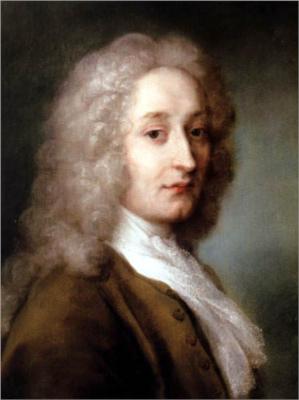
Biography
Solis Prints offers fine art prints of works by Antoine Watteau, including Arlecchino Emperor in the Moon, Autumn, Ceres (Summer), Cupid Disarmed, and Diana at her Bath.
Timeline
- 1684Born in Valenciennes, which had recently passed from the Spanish Netherlands to France.
- 1712Admitted to the Académie Royale de Peinture et de Sculpture. The Academy invented the category of fêtes galantes to accommodate his style of painting.
- 1717Delivered "A Pilgrimage to Cythera" as his reception piece for the Académie Royale de Peinture et de Sculpture. It was the first work officially catalogued as a fête galante.
- 1721Painted "Gersaint's Shop Sign" in eight mornings. It was displayed outside a Paris art dealer's and sold within fifteen days.
- 1721Died of tuberculosis, aged 37.
Notable Works
Tap to view larger.
Next stop
Rococo →
Explore the artists and ideas of Rococo.
Antoine Watteau prints
Hand-finished archival prints from Antoine Watteau's body of work.


Related Artists


Take Antoine Watteau home.
See all Antoine Watteau prints →Frequently Asked Questions
What is Antoine Watteau known for?
Antoine Watteau's last work was intended as a signboard for an art-dealing business run by his friend, E.F. Gersaint. It depicts a slice of life showing the interior of Gersaint's shop, where Watteau was staying after visiting a doctor in England.What is Antoine Watteau's most famous work?
Antoine Watteau is best known for his paintings of "fêtes galantes": dream-like, idealised scenes of elegant men and women relaxing in imaginary outdoor settings. He is considered the originator of this type of picture. His most famous painting is The Embarkation for Cythera. There are in fact two versions of this work. The first, from 1717[3], is in the Louvre Museum, Paris. The second, from 1718, is located at Schloss Charlottenburg, Berlin. The painting can be interpreted as a theatrical scene, which unfolds from right to left. It depicts couples of lovers about to board a boat for the island of Cythera, the birthplace of Venus, goddess of love. Every detail is an invitation to embark for the island. Watteau was born in Valenciennes, near the Flemish border. He died at only 37, after suffering from consumption. His last work was intended as a signboard for an art dealer's business owned by his friend, E.F. Gersaint.What should I know about Antoine Watteau's prints?
Antoine Watteau became interested in printmaking around 1710[3], as his artistic talent began to be recognised. His initial efforts were etchings; the Goncourt brothers described them as 'free improvisations' and 'scrawls'. It is believed that only two or three copies of each exist. Experts in printmaking, Simon Thomassin fils and Simonneau l’aîné, immediately 'touched up' these etchings with the burin. The number of Watteau's prints is limited, probably only nine altogether. These include the seven Figures de mode, Recruë Going to Join the Regiment, and The Clothes Are Italian (circa 1716). Watteau created them all from his own drawings, imparting their nervous line and spontaneity. It is possible that he drew directly on the copperplate, which would explain certain clumsy passages. Two volumes, published in 1726 and 1728, present a unique source of information for the drawings of Watteau.What style or movement did Antoine Watteau belong to?
Antoine Watteau (1684[3]-1721[3]) is considered a key figure in the Rococo[3] style. Born in what is now Belgium, he moved to Paris in 1702[3]. There, he developed an interest in genre painting and the world of theatre, especially the commedia dell'arte. Rococo emerged in the early 18th century, when the Baroque style in France gave way to a more intimate culture based in the Parisian town houses of the aristocracy. These aristocrats and intellectuals gathered for conversation in salons decorated with delicate colours, curving lines, gilded mirrors, elegant furniture, and small paintings. Watteau’s paintings often feature light colours and elegant figures in ornate costumes moving through lush outdoor settings. His "fête galante" paintings depict the outdoor pastimes of French[3] high society. His gift for colour allowed him to imbue even the lightest tones with softness and mystery. Watteau's successors, including François Boucher and Jean-Honoré Fragonard, continued the Rococo style later in the 18th century.What techniques or materials did Antoine Watteau use?
Antoine Watteau was admired for his skill with colour. He seldom used watercolours, preferring a cream-coloured paper. However, he was a virtuoso practitioner of the three-colour chalk technique, and produced a range of tones and tints in his red chalk drawings. He also favoured subdued washes. Contemporary accounts describe Watteau's painting manner in terms of 'touch', oriented to the surface of the canvas. According to the Comte de Caylus, Watteau would 'rub' his blank canvases all over with oil in a haphazard manner. Then, according to Antoine-Joseph Dézallier d’Argenville, he applied paint with 'a flowing brush and the finest and lightest touch'. Watteau seemed to respond to the possibilities of canvas and rag paper as infinitely extendable surfaces.What was Antoine Watteau known for?
Antoine Watteau (1684[3]-1721[3]) is considered the most celebrated French[3] artist of the Rococo[3] period. He is known for translating the habits and preferences of Parisian society into visual form. His paintings often depict themes of sociability, love, conversation, dance, or the theatre; they express the artfulness of daily life in 18th-century Paris. Watteau is best known for his creation of the *fête galante*, a genre of painting that blends fantasy with reality. These scenes of sociability often take place in gardens. They mix men and women in contemporary dress with those wearing theatrical costumes. Figures often have their backs to the viewer, and expressions are often obscured through loose brushwork and lack of detail. Elegant gestures and the fluid fall of drapery combine with Watteau’s characteristically painterly handling to achieve remarkable gracefulness. His sense of colour and depiction of shimmering fabrics were inspired by his close study of works by Peter Paul Rubens.Where was Antoine Watteau from?
Antoine Watteau was born in 1684[3] in Valenciennes. At the time of his birth, Valenciennes was a Flemish town that had recently become part of France. Watteau is considered one of the greatest French[3] artists of the eighteenth century. Watteau moved to Paris in 1702[3]. In 1707, he began working with Claude Audran, who was the keeper of the Luxembourg Palace. This position gave Watteau access to Peter Paul Rubens's *Life of Marie de Médicis* series. The series had a Venetian influence, and Watteau's early experiences with Rubens and the Venetian works in Paris helped form his style. The French Academy admitted Watteau in 1712. Five years later, he completed his reception piece, *Departure from the Isle of Cythera*.Who did Antoine Watteau influence?
Antoine Watteau, a key figure in Rococo[3] art, had a notable impact on French[3] art, despite apparently guarding his artistic methods closely. Although he only accepted one student, Jean-Baptiste Pater (likely out of obligation to Pater's father), Watteau's style influenced several artists. Nicolas Lancret's work was so similar that it caused Watteau to end their friendship. After Watteau's early death from tuberculosis at 37, Jean de Jullienne's publications of engravings and etchings, such as Figures de différents caractères (1726 and 1728) and the Recueil Jullienne (1735), greatly assisted the dissemination of his art. François Boucher worked extensively on these publications and was influenced by Watteau's graceful handling of form. Jacob de Wit, the leading Dutch painter of his generation, also felt Watteau's influence. De Wit is known for imitative stucco reliefs or grisailles that generally depicted allegorical and religious subjects or attributes represented by putti. In their playful spirit, they are Rococo.Who influenced Antoine Watteau?
Antoine Watteau (1684[3]-1721[3]) is considered a central figure in Rococo[3] art. Of Flemish heritage, he moved to Paris around 1702[3], where he developed an interest in genre painting and the theatre, especially the *commedia dell’arte*. Rubens (1577-1640[3]) influenced Watteau; this influence affected his subject matter more than his style, leading him to the *fête galante*. After the reign of Louis XIV, attention shifted to the pleasing, private, and decorative. Watteau became the painter of the 18th century due to his spirit. Watteau's native region allowed him to become familiar with Rubens and a host of Dutch artists. In Paris, he met friends and patrons who allowed him to practice his art freely. He was a student and apprentice of the painter, draughtsman, and engraver Claude Gillot (1673-1722), who introduced him to the world of actors. At that time, the French[3] and Italian comedies competed for prominence. Watteau initiated the Rocaille style, starting from the decorative style of Louis XIV's time, linked to Chinese and Japanese decorative elements for the decorative painting of rooms. He borrowed the elegant costumes of rural theatre characters to dress the male and female figures in his paintings.Who was Antoine Watteau?
Antoine Watteau (1684[3]-1721[3]) was a French[3] painter whose short career greatly influenced the development of Rococo[3] art. Born in Valenciennes, Watteau first trained with local artists before moving to Paris around 1702[3]. There, he worked in the studio of Claude Gillot, a painter of theatrical subjects, and later with Claude Audran III, an ornamental designer. Watteau is best known for his *fêtes galantes*: paintings depicting elegant figures in park-like settings. These works, such as *Pilgrimage to Cythera* (first version, 1717), present an idealised vision of aristocratic leisure and courtship. Watteau's style is characterised by delicate brushwork, subtle colour harmonies, and a sense of wistful melancholy. Although Watteau gained recognition during his lifetime, becoming a member of the Académie Royale de Peinture et de Sculpture in 1717, his career was cut short by illness. He died at the age of 36, leaving behind a relatively small but highly influential body of work. His paintings and drawings were widely collected and imitated, shaping the course of French art in the 18th century.Why are Antoine Watteau's works important today?
Antoine Watteau (1684[3]-1721[3]) is considered a central figure in Rococo[3] art. Around 1702[3], the Flemish-born Watteau moved to Paris, where he developed an interest in both genre painting and the theatre, especially the *commedia dell’arte*. The shift in subject matter toward the *fête galante* was influenced by Peter Paul Rubens (1577-1640[3]). After the reign of Louis XIV, attention turned to the pleasant, private, and decorative. Watteau responded to a relaxation in politics and morals by introducing intimate, decorative, and erotic motifs, including nudes and familiar mythological scenes. His pastoral scenes celebrated physical pleasure and life's joys. Watteau had a gift for colour, imbuing even the lightest tones with softness, mystery, and a musicality. This virtuosity, combined with his skill in drawing, places him among the greatest artists. His 1720 work, *Gersaint's Shopsign*, assimilates bourgeois leisure into older notions of luxury.
Sources
Editorial draws on the following primary and tertiary references for Antoine Watteau.
- [1] academic Antoine Watteau | French Rococo Painter & Draftsman - Britannica Used for: biography.
- [2] academic Antoine Watteau - Smarthistory Used for: stylistic analysis.
- [3] wikipedia Wikipedia: Antoine Watteau Used for: biography, birth dates, death dates, identifiers, movement attribution, nationality.
- [4] book Elizabeth Gilmore Holt; Project Muse, A Documentary History of Art, Volume 2 _ Michelangelo and the Mannerists, The Baroque and the Eighteenth Century Used for: biography.
- [5] book Elizabeth Gilmore Holt; Project Muse, A Documentary History of Art, Volume 2 _ Michelangelo and the Mannerists, The Baroque and the Eighteenth Century Used for: biography.
- [6] book Elizabeth Gilmore Holt; Project Muse, A Documentary History of Art, Volume 2 _ Michelangelo and the Mannerists, The Baroque and the Eighteenth Century Used for: biography.
- [7] book Susie Hodge, Art Used for: stylistic analysis.
- [8] museum Watteau, Jean Antoine, Antoine Watteau, Four studies of a young woman's head, a drawing - British Museum collection online Used for: technique.
- [9] museum Antoine Watteau - Mezzetin - The Metropolitan Museum of Art Used for: museum holdings.
- [10] museum Jean-Antoine Watteau, La Surprise - Getty Museum Used for: notable works.
Editorial overseen by Solis Prints. Sources verified 2026-09-22. Click a source for details, or hover over [N] in the page above to preview.
Editorial standardsMethodologyCorrectionsAI disclosureAbout the editorial team