



Angelica Kauffman
In 1764[4], at 22, Angelica Kauffman painted the portrait of Johann Joachim Winckelmann, the most influential art theorist in Europe, in Rome. The work, now in the Kunsthaus Zurich, shows him leaning toward the viewer with a pen in hand, in a relaxed naturalism that marks her shift from her father's Rococo training toward the Neoclassicism[4] Winckelmann had himself theorised. That same year she was elected to Rome's Accademia Nazionale di San Luca.
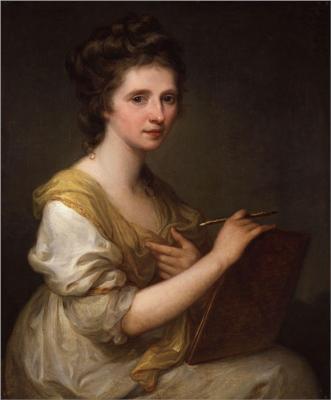
Biography
Born in Chur in 1741[4] to an itinerant Swiss painter, Kauffman had grown up painting commissions across Austria and Italy, speaking four languages fluently by the time she moved to London in 1766[4]. Two years later she became one of only two female founding members of the Royal Academy, alongside the flower painter Mary Moser, a distinction not repeated for nearly two centuries. She sent history paintings to the first Royal Academy exhibition in 1769: Hector Taking Leave of Andromache and, the following year, Vortigern and Rowena, both now at Saltram House in Devon.
Her most celebrated work is Cornelia, Mother of the Gracchi (c.1785[4], Virginia Museum of Fine Arts), in which Cornelia presents her two young sons to a visiting woman as her jewels in place of material ornament. Scholars describe it as a paradigmatic Enlightenment exemplum virtutis, composed with the severity and low-relief clarity characteristic of Neoclassicism[4]. Unusually for the period, Kauffman placed women consistently at the centre of historical action rather than at its weeping margins.
After marrying the Venetian painter Antonio Zucchi in 1781[4], she returned to Rome, where her studio became a fashionable Grand Tour destination. Goethe noted her work ethic with admiration; courts in Russia, Poland, Naples, and Austria collected her work. She died in Rome in 1807[4].
Timeline
- 1741Born in Chur, Switzerland, to an itinerant Swiss painter.
- 1764Painted the portrait of Johann Joachim Winckelmann in Rome, aged 22.
- 1764Elected to Rome's Accademia Nazionale di San Luca at 22.
- 1766Moved to London, aged 25.
- 1768Became one of two female founding members of the Royal Academy, aged 27.
- 1769Sent the history painting "Hector Taking Leave of Andromache" to the first Royal Academy exhibition.
- 1770Sent the history painting "Vortigern and Rowena" to the Royal Academy exhibition.
- 1781Married the Venetian painter Antonio Zucchi, aged 40.
- 1781Returned to Rome after her marriage, aged 40.
- 1785Painted "Cornelia, Mother of the Gracchi".
- 1807Died in Rome at the age of 66.
Notable Works
Tap to view larger.
Next stop
Neoclassicism →
Explore the artists and ideas of Neoclassicism.
Related Artists


Frequently Asked Questions
What is Angelica Kauffman known for?
Angelica Kauffman is known for being one of the few successful female history painters of the 18th century. She was also one of only two female founding members of the Royal Academy. Her most celebrated work is Cornelia, Mother of the Gracchi (c.1785[4], Virginia Museum of Fine Arts).Who was Angelica Kauffman?
What was Angelica Kauffman's art style?
Angelica Kauffman's art shifted from her father's Rococo training toward Neoclassicism[4]. Her celebrated work, Cornelia, Mother of the Gracchi, is described as a paradigmatic Enlightenment exemplum virtutis, composed with the severity and low-relief clarity characteristic of Neoclassicism. She consistently placed women at the centre of historical action rather than at its weeping margins.How did Angelica Kauffman die?
Angelica Kauffman died in 1807[4] at the age of 66.
Sources
Editorial draws on the following primary and tertiary references for Angelica Kauffman.
- [1] academic Angelica Kauffmann Used for: biography.
- [2] academic Britannica Editors, Angelica Kauffmann | Painter, Neoclassical style Used for: biography.
- [3] academic Wendy Wassyng Roworth, The Gentle Art of Persuasion: Angelica Kauffman's Praxiteles and Phryne Used for: stylistic analysis.
- [4] wikipedia Wikipedia: Angelica Kauffman Used for: biography, birth dates, death dates, identifiers, movement attribution, nationality.
- [5] book Jesse Bryant Wilder, Art History For Dummies Used for: biography, stylistic analysis.
- [6] book Palmer, Allison Lee, Historical Dictionary of Neoclassical Art and Architecture Used for: biography, stylistic analysis.
- [7] book Milam, Jennifer Dawn, Historical Dictionary of Rococo Art Used for: biography, stylistic analysis.
- [8] museum Angelica Kauffman 1741–1807 | Tate Used for: biography.
- [9] museum Angelica Kauffmann, A Nymph Drawing her Bow on a Youth Used for: museum holdings.
Editorial overseen by Solis Prints. Sources verified 2026-09-22. Click a source for details, or hover over [N] in the page above to preview.
Editorial standardsMethodologyCorrectionsAI disclosureAbout the editorial team