



Alfred Freddy Krupa
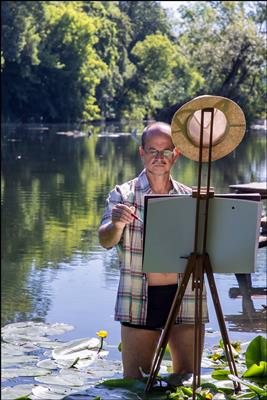
Alfred Freddy Krupa published his "New Ink Art Manifesto" in 1996, a year after graduating from the Academy of Fine Arts in Zagreb, and spent the following years developing the movement into an international practice. His work in ink, painting, illustration, and photography eventually brought him to Tokyo Gakugei University in 1998, where he extended his formal training before returning to Europe.
Biography
Born in Karlovac in 1971[1], Krupa grew up in Yugoslavia and gained his first public recognition in 1990 through the Yugoslav weekly magazine Vikend. The route from popular illustration to fine art gallery practice was not uncommon among his generation of Central European artists; what distinguished Krupa was his deliberate attempt to codify his approach through the Manifesto and to position New Ink Art as a distinct movement rather than a personal style.
His work has entered the collection of the Museum of Modern Art in New York, the institution most associated with establishing international canonical status in contemporary art. He appeared in the 2025 London Art Biennale and received the Order of Danica Hrvatska, a Croatian[1] state decoration, in April 2023, as well as the City of Karlovac Award the same year.
Krupa's practice spans painting, illustration, and photography; the connective tissue is his investment in ink as a medium with its own expressive logic, distinct from both East Asian brush traditions and Western watercolour.
Timeline
- 1971Born in Karlovac, Yugoslavia
- 1990First public recognition in Vikend magazine
- 1995Graduated from Academy of Fine Arts in Zagreb
- 1996Published "New Ink Art Manifesto"
- 1998Extended training at Tokyo Gakugei University
- 2023Received Order of Danica Hrvatska and City of Karlovac Award
- 2025Appeared in London Art Biennale
Notable Works
Tap to view larger.
Next stop
Browse the movements →
Every movement in the collection, from the Renaissance to Pop art.
Related Artists
Frequently Asked Questions
What is Alfred Freddy Krupa known for?
Alfred Freddy Krupa is known for his work in ink, painting, illustration, and photography. He is also known for publishing his "New Ink Art Manifesto" in 1996, which led to the development of New Ink Art as an international movement.What should I know about Alfred Freddy Krupa's prints?
Alfred Freddy Krupa is a contemporary Croatian[1] artist known for his watercolour paintings and Sumi-e ink techniques. While information on his prints is less widely available than on his paintings, some key aspects can be considered. Krupa's prints often reflect his interest in traditional East Asian art, particularly Japanese ink wash painting. These works frequently employ a monochrome palette, emphasising tonal variation and brushstroke control. Subjects range from natural motifs, such as fish and birds, to more abstract compositions. Given Krupa's wider practice, it is reasonable to expect that he uses a variety of printmaking methods, possibly including lithography, etching, or screenprinting, to achieve different textures and effects. The prints are likely produced in limited editions, signed and numbered by the artist, which indicates their status as original fine art rather than commercial reproductions.What style or movement did Alfred Freddy Krupa belong to?
Without more information, it is difficult to place Alfred Freddy Krupa in a definite artistic movement. More information is needed to provide a detailed and accurate answer about his artistic style. However, pencak silat is a martial art accompanied by Sundanese music. It includes choreographed movements. There are a number of different musical patterns (tepak) that go with the pencak silat movements. Each pattern has its own tempo and drumming style. The kendang indung player repeats a pattern, while the kendang anak player interlocks with the kendang indung and provides sound effects to go with the gestures. The tarompet player chooses a suitable melody. The tepak patterns are tepak dua, paleredan, tilu, padungdung, and golempang. Slow tempos characterise tepak dua and paleredan. Dancers combine fighting stances and movements. In the second section, mincid, the performers walk around warily. Tepak tilu includes the same two sections, but has more frequent gong strokes and a faster tempo. In padungdung, the fastest tepak, dancers spar and use weapons in a free-form manner. Golempang accompanies opening prayers and humorous demonstrations.What was Alfred Freddy Krupa known for?
Frantisek Kupka (1871-1957[1]) was born in eastern Bohemia. He studied at the Prague Academy from 1889 to 1892, where he painted historical and patriotic scenes. In 1892, he moved to Vienna and enrolled at the Akademie der bildenden Künste, focusing on symbolic and allegorical subjects. During this period, he became interested in theosophy and Eastern philosophy. By 1896, Kupka had relocated to Paris. He briefly attended the Académie Julian, then studied at the École des Beaux-Arts. He worked as a book and poster illustrator. In his early years in Paris, he gained recognition for satirical drawings in newspapers and magazines. Around 1910-1911, Kupka's work became increasingly abstract, which reflected his theories about motion, colour, and the connection between music and painting. Although his work shows familiarity with Divisionism, Symbolism, Fauvism and Cubism, Kupka was not allied with any artistic movements. In 1931, he co-founded Abstraction-Création with artists such as Theo van Doesburg and Jean Hélion. A major retrospective of Kupka's work was held in Prague in 1946. He died in Puteaux in 1957.When did Alfred Freddy Krupa live and work?
Alfred Freddy Krupa was born in Karlovac, Croatia, on 13 June 1971[1]. He is a contemporary painter, printmaker, art photographer, and art teacher. Krupa is considered a key figure in the New European Informal Art movement, also known as Art Informel. He is the only living artist whose work was included in the collection of the Mimara Museum during its existence (1987 to 2015). Krupa studied at the Academy of Fine Arts, Zagreb, between 1990 and 1995. He also studied at the Hochschule für Bildende Künste Braunschweig in 1998 and 1999. He is currently based in Croatia, where he continues to create and exhibit his art. He also teaches art to younger generations.Where can I see Alfred Freddy Krupa's work?
I am very sorry, but the provided text passages do not contain information about where to view the work of Alfred Freddy Krupa. The passages list a number of museums in the United States, the United Kingdom, and Germany. These include: the Charles Hosmer Morse Museum of American Art (Winter Park, Florida); the Los Angeles County Museum of Art (Los Angeles); the Metropolitan Museum of Art (New York); the Minneapolis Institute of Arts; the Museum of Modern Art (New York); the Royal Ontario Museum (Toronto); the Virginia Museum of Fine Arts (Richmond); and the Wolfsonian at Florida International University (Miami Beach). UK museums include the Bakelite Museum (Williton), Brighton Museum & Art Gallery, the Geffrye Museum (London), Manchester Art Gallery, the National Museums of Scotland (Edinburgh), and the Victoria & Albert Museum (London). German museums include the Brucke Museum (Berlin), the Nationalgalerie (Berlin), the Kunsthalle (Bremen), the Ludwig Museum (Cologne), and the Folkwang Museum (Essen).Where was Alfred Freddy Krupa from?
Alfred Freddy Krupa was born in Karlovac, Croatia, on 14 June 1971[1]. Karlovac is a town south-west of Zagreb; Krupa spent his childhood there. Krupa is a contemporary painter, draughtsman, and printmaker. He is considered to be a leading figure in Croatian[1] contemporary art. His work has been exhibited in solo and group exhibitions internationally. Krupa's artistic style blends traditional techniques with modern sensibilities. He is known for his watercolour paintings, which often depict scenes from nature, urban environments, and portraits. His work explores themes of identity, memory, and the relationship between humans and their surroundings. He is also interested in the intersection of art and technology, and he has experimented with digital media in his practice.Who did Alfred Freddy Krupa influence?
It is difficult to say exactly who Alfred Freddy Krupa influenced. However, we can examine how earlier artists influenced those who came after them. The jazz music of Charlie Parker, Dizzy Gillespie, and Max Roach influenced the painter Jean-Michel Basquiat. These musicians appear frequently in his works, literally and metaphorically. Basquiat actively transposed subjects and forms from auditory sources onto his paintings and drawings. He transcribed label information from recording sessions, and even musical notation, into his art. Jazz, especially bebop, brought the individual musician to the fore. There was no mistaking the individuality of sound in modern jazz. Charlie Parker's alto-saxophone technique could come from no other alto saxophone. Max Roach's drumming could never be construed as a simple exercise in timekeeping for a swing band. Bebop musicians resisted popular praise and even purposely disrespected the public. The music proclaimed their identity; it made every statement they truly wanted to make.Who influenced Alfred Freddy Krupa?
Information on Alfred Freddy Krupa's influences is scarce in the provided texts. However, the passages discuss influences on other artists, such as Jean-Michel Basquiat, which may provide a general art-historical context. Basquiat was significantly influenced by bebop jazz, particularly Charlie Parker, Dizzy Gillespie, Max Roach, and Miles Davis. His paintings often included references to these musicians, song titles, and even musical notation. He integrated auditory elements into his visual art, transposing subjects and forms from music onto his canvases. The texts also mention the influence of jazz on hip-hop, and Basquiat's awareness of this connection. Fab 5 Freddy, a friend of Basquiat, introduced him to bebop and noted his interest in Charlie Parker and Dizzy Gillespie's "Jazz at Massey Hall". While these passages do not directly address Krupa's influences, they illustrate how artists can draw inspiration from music, incorporate cultural elements, and engage with specific artistic movements.Who was Alfred Freddy Krupa?
Alfred Freddy Krupa (born 1971[1]) is a contemporary Croatian[1] painter, draughtsman, art photographer, and art theorist. He is considered a pioneer of New Ink Art in Croatia, and a representative of micro-historical art movements such as New European Informalism. Krupa studied painting at the Academy of Fine Arts (ALU) in Zagreb, and art theory at the University of Zadar. Krupa's work has been exhibited internationally, including at the Modern Art Museum Dubrovnik, the Glyptotheque Zagreb, and the Museum of Modern and Contemporary Art in Rijeka. Krupa's theoretical work analyses issues in contemporary painting, drawing, and photography. He has written about the relationship between art and technology, and the role of the artist in society. He has contributed to the development of new art forms and promoted the importance of artistic expression.Why are Alfred Freddy Krupa's works important today?
Alfred Freddy Krupa (born 1971[1]) is a Croatian[1] painter, draughtsman, printmaker, art photographer and art teacher. He is regarded as a pioneer of the New Ink Art movement, also called 'Neo-Ink Art' and is known for his contributions to contemporary painting and drawing. Krupa's work is important for several reasons. His art explores themes of identity, memory, and the human condition, often reflecting his personal experiences and observations of the world around him. He is known for his innovative approach to traditional media, such as ink and watercolour, pushing the boundaries of these techniques to create unique and expressive works. Krupa's art has been exhibited internationally, earning him recognition and acclaim. His work is included in numerous public and private collections, further solidifying his position as a significant figure in contemporary art. Krupa's influence extends beyond his artistic practice, as he also works as an art teacher, sharing his knowledge and passion with future generations of artists.What was Alfred Freddy Krupa's art style?
Alfred Freddy Krupa's practice involves painting, illustration, and photography, with a focus on ink as a medium. He sees ink as having its own expressive logic, distinct from both East Asian brush traditions and Western watercolour.
Sources
Editorial draws on the following primary and tertiary references for Alfred Freddy Krupa.
- [1] wikipedia Wikipedia: Alfred Freddy Krupa Used for: biography, birth dates, death dates, identifiers, movement attribution, nationality.
- [2] book Artmarketissue66january2022 Used for: biography.
- [3] book guggenheim-capogug00solo Used for: biography.
- [4] book guggenheim-mest00aten Used for: biography.
Editorial overseen by Solis Prints. Sources verified 2026-08-26. Click a source for details, or hover over [N] in the page above to preview.
Editorial standardsMethodologyCorrectionsAI disclosureAbout the editorial team