

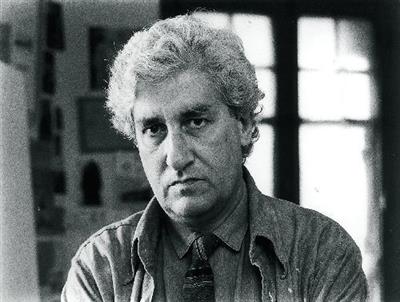
Albert Rafols-Casamada
Albert Ràfols-Casamada occupied a singular position in postwar Catalan culture: a painter who was also a significant poet, and a teacher who shaped generations of Barcelona artists without ever abandoning his own studio practice. Born in Barcelona in 1923[1], he worked through a figurative phase in the late 1940s before finding his own territory in abstraction, a poetic and restrained kind rooted in the textures of everyday life rather than the gestural drama of American Abstract Expressionism.
Biography
His early public commissions showed considerable range. In 1959[1] he designed stained glass windows for the Virgen del Camino Sanctuary in León, and in 1967 he co-founded EINA, the Barcelona art and design school he would direct for seventeen years. That dual role, practitioner and institution-builder, gave him unusual influence over the development of Catalan design culture during the Franco years and beyond.
The scale of his late works surprised critics who knew only his small canvases. The ceiling paintings for Barcelona City Hall (1982[1]) and the murals for the Palau Sant Jordi sports pavilion, completed for the 1992 Olympics, showed an artist comfortable with architecture-scale ambition. His poetry, collected across volumes including Signe d'aire (1976), ran in parallel with the painting throughout his life.
By his death in 2009[1], works had entered the Guggenheim in New York, the Centre Pompidou in Paris, and the British Museum in London. Spain awarded him the National Prize for Plastic Arts in 1980[1]; France made him a Knight of the Order of Arts and Letters in 1985.
Timeline
- 1923Born in Barcelona, Spain
- 1959Designed stained glass windows for Virgen del Camino Sanctuary in León
- 1967Co-founded EINA art and design school in Barcelona
- 1976Published 'Signe d'aire' poetry collection
- 1980Awarded the National Prize for Plastic Arts in Spain
- 1982Created ceiling paintings for Barcelona City Hall
- 1985Made a Knight of the Order of Arts and Letters in France
- 1992Completed murals for Palau Sant Jordi for Olympics
- 2009Died in 2009
Notable Works
Tap to view larger.
Next stop
Browse the movements →
Every movement in the collection, from the Renaissance to Pop art.
Related Artists



Frequently Asked Questions
What is Albert Rafols-Casamada known for?
Albert Ràfols-Casamada is known for his painting, poetry, and teaching. His public commissions included stained glass windows for the Virgen del Camino Sanctuary in León and murals for the Palau Sant Jordi sports pavilion for the 1992[1] Olympics.What is Albert Rafols-Casamada's most famous work?
It is difficult to name Albert Rafols-Casamada's single most famous work. He produced a large body of paintings, prints, and stage designs over a long career. Born in Barcelona in 1923[1], Rafols-Casamada belonged to the Catalan avant-garde. His early work engaged with surrealism and cubism. Later, he moved toward abstraction, developing a distinctive style using colour and geometric forms. He was also a noted designer of theatre sets and costumes. His set design for Mozart's opera *The Magic Flute* at the Gran Teatre del Liceu in Barcelona was particularly well received. Rafols-Casamada's work is held in many major collections, including the Museo Nacional Centro de Arte Reina Sofía in Madrid and the Museu d'Art Contemporani de Barcelona (MACBA).What should I know about Albert Rafols-Casamada's prints?
Albert Rafols-Casamada (1923[1]-2009[1]) was a Catalan artist known for his abstract paintings, stage designs, and prints. When considering his prints, it is helpful to understand some basics about printmaking. An original print is conceived as a print, executed solely as a print, and is usually part of a numbered, signed edition. Each print in the edition is an original, created from a plate, stone, screen or block made for that purpose. There is no single original from which copies are made; instead, each print is individually inked and pulled. The artist decides the number of prints in the edition, and sequential numbering accounts for the prints (e.g., 12/25 means it is print number 12 from an edition of 25). Prints began to gain importance as an artistic medium in the later part of the nineteenth century. Artists started signing their prints, differentiating original graphics, which have aesthetic value, from reproductions. A signature also confirms the print's authenticity and the artist's approval. Edition sizes were limited, and numbering began, which influences the price of each print.What style or movement did Albert Rafols-Casamada belong to?
Albert Rafols-Casamada (1923[1]-2009[1]) was a Catalan artist whose work defies easy categorisation, though he is often associated with abstract expressionism and conceptual art. His career began in the post-war period, during which he absorbed influences from the European avant-garde. Rafols-Casamada's paintings often feature geometric forms, muted colour palettes, and a focus on texture and surface. While his early work showed the influence of informalism, he moved towards a more personal and lyrical form of abstraction. Throughout his career, Rafols-Casamada explored the relationships between colour, space, and form, creating a body of work that is both visually striking and intellectually stimulating. He also worked in other media, including set design and graphic arts.What was Albert Rafols-Casamada known for?
Albert Rafols-Casamada (1923[1]-2009[1]) was a Catalan artist known for his abstract paintings and stage designs. After initially studying architecture, he shifted his focus to painting in the 1950s. His early work showed some figurative elements, but he soon moved towards abstraction. Rafols-Casamada's paintings often feature geometric shapes, subtle colours, and a sense of calm. He represented Spain at the Venice Biennale in 1978[1]. In addition to painting, Rafols-Casamada was involved in stage design, working on numerous theatre and opera productions. He also taught at the Eina School of Design and Art in Barcelona. His work can be found in major museums in Spain, including the Museu d'Art Contemporani de Barcelona.When did Albert Rafols-Casamada live and work?
Albert Rafols-Casamada was a Catalan artist who lived from 1923[1] to 2009[1]. Born in Barcelona, he initially trained in law before dedicating himself to painting. His artistic career began in the post-war period, and his work evolved through various styles. Rafols-Casamada's early paintings showed figurative elements. Later, he moved towards abstraction, developing a personal style characterised by subtle colour harmonies and geometric forms. He often incorporated architectural motifs and literary references into his compositions. Throughout his career, Rafols-Casamada exhibited extensively both in Spain and internationally. He also worked in other artistic fields, including stage design and graphic art. His contributions to Catalan art were recognised with numerous awards and honours.Where can I see Albert Rafols-Casamada's work?
It is difficult to say with certainty where specific works by Albert Rafols-Casamada are located. However, some museums with collections of modern art may hold his pieces. These include institutions such as the Museu d’Art Modern (MNAC) in Barcelona, located in Parc de la Ciutadella. Another Spanish[1] museum is the Museo Art Nouveau y Art Deco in Salamanca, on Calle Gibraltar. Other European museums include the Museu Calouste Gulbenkian, found in Lisbon, Portugal, on Av. de Berna. In Switzerland, the Kunstmuseum in Basle and the Kunsthaus in Zurich are possibilities, along with the Kunstmuseum in Winterthur. The Kunstmuseum and Gottfried Keller Stiftung, both in Berne, may also be worth investigating. These museums sometimes hold works by post-impressionist and Art Deco artists.Who influenced Albert Rafols-Casamada?
Albert Rafols-Casamada was influenced by a number of artists associated with abstraction and the Bauhaus movement. He expressed admiration for Piet Mondrian, Kazimir Malevich, and Paul Klee, but distanced himself from Klee's symbolism. Rafols-Casamada also studied the work of Josef Albers, viewing Albers' paintings at the Galerie Denise René. In Paris, Rafols-Casamada initially sought to add dynamism to Mondrian's works, but realised Mondrian had already addressed that issue in *Broadway Boogie-Woogie*. He found the approach of László Moholy-Nagy important, and also discovered Alexander Calder, Marcel Duchamp, and Naum Gabo. Rafols-Casamada aimed to build on the elements that these artists had initiated, attempting to answer the questions they had posed but not resolved.Who was Albert Rafols-Casamada?
Albert Rafols-Casamada was born in Barcelona in 1923[1]. From an early age, he showed both ability and interest in painting. Catalonian magazines provided his first contact with contemporary art; he was particularly interested in the publication *d'ao I d'alla*, directed by J. Prats and Jose Luis Sert. Rafols-Casamada enrolled at the University of Barcelona to study law in 1943[1]; however, he abandoned his legal studies in 1946 to focus solely on painting. In 1947, he befriended the poet and playwright Joan Brossa. Rafols-Casamada was a founding member of the group and magazine DAU AL SET (The Seventh Side of the Die) in Barcelona in 1948. That same year, he met Joan Miró. In 1950, he received a scholarship from the French Institute of Barcelona to go to Paris, and he visited Paris regularly thereafter. He also visited Belgium and Holland in 1951.Why are Albert Rafols-Casamada's works important today?
Albert Rafols-Casamada (1929[1]-2009[1]) was a Catalan painter, stage designer, and musician whose work contributed to the development of abstract art in Spain. His artistic approach involved a synthesis of various influences, from informalism to a personal exploration of colour and form. Rafols-Casamada's interest in reassessing cultural materials, and recasting them, connects him to other artists of his generation. Like them, he ordered and translated subjects into concrete artifacts, compiling them into anthologies of plastic signs, projecting a new image and meaning. His work can be seen as part of a broader movement in which artists sought to create autonomous cultural statements. Rafols-Casamada's understanding of innate potential allowed him to develop a personal style. His art offers a comment on the painter's means and ends, developed in relation to the artist's roots and experience. His legacy is maintained through collections and exhibitions of his work, ensuring his continued recognition.What was Albert Rafols-Casamada's art style?
Albert Ràfols-Casamada worked through a figurative phase in the late 1940s before finding his own territory in abstraction. His abstraction was poetic and restrained, rooted in the textures of everyday life rather than the gestural drama of American Abstract Expressionism.
Sources
Editorial draws on the following primary and tertiary references for Albert Rafols-Casamada.
- [1] wikipedia Wikipedia: Albert Rafols-Casamada Used for: biography, birth dates, death dates, identifiers, movement attribution, nationality.
- [2] book guggenheim-antonitapies00tp Used for: biography.
- [3] book guggenheim-beforepicassoaft00swee Used for: biography.
- [4] book guggenheim-guhe00solo Used for: biography.
Editorial overseen by Solis Prints. Sources verified 2026-10-15. Click a source for details, or hover over [N] in the page above to preview.
Editorial standardsMethodologyCorrectionsAI disclosureAbout the editorial team