



Albert Herter
- Aestheticism
The mural Albert Herter painted for the Gare de Paris-Est in 1926[1] was partly an act of grief. *Le Depart des poilus, aout 1914* commemorated the departure of French soldiers for the front, among them his own son Everit, killed in action in 1918. That one painting encapsulates what made Herter unusual: a New York artist with classical European training who remained entangled with France in ways both professional and deeply personal.
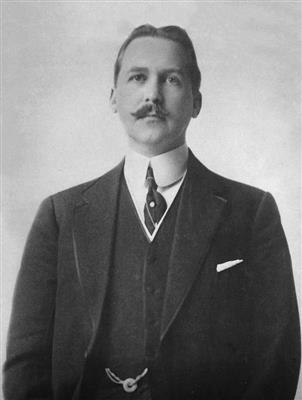
Biography
Herter trained at the Art Students League under James Carroll Beckwith before moving to Paris, where he studied at the Academie Julian under Jean-Paul Laurens and Fernand Cormon. His father's firm, Herter Brothers, had been among the most admired design practices in America; Albert brought the same breadth to his own work, moving between paintings, tapestries, murals, and interior design. The twenty-eight-panel tapestry series *The Story of New York* (1912[1]) for the McAlpin Hotel demonstrated his range, as did the four law-themed murals for the Wisconsin State Capitol Supreme Court Chamber in 1915 and the eight California history murals at the Los Angeles Public Library in 1928.
He was made a Chevalier of the French Legion of Honour in 1923[1] and elected a full Academician of the National Academy of Design in 1943. His son Christian, whose brother Everit had died in the war Herter commemorated in Paris, later served as US Secretary of State. Albert Herter died at his Santa Barbara estate in February 1950[1].
Timeline
- 1871Born Albert Herter.
- 1890Studied at the Art Students League under James Carroll Beckwith.
- 1890Studied at Academie Julian under Jean-Paul Laurens and Fernand Cormon.
- 1912Created *The Story of New York* tapestry series for the McAlpin Hotel.
- 1915Created law-themed murals for the Wisconsin State Capitol.
- 1918Son Everit killed in action during WWI.
- 1923Made a Chevalier of the French Legion of Honour.
- 1926Painted *Le Depart des poilus, aout 1914* for Gare de Paris-Est.
- 1928Created California history murals at Los Angeles Public Library.
- 1943Elected a full Academician of the National Academy of Design.
- 1950Died at his Santa Barbara estate.
Notable Works
Tap to view larger.
Next stop
Browse the movements →
Every movement in the collection, from the Renaissance to Pop art.
Related Artists



Frequently Asked Questions
What is Albert Herter's most famous work?
Albert Herter was an American[1] painter, illustrator, and designer, active in the late 19th and early 20th centuries. Although he worked across several genres, including murals and portraits, he is perhaps best known for his decorative work and designs. One of Herter's most celebrated achievements is the series of murals he created for the Waldorf-Astoria Hotel in New York City. These large-scale paintings, executed in the early 1900s, adorned the hotel's banquet halls and public spaces. They contributed significantly to the opulent atmosphere of the famous hotel. Herter's murals often depicted historical or allegorical scenes, executed in a classical style with attention to detail and colour. His work at the Waldorf-Astoria, sadly now lost, cemented his reputation as a leading decorative artist of his time. He also designed textiles and furnishings, further demonstrating his versatility.What should I know about Albert Herter's prints?
Albert Herter (1871[1]-1950[1]) was an American[1] painter, illustrator, muralist, and designer. He is known for his involvement in the American Arts and Crafts movement. Herter studied at the Art Students League in New York and later in Paris with Jean-Paul Laurens and Fernand Cormon. He travelled extensively in Europe, Asia, and the Middle East, which influenced his artistic style and subject matter. Herter's prints often reflect his interest in historical and allegorical themes. He created illustrations for books, including an edition of Omar Khayyam's *Rubaiyat*. Some of his prints are reproductions of his larger paintings or mural designs. He also designed posters and advertisements. His work can be found in several public collections. These include the Metropolitan Museum of Art in New York, the Smithsonian American Art Museum in Washington, D.C., and the Musée d'Orsay in Paris.What style or movement did Albert Herter belong to?
Albert Herter's career spanned a period of considerable stylistic change. The Aesthetic Movement, Symbolism, and Art Nouveau were all related modes of 'art for art's sake' that gained traction at the end of the 19th century. These movements were inspired, in part, by the arrival of Japanese art in Europe and America. Japanese artists disregarded illusionistic perspective, favouring close observation of nature, sensitivity to form, and integration of line, shape, and colour. This challenged the traditional European hierarchy of the arts. In Britain and America, this approach became known as the Aesthetic Movement. Aesthetes were sensitive to nuances of line and colour, aware of the qualities of different mediums, and the resonances between objects and their surroundings. The Arts and Crafts movement shared some of these concerns, but its reformers also sought to bring beauty to all classes of society through a return to simplified hand-making. Art Nouveau developed out of the ideas promoted by the Arts and Crafts movement.What techniques or materials did Albert Herter use?
Albert Herter created glass pictures using a sandblasting technique. He employed opaque glass, typically flashed glass, which consists of a milk glass body covered with a thin coating of coloured glass, often black or red. The sandblasting method is similar to tombstone carving. The glass is covered with a stencil, and the design is cut out, exposing the areas to be sandblasted. Sand, propelled at high pressure, grinds a relief into the glass. This process can create either a relief or a dulling effect on the surface, depending on the duration of the sandblasting. Herter also used glass painters' colours, which are made permanent by firing in a kiln. He acknowledged that this technique limited colour and form options, but it also provided unusual colour intensity and precision.What was Albert Herter known for?
Albert Herter's artistic practice was shaped by the aesthetic movements of the late 19th century. These movements, emerging in Britain, America, and continental Europe (Symbolism), advocated 'art for art’s sake'. This contrasted with traditional academic art, which often conveyed political or moral messages. Appreciation for art became less about narrative and more about the integration of line, form, and colour. This approach was influenced by the rise in popularity of Japanese art. After 1853, when trade routes opened, Japanese goods and aesthetics began circulating in the West, offering an alternative to classical European ideals. Japanese art emphasised close observation, sensitivity to form, and the beauty of everyday life. Appreciation of Japanese art helped dissolve the traditional hierarchy between fine and applied arts. Figures such as Walter Pater promoted the value of aesthetic engagement, viewing art and beauty as essential for inner life and meaning in a rapidly industrialising world. This aesthetic sensibility led to the creation of total environments, such as James Abbott McNeill Whistler’s Peacock Room, designed to synthesise various art forms into a complete aesthetic experience.When did Albert Herter live and work?
Albert Herter was born in New York City on 2 March 1871[1]. He came from a family that had founded the Herter Brothers decorating firm. He studied at the Art Students League in New York, then at the Atelier of Jean-Paul Laurens and Fernand Cormon in Paris. By 1893[1], he had his own studio. Herter painted murals for the Waldorf-Astoria Hotel in New York, the Los Angeles Public Library, and the Massachusetts State House. He also created designs for his family's textile department. During World War I, he was chairman of the Mayor’s Committee of Welcome to returning soldiers and sailors. He died in Santa Barbara, California, on 15 February 1950[1].Where can I see Albert Herter's work?
To view Albert Herter's work, consider visiting institutions that feature Art Deco and American[1] art. These include the Metropolitan Museum of Art (New York), the Los Angeles County Museum of Art (LACMA), and the Minneapolis Institute of Arts. You might also check the Royal Ontario Museum (Toronto), the Museum of Modern Art (New York), or the Virginia Museum of Fine Arts (Richmond). Smaller collections are held at the Charles Hosmer Morse Museum of American Art (Winter Park, Florida), and the Wolfsonian at Florida International University (Miami Beach). In the UK, you could try the Victoria & Albert Museum (London), the National Museums of Scotland (Edinburgh), or the Manchester Art Gallery. Other museums with collections of note include the Yale University Art Gallery (New Haven, CT), the Philadelphia Museum of Art, and the National Gallery of Art (Washington DC).Where was Albert Herter from?
Albert Herter was born in New York City in 1871[1]. He came from a family with artistic connections; his father, Christian Herter, was a prominent interior designer and decorator who co-founded the firm Herter Brothers. Herter received his artistic training in New York and Paris. He studied at the Art Students League in New York, then travelled to France to study with Jean-Paul Laurens and Fernand Cormon. His time in Paris exposed him to current European art movements and provided him with academic training. Although born and initially trained in the United States, Herter's later studies in France shaped his artistic style and career. He maintained connections to both countries throughout his life.Who did Albert Herter influence?
It is difficult to assess the extent of Albert Herter's influence on other artists. However, we can examine the artistic lineage of some of his contemporaries and near-contemporaries within the American[1] art world. For instance, consider the relationships between artists such as Winslow Homer, Thomas Eakins, and William Merritt Chase. Homer was, it seems, influenced by Eakins. George Bellows is considered a descendant of Chase. These connections suggest a network of influence and artistic exchange among American painters. Other American artists, such as Fuller and Morse, were influenced by the school of Munich or by British art. Some, like Benjamin West, emulated French historical painters such as Jacques-Louis David and Jean-Auguste-Dominique Ingres. Albert Pinkham Ryder's work shows a mixture of Florentine, Pre-Raphaelite, and Blake-like conceptions. These varied influences contributed to the development of an American artistic tradition.Who influenced Albert Herter?
Albert Herter's artistic development was shaped by several influences. Early on, teachers exposed him to Cubism. He studied with Rufino Tamayo in high school, and during his college years, with Paul Feeley at Bennington. During non-resident terms, he studied with Vaclav Vytlacil at the Art Students League, and he attended Wallace Harrison's drawing class in New York. These teachers were themselves influenced by Cubism. Herter learned to apply the rules of Analytic Cubism to everything he observed. By 1951, Hans Hofmann gave him a similar message, with the addition of colour. Later, Herter studied the colourists Matisse and Monet. He looked hard at their work, honouring it, and wanted to use what Monet could teach him.Who was Albert Herter?
Albert Herter was a New York artist with classical European training. He is unusual for remaining entangled with France in ways that were both professional and personal.Why are Albert Herter's works important today?
Albert Herter's creations offer insight into early 20th-century artistic and cultural values. He worked as both a painter and a designer, and his commissions included murals, stained glass, and interior design. Herter's artistic training in Paris exposed him to academic traditions, which he combined with an interest in decoration. This is seen in his work for private residences, public buildings, and the Herter Looms, a family business. These projects often involved historical or allegorical subjects, reflecting the tastes of his elite clientele. Today, Herter's work provides a view of the artistic preferences of the Gilded Age. His emphasis on craftsmanship and integration of art with architecture are of interest to those studying American[1] art and design. His creations offer a tangible connection to a specific time.
Sources
Editorial draws on the following primary and tertiary references for Albert Herter.
- [1] wikipedia Wikipedia: Albert Herter Used for: biography, birth dates, death dates, identifiers, movement attribution, nationality.
- [2] book guggenheim-futurismmodernfo00solo Used for: biography.
- [3] book guggenheim-guhe00solo Used for: biography.
- [4] book Landauer, Susan, The not-so-still life : a century of California painting and sculpture Used for: biography.
Editorial overseen by Solis Prints. Sources verified 2026-10-13. Click a source for details, or hover over [N] in the page above to preview.
Editorial standardsMethodologyCorrectionsAI disclosureAbout the editorial team