



Aladar Korosfoi-Kriesch
In 1907[1] the Nemzeti Szalon in Budapest reopened with stained-glass windows designed by Aladár Körösfői-Kriesch and executed by the glass master Miksa Róth, set into a building clad in iridescent green Zsolnay eosin tiles. The total renovation cost 115,000 korona. It was the most visible public statement of the particular modernism he had been building, piece by piece, since the turn of the century.
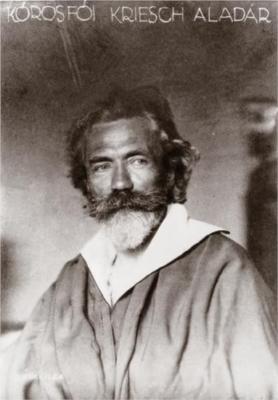
Biography
That modernism was rooted in William Morris. Körösfői-Kriesch had studied Morris's writings carefully, and together with the painter Sándor Nagy founded the Gödöllő Artists' Colony northeast of Budapest in the early 1900s: a workshop community producing tapestries, embroidery, furniture, leather goods, bookbinding, and stained glass alongside fine art. The mission was to reunite making and meaning in the face of industrial production, and to do so through a specifically Hungarian[1] visual language drawn from Transylvanian folk art rather than from Vienna or Paris.
Born in Buda in 1863[1] and trained under the fresco specialist Károly Lotz and the historical painter Bertalan Székely, Körösfői-Kriesch had the technical foundation for monumental work. His Symbolist painting style, with its flat forms, strong outline, and medievalising gravity, suited a country turning towards its own folk traditions as a counterweight to Habsburg cultural dominance. The colony exhibited collectively at the Uránia gallery from 1908[1], maintaining output across painting, textile, and applied arts until his death in 1920[1] aged 56.
Scholars of Hungarian[1] modernism distinguish his Arts and Crafts current sharply from the Nagybánya school of plein-air Impressionists who dominated the Budapest gallery scene. The Gödöllő colony is Hungary's most sustained equivalent of the Wiener Werkstätte model: the democratic ideal of art without commercial compromise, in Morris's own phrase.
Timeline
- 1863Born in Buda, Hungary
- 1900Studied under Károly Lotz and Bertalan Székely
- 1900Founded the Gödöllő Artists' Colony with Sándor Nagy
- 1907Designed stained-glass windows for Nemzeti Szalon
- 1908Gödöllő colony exhibited at the Uránia gallery
- 1920Died at age 56
Notable Works
Tap to view larger.
Next stop
Browse the movements →
Every movement in the collection, from the Renaissance to Pop art.
Related Artists

Frequently Asked Questions
What is Aladar Korosfoi-Kriesch known for?
Aladár Körösfői-Kriesch is known for his role in Hungarian[1] modernism and for co-founding the Gödöllő Artists' Colony with Sándor Nagy. The colony was a workshop community that produced tapestries, embroidery, furniture, leather goods, bookbinding, and stained glass alongside fine art.What is Aladar Korosfoi-Kriesch's most famous work?
Aladar Korosfoi-Kriesch was a Hungarian[1] artist associated with the Arts and Crafts movement. He worked in a variety of media, including painting, stained glass, and ceramics. He is known for his role in Hungarian Secession. One of Korosfoi-Kriesch's most significant achievements was his direction of the Godollo artists' colony. This group, established in 1901[1], sought to create a total work of art, integrating various artistic disciplines. The colony's output included furniture, textiles, and architectural designs. While it is difficult to single out one definitive "most famous work", his murals and stained glass designs are particularly noteworthy. Many of these were commissions for public buildings and churches in Hungary. They display a distinctive synthesis of Hungarian folk motifs and Art Nouveau aesthetics. His work on the Wekerle Estate in Budapest is an example of this synthesis. He designed multiple elements for the buildings, including sgraffito decorations. These large-scale projects contributed significantly to his recognition during his lifetime and continue to be appreciated today.What should I know about Aladar Korosfoi-Kriesch's prints?
Aladar Korosfoi-Kriesch was active at a time when interest in printmaking was growing. Several factors contributed to a boom in printmaking, especially in Germany, in the late 1910s and early 1920s. Economic instability, specifically inflation, made art a relatively sound investment. Prints were more affordable than paintings; this made them accessible to a wider range of collectors. At the same time, rising prices for materials such as canvas encouraged artists to work on paper. The years 1919[1] and 1920[1] saw a high number of new prints and portfolios, with only a slight drop in productivity for the next three years. Publishers such as Cassirer, Gurlitt, and Neumann became very productive. New firms like Propyläen, Euphorion, and Karl Nierendorf also appeared. The increased involvement of professional publishers led to more polished, commercial print production. Before this, groups such as Die Brücke and Der Blaue Reiter printed their own work, often in small numbers with inconsistent results. Publishers commissioned professional printers to produce larger, more uniform editions. Before the war, print runs of ten to forty were typical. Afterwards, editions of at least forty or fifty were common, sometimes reaching one hundred or more.What style or movement did Aladar Korosfoi-Kriesch belong to?
Aladar Korosfoi-Kriesch (born 1863[1], died 1920[1]) was a Hungarian[1] artist associated with the Sezession movement, specifically the Hungarian variant. This movement, which emerged in the late 19th century, represented a departure from academic art traditions. Sezession artists sought to create a new, modern style that reflected the spirit of their time. Korosfoi-Kriesch's work often incorporated elements of symbolism and nationalism, drawing inspiration from Hungarian folk art and mythology. His artistic output spanned various mediums, including painting, decorative arts, and book illustration. He aimed to create a unified artistic style that permeated all aspects of life, aligning with the broader goals of the Arts and Crafts movement. Korosfoi-Kriesch's involvement in the design of furniture, textiles, and stained glass demonstrates this holistic approach to art.What techniques or materials did Aladar Korosfoi-Kriesch use?
Aladar Korosfoi-Kriesch developed a new type of glass picture using opaque glass, which allowed the work to be hung on a wall, or mounted into a wall, indoors or outdoors. His technique involved sandblasting flashed glass; this material usually featured a milk-glass body covered with a thin coating of another colour, often black or red. Sandblasting was applied much like tombstone carvers engrave names. The glass was covered with prepared stencil paper, with the design cut out. Sandblasting ground a relief into the uncovered areas. A short sandblasting treatment could also dull the glossy surface, creating a frosted effect. This method could produce a dull dark grey on a shiny deep black, requiring a second stencil cut and sandblasting. In addition to sandblasting, glass-painter's colours could be applied and made permanent in a kiln.What was Aladar Korosfoi-Kriesch known for?
Aladar Korosfoi-Kriesch (born 1863[1], died 1920[1]) was an Austrian artist who spent most of his youth in Vienna. He entered the Kunstgewerbeschule in either 1904[1] or 1905. While a student, he painted fans and postcards for the Wiener Werkstatte, which published his first book of poetry in 1908. That same year, Korosfoi-Kriesch was fiercely criticised for the works he exhibited in the Vienna Kunstschau and consequently was dismissed from the Kunstgewerbeschule. At this time he attracted the attention of the architect Adolf Loos, who became his most vigorous supporter. In this early period Korosfoi-Kriesch wrote plays that are considered among the first examples of expressionist drama. His first one-man show was held at Paul Cassirer's gallery in Berlin in 1910, followed later that year by another at the Museum Folkwang in Essen. In 1910 he also began to contribute to Herwarth Walden's periodical Der Sturm. Korosfoi-Kriesch concentrated on portraiture, dividing his time between Berlin and Vienna from 1910 to 1914.When did Aladar Korosfoi-Kriesch live and work?
Aladar Korosfoi-Kriesch was born on 3 January 1863[1] in Budapest. He died on 16 June 1920[1] in Budapest. He was a Hungarian[1] painter, graphic artist, and designer associated with the Arts and Crafts movement. He is known for his varied artistic activities, including painting, printmaking, and applied arts. During his career, Korosfoi-Kriesch engaged with a number of artistic styles, from symbolism to art nouveau. He also took inspiration from Hungarian folk art. Like many artists of his generation, he travelled widely in Europe. He studied in Vienna and Munich, and he visited Paris in 1890[1]. He was interested in the work of the Vienna Secession artists, such as Gustav Klimt (born 1862, died 1918), and exhibited with them.Where can I see Aladar Korosfoi-Kriesch's work?
While specific locations holding works by Aladar Korosfoi-Kriesch are not widely published, several museums with collections of related art styles may hold his pieces. In the United States, you might check the Charles Hosmer Morse Museum of American Art (Winter Park, Florida), the Los Angeles County Museum of Art (Los Angeles), the Metropolitan Museum of Art (New York), the Minneapolis Institute of Arts, the Museum of Modern Art (New York), the Royal Ontario Museum (Toronto), the Virginia Museum of Fine Arts (Richmond), and the Wolfsonian at Florida International University (Miami Beach). In the United Kingdom, consider the Bakelite Museum (Williton), the Brighton Museum & Art Gallery (Brighton), the Geffrye Museum (London), the Manchester Art Gallery, the National Museums of Scotland Royal Museum (Edinburgh), and the Victoria & Albert Museum (London). Additionally, museums with Bauhaus collections sometimes include works by associated artists. These include the Bauhaus-Archiv Museum für Gestaltung (Berlin), the Stiftung Bauhaus Dessau, the Stiftung Meisterhäuser Dessau, the Klassik Stiftung Weimar/Bauhaus-Museum (Weimar), the Zentrum Paul Klee Bern, the Busch-Reisinger Museum (Cambridge, Massachusetts), the Josef and Anni Albers Foundation (Bethany, Connecticut), the Moholy-Nagy Foundation (Ann Arbor, Michigan), the Utsunomiya Museum of Art, and the Misawa Bauhaus Collection (Tokio).Where was Aladar Korosfoi-Kriesch from?
Aladar Korosfoi-Kriesch's biography is not well documented. What is known is that he was Hungarian[1]. Evidence for this comes from the number of Hungarian artists who, like him, supported the short-lived Hungarian Soviet Republic established by Béla Kun. When Kun's government was overthrown, many artists went into exile in Vienna. There, they associated with the international avant-garde, as publicised by the journal *Ma*. This journal was edited first in Budapest, then in Vienna, by Lajos Kassák. Kassák considered Dada to be the 'tragic scream of our entire social existence'. His statement suggests that the political disappointment of the Hungarian revolution gave his group an outlook comparable to that of the Berlin Dadaists a few years earlier.Who did Aladar Korosfoi-Kriesch influence?
Aladar Korosfoi-Kriesch's artistic milieu was that of late-19th and early-20th century Hungary, a place where Impressionism had a delayed and complex reception. The Nagybánya Group, founded in 1896[1], paralleled France’s earlier Barbizon School by painting outdoors. However, the Nagybánya Group did not fully embrace Impressionist fundamentals such as spontaneity. Instead, they moved towards an Art Nouveau aesthetic, and then to post-impressionist forms. By 1910, many Hungarian[1] artists and critics rejected Impressionism in favour of modernist neoclassicism and abstraction. Georg Lukács, a champion of The Group of Eight, promoted what he termed an 'architectonic' art. Lukács attacked Impressionism for turning everything 'into decorative surface'. He favoured instead a disciplined art of structure and order. Despite this critical opposition, Impressionism gained commercial traction, with dealers marketing new canvases and reclassifying older works.Who influenced Aladar Korosfoi-Kriesch?
Aladar Korosfoi-Kriesch (1863[1]-1920[1]) was a Hungarian[1] artist associated with the Arts and Crafts movement. His artistic development involved several influences, most notably the Pre-Raphaelites and the Nazarenes. The Nazarenes, a group of early 19th-century German Romantic painters who aimed to revive religious art, impacted Korosfoi-Kriesch's approach to spiritual and historical subjects. Their emphasis on clarity, symbolism, and moralising narratives resonated with his own artistic inclinations. The Pre-Raphaelites, with their attention to detail, medievalising interests, and literary themes, also played a role in shaping Korosfoi-Kriesch's aesthetic. He shared their interest in Arthurian legends, folklore, and the natural world. Like the Pre-Raphaelites, Korosfoi-Kriesch integrated literary and mythological themes into his work. Beyond these movements, it is likely that Korosfoi-Kriesch absorbed elements from other contemporary artistic trends. His synthesis of various sources contributed to his unique style within the broader European Arts and Crafts context.Who was Aladar Korosfoi-Kriesch?
Aladar Korosfoi-Kriesch (1863[1]-1920[1]) was a Hungarian[1] artist. He was involved with the Magyar Impresszionisták és Naturalisták Köre (M.I.É.N.K.), or Circle of Hungarian Impressionists and Naturalists. In 1909[1], Korosfoi-Kriesch, along with others such as Szinyei-Merse, Iványi-Grünwald and Vaszary, was expelled from the M.I.É.N.K. following a contentious general assembly in 1907. This occurred as the more traditional members consolidated control over the institution. The director, Lajos Ernst, was also removed at this time. Korosfoi-Kriesch's expulsion, along with that of the others, caused outrage. Ernő Kammerer, director of the Fine Arts Museum, and Gábor Térey, its managing director, immediately resigned their memberships in response. Rózsa led a delegation to Count Gyula Andrássy, requesting he also renounce his position.
Sources
Editorial draws on the following primary and tertiary references for Aladar Korosfoi-Kriesch.
- [1] wikipedia Wikipedia: Aladar Korosfoi-Kriesch Used for: biography, birth dates, death dates, identifiers, movement attribution, nationality.
- [2] book Husslein-Arco, Agnes, editor; Koja, Stephan, editor; Law, Rebecca (Translator), translator; McInnes, Robert (Translator), translator; Somers, Nick, translator; Monet, Claude, 1840-1926. Paintings. Selections; Österreichische Galerie Belvedere, h Used for: biography.
- [3] book Masterpieces of western art : a history of art in 900 individual studies from the Gothic to the present day Used for: biography.
Editorial overseen by Solis Prints. Sources verified 2026-08-26. Click a source for details, or hover over [N] in the page above to preview.
Editorial standardsMethodologyCorrectionsAI disclosureAbout the editorial team