



Berény Róbert
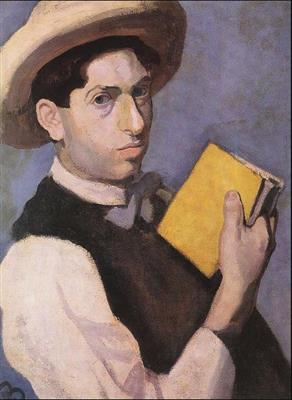
One of the most internationally orientated members of A Nyolcak (The Eight), Berény Róbert studied under Tivadar Zemplényi before leaving Budapest for Paris and the Académie Julian, where he absorbed Cézanne's structural discipline and the colour experiments of the Fauves. He exhibited at the Salon d'Automne alongside the French avant-garde, bringing those influences back to a Hungarian[1] art world still dominated by academic convention.
Biography
The Eight's founding exhibition, "New Pictures" at the Könyves Kálmán Szalon in December 1909[1], marked a rupture with that tradition. Berény was among the core exhibitors alongside Dezső Czigány and Károly Kernstok, and the group's confrontational approach to form and colour earned them both notoriety and lasting significance in Central European modernism. His 1913 portrait of composer Béla Bartók stands among his most admired works, capturing the subject with an expressionist directness that prefigures his later career interests.
Politics interrupted that career sharply. After serving in the Art Directorate of the short-lived Hungarian[1] Democratic Republic in 1919[1], Berény fled the country following its collapse, spending seven years in Berlin before returning. His atelier was destroyed during the Second World War, taking an unknown quantity of work with it.
What survived includes "Sleeping Lady with Black Vase", a canvas that disappeared for decades before turning up as a prop in the 1999 Hollywood film Stuart Little. Recognised and repatriated, it sold for €229,500 at a Budapest auction in 2014: an unlikely postscript to a turbulent artistic life. He was awarded the Szinnyei Prize in 1936[1] and spent his final years teaching at the Hungarian[1] University of Fine Arts.
Timeline
- 1887Born in Hungary; he later became a member of The Eight.
- 1909Exhibited in "New Pictures", the founding exhibition of The Eight, at the Könyves Kálmán Szalon with Dezső Czigány and Károly Kernstok.
- 1913Painted a portrait of composer Béla Bartók.
- 1919Served in the Art Directorate of the Hungarian Democratic Republic.
- 1919Fled Hungary after the collapse of the Hungarian Democratic Republic.
- 1936Awarded the Szinnyei Prize.
Notable Works
Tap to view larger.
Next stop
Expressionism →
Explore the artists and ideas of Expressionism.
Related Artists


Frequently Asked Questions
What is Berény Róbert known for?
Berény Róbert is known for being one of the most internationally orientated members of the group, The Eight. His 1913[1] portrait of composer Béla Bartók is among his most admired works.What is Berény Róbert's most famous work?
Berény Róbert is best known for his painting *Sleeping Lady with Black Vase*. The work gained considerable attention when it was rediscovered and sold at auction for a high price in 2005. Berény, born in Budapest in 1887[1], was a significant figure in the Hungarian[1] avant-garde movement. He was a founding member of the Group of Eight, a collective of artists who introduced cubist and expressionist styles to Hungary. His artistic output included portraits, nudes, and abstract compositions. He also designed posters and stage sets. *Sleeping Lady with Black Vase* is considered one of his most important works, representing a fusion of modern styles with a distinctive Hungarian sensibility. Berény's other notable works include *Self-Portrait* (1913[1]) and *Portrait of Lajos Kassák* (1927). He taught at the Academy of Fine Arts in Budapest from 1945 until his death in 1953[1].What style or movement did Berény Róbert belong to?
Berény Róbert (1887[1]-1953[1]) was associated with several early twentieth-century avant-garde movements. These included Fauvism, Expressionism[1], and Cubism. These movements arose in the early 1900s, following on from the work of Post-Impressionist artists such as Vincent van Gogh and Paul Gauguin. Fauvism, which emerged around 1905[1] in France, was characterised by its bold use of colour and simplified design. The Fauves, or 'wild beasts' as they were labelled by a critic, used unrealistic colours and broad brushstrokes to create a decorative and expressive effect. Henri Matisse led this group. Expressionism, which developed in Germany, also used colour emphatically, but aimed to convey inner emotions and subjective experiences. Die Brücke (The Bridge), a prominent Expressionist group active from 1905 to 1913, explored themes of alienation and social fragmentation through emotion-charged images and simplified forms. Cubism, originating around 1907, involved the interplay of abstract forms and recognisable images.What was Berény Róbert known for?
Berény Róbert (1887[1]-1953[1]) was a Hungarian[1] painter associated with several early twentieth-century avant-garde movements. Around 1905[1], new art movements began to appear in Europe, marking a departure from the established academies. One such movement, Fauvism[1], emerged in France. The Fauves, including Henri Matisse, used bright colours and simple designs. Critics called them "Wild Beasts" because their paintings were unrealistic and free. The Fauves built upon the ideas of Vincent van Gogh and Paul Gauguin, using colour in a more daring way. They also employed broad shapes and lively lines. Later, Cubism gained prominence. Cubism balanced abstract forms with recognisable images. Artists such as Picasso and Braque explored new possibilities within the style. Later Cubists, like Gleizes and Metzinger, moved towards a more systematic approach. Other artists, including Delaunay and Kupka, shifted away from Cubism's static phase. They chose to emphasise movement through graphic techniques and the kinetic potential of colour.When did Berény Róbert live and work?
Berény Róbert (1887[1]-1953[1]) was a Hungarian[1] painter and graphic artist. He was a member of The Eight, an avant-garde group that brought cubist and expressionist ideas to Hungarian art. Berény was born in Budapest. He studied at the Académie Julian in Paris from 1905[1] to 1907. His early work shows the influence of French post-impressionism. After his time in Paris, Berény returned to Hungary. There, he became a central figure in the development of modern art. The Eight, active from 1909 to 1918, included artists such as Károly Kernstok and Lajos Tihanyi. Berény's posters and paintings from this period often addressed social and political issues. He also experimented with abstract forms. Following the First World War and the collapse of the Hungarian Soviet Republic in 1919, Berény emigrated to Berlin. He worked as a graphic designer and painter. He returned to Budapest in 1926, where he continued to paint, teach, and exhibit his work until his death. His later work moved towards a more representational style, including portraits and figure studies.Where was Berény Róbert from?
Berény Róbert was a Hungarian[1] painter and graphic artist. He was born in Budapest in 1887[1]. Budapest was then part of the Austro-Hungarian Empire. He died there in 1953[1]. Berény is associated with the group of Hungarian painters called "The Eight" (A Nyolcak). This was an avant-garde movement at the beginning of the 20th century. Other members included Czóbel Béla, Kernstok Károly, and Tihanyi Lajos. They were inspired by French Post-Impressionism and Fauvism[1]. Berény studied art in Budapest. He also studied in Paris at the Académie Julian. Later, he travelled extensively in Europe. He returned to Hungary and became an important figure in its artistic community. He taught at the Hungarian University of Fine Arts from 1945[1]. His work includes portraits, posters, and paintings.Who did Berény Róbert influence?
It is difficult to say precisely who Berény Róbert influenced. However, considering the artistic environment of the late 19th and early 20th centuries, some context can be provided. The "Munich Realism" movement, with its emphasis on colour and light, gained traction. This movement looked to earlier Dutch masters such as Hals and Rembrandt. These artists offered a fresh direction through their techniques. The Polish artist Stanisław Lentz, educated in Munich and Paris, was called the "Polish Hals" by critics. Lentz studied Old Masters during travels to Holland between 1905[1] and 1914. He adopted an energetic brushstroke and a monochromatic palette from them. Hals's influence is apparent in Lentz's paint application, colour choices, accessories, gestures, and poses in his portraits and genre scenes.Who was Berény Róbert?
Róbert Berény (1887[1]-1953[1]) was a Hungarian[1] painter associated with the avant-garde group The Eight. He was born in Budapest, and he studied art there before travelling to Paris. Berény's time in Paris exposed him to new artistic currents. He developed a style influenced by cubism and expressionism. These interests aligned him with The Eight, who sought to introduce modernism to Hungarian art. His work from this period included portraits and nudes, often with a strong sense of colour and form. After the First World War, Berény taught in Budapest. He continued to paint, but also worked as a graphic designer and stage designer. His work moved away from his earlier avant-garde style. Berény died in Budapest in 1953[1].Why are Berény Róbert's works important today?
It is difficult to say why Berény Róbert's works are important today. Some observers believe that the value of modern art is connected less to artistic achievement and more to social conflict. They argue that the art world has become an international society, where innovation and scandal are more important than draughtsmanship, colour, or form. Others might say that geographical distance has replaced validation by time, and globalization has changed the art world. This viewpoint suggests that no country can claim greater artistic importance than any other, and it is all a matter of individual talent. However, some maintain that a hierarchy of countries still exists. When analysing the hangings of permanent collections in major international institutions, a high proportion of national artists is evident, with American, German, British, French and Italian artists predominating.What was Berény Róbert's art style?
Berény Róbert absorbed Cézanne's structural discipline and the colour experiments of the Fauves in Paris. His portrait of Béla Bartók shows an expressionist directness.How did Berény Róbert die?
Berény Róbert died in 1953[1] at the age of 66.
Sources
Editorial draws on the following primary and tertiary references for Berény Róbert.
- [1] wikipedia Wikipedia: Berény Róbert Used for: biography, birth dates, death dates, identifiers, movement attribution, nationality.
- [2] book guggenheim-artoftomorrowfif1939gugg Used for: biography.
- [3] book guggenheim-berriarei00bilb Used for: biography.
- [4] book Masterpieces of western art : a history of art in 900 individual studies from the Gothic to the present day Used for: biography, stylistic analysis.
- [5] book Post-impressionism : cross-currents in European painting Used for: biography, stylistic analysis.
- [6] book Post-impressionism : cross-currents in European painting Used for: stylistic analysis.
Editorial overseen by Solis Prints. Sources verified 2026-09-30. Click a source for details, or hover over [N] in the page above to preview.
Editorial standardsMethodologyCorrectionsAI disclosureAbout the editorial team