

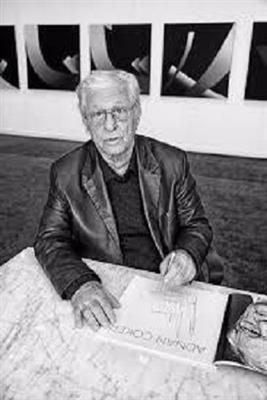
Adnan Coker
Between 1961[1] and 1966, Adnan Coker performed live painting demonstrations synchronised with music in Istanbul, making him an early practitioner of what later generations would call multimedia art. The gesture was consistent with a career spent testing the limits of Turkish[1] abstraction while staying closely engaged with the European avant-garde.
Biography
Born in Istanbul in 1927[1], Coker graduated from the Academy of Fine Arts there in 1951[1] before studying in Paris on a Turkish[1] state scholarship, working in the studios of André Lhote and Henri Goetz, and at Stanley William Hayter's celebrated Atelier 17. He also trained at the Emilio Vedova Studio during a summer academy in Salzburg. This combination of Parisian and European workshop training shaped an abstract practice that remained formally rigorous throughout his long career.
He won the European Concours Prize in 1955[1] and returned to Turkey to teach at the İstasyon Academy of Fine Arts, where he remained on the faculty from 1960 to 1995. Over more than three decades, he held over twenty solo exhibitions and participated in as many group shows, accumulating eight national and two international awards.
Coker died in Istanbul in 2022[1] at the age of ninety-four, one of the significant figures in Turkish[1] abstract painting, part of a generation that absorbed mid-century European modernism and built a local visual language from it.
Timeline
- 1927Born in Istanbul, Turkey
- 1951Graduated from the Academy of Fine Arts in Istanbul
- 1955Won the European Concours Prize
- 1960Began teaching at the İstasyon Academy of Fine Arts
- 1961Began live painting demonstrations with music in Istanbul
- 1995Left faculty at İstasyon Academy of Fine Arts
- 2022Died in Istanbul, Turkey
Notable Works
Tap to view larger.
Next stop
Browse the movements →
Every movement in the collection, from the Renaissance to Pop art.
Related Artists


Frequently Asked Questions
What is Adnan Coker known for?
What is Adnan Coker's most famous work?
It is difficult to identify Adnan Coker's single "most famous" work, as different sources focus on separate periods and themes in his career. Without a consensus, it is more accurate to discuss recurring motifs and periods. Coker's art often explores the human figure, sometimes in isolation and sometimes in groups. He engaged with themes of urban life, mythology, and personal experience. His style moved through phases of abstraction and figuration, often characterised by bold lines and a strong sense of form. His work also includes still lifes. To identify a "most famous" work would require a more comprehensive analysis of his reception and recognition across different periods of his career.What style or movement did Adnan Coker belong to?
Adnan Coker (1927[1]-1991[1]) was a Turkish[1] abstract painter. He is associated with Turkish modern art, specifically the development of abstract expressionism in Turkey during the mid-20th century. After studying in Paris during the 1950s, Coker moved away from earlier figurative work. He began to develop a non-objective style. This approach involved gestural brushstrokes and a focus on the materiality of paint. His paintings often feature dynamic compositions and a restricted colour palette, typically emphasising blacks, whites, and greys. Coker's art moved away from strict representation. Instead, it prioritised the expressive potential of form and colour. He was part of a generation of Turkish artists who sought to integrate international artistic trends with their own cultural backgrounds. His work contributed to the growth of a modern artistic vocabulary in Turkey, distinct from both traditional art forms and direct imitation of Western styles. Although linked to abstract expressionism, Coker's paintings possess individual characteristics that set him apart.What was Adnan Coker known for?
Adnan Coker (1927[1]-1991[1]) was a Turkish[1] abstract expressionist painter. He is known for his gestural style and use of impasto, often working on a large scale. Coker studied at the Académie de la Grande Chaumière in Paris during the 1950s. He then returned to Turkey, becoming a significant figure in the Turkish art scene. His early works show the influence of European modernism, particularly the art informel movement. This is evident in his textured surfaces and non-representational forms. Throughout his career, Coker explored themes of urban life and social commentary. He frequently incorporated calligraphic elements into his compositions, blending Western and Eastern artistic traditions. His paintings often feature bold colours and dynamic brushstrokes, creating a sense of movement and energy. Coker's work has been exhibited internationally, and he is considered one of Turkey's most important modern artists. He received several awards and accolades during his lifetime, solidifying his place in art history.When did Adnan Coker live and work?
Adnan Coker (1927[1]-1991[1]) was a Turkish[1] artist known for his abstract paintings and prints. He was born in Istanbul. Coker studied at the Academy of Fine Arts in Istanbul, graduating in 1951. He then moved to Paris in 1955, where he lived for many years. Paris was a centre for artistic innovation at the time, and Coker was exposed to various modern movements. He developed his own distinctive style, characterised by bold colours and dynamic compositions. Coker's work often explored themes of urban life, nature, and the human condition. He exhibited widely in Europe and Turkey. His paintings are held in numerous public and private collections. Later in his life, Coker returned to Turkey. He continued to paint and exhibit there until his death in 1991. His work continues to be celebrated for its energy and originality.Where can I see Adnan Coker's work?
Adnan Coker's artwork can be viewed in several public collections. These include the British Museum, the Victoria and Albert Museum, and the Whitworth Art Gallery (University of Manchester). Coker's paintings and prints are also held by institutions in Turkey. Examples include the Istanbul Modern, the Yapi Kredi Collection, and the collection of the Turkish[1] Central Bank. Commercial galleries sometimes hold exhibitions of Coker's work, so checking gallery listings in London and Istanbul may be useful. Auction houses occasionally offer his pieces as well. These sales are another avenue for viewing, and potentially acquiring, Coker's art. Major auction houses such as Sotheby's and Christie's have handled his works in the past.Where was Adnan Coker from?
Adnan Coker was a Turkish[1] artist, born in Istanbul in 1927[1]. He spent much of his career in France. Coker studied at the Academy of Fine Arts in Istanbul. He then moved to Paris in 1955[1], where he lived for many years. Paris was a centre for artistic innovation after the Second World War, attracting artists from around the world. Coker's time there exposed him to various modern movements. Although based in Paris, Coker maintained strong links with Turkey. He exhibited regularly in Istanbul and Ankara. He also taught at the Academy of Fine Arts in Istanbul during the 1960s. This back-and-forth between France and Turkey informed his artistic output. He synthesised European modernism with Turkish cultural elements. Coker died in Paris in 1991. He is remembered as a significant figure in Turkish modern art. His work continues to be exhibited in Turkey and internationally.What was Adnan Coker's art style?
Adnan Coker's art style was abstract, shaped by his training in Parisian and European workshops. His abstract practice remained formally rigorous throughout his career.When was Adnan Coker born?
Adnan Coker was born in 1927[1].
Sources
Editorial draws on the following primary and tertiary references for Adnan Coker.
- [1] wikipedia Wikipedia: Adnan Coker Used for: biography, birth dates, death dates, identifiers, movement attribution, nationality.
- [2] book guggenheim-amsterdamparisdu00solo Used for: biography.
- [3] book guggenheim-guggenheimintern1964allo Used for: biography.
- [4] book guggenheim-refigur00kren Used for: biography.
Editorial overseen by Solis Prints. Sources verified 2026-09-30. Click a source for details, or hover over [N] in the page above to preview.
Editorial standardsMethodologyCorrectionsAI disclosureAbout the editorial team