



Aaron Siskind
Aaron Siskind came to photography as a social documentarian in the 1930s, shooting tenement life in Harlem for the Feature Group of the Photo League. By the late 1940s he had abandoned documentation entirely. He began photographing peeling paint, torn posters, weathered walls, and fragments of signage, presenting the resulting images as flat, self-contained objects rather than windows onto the world. His stated aim was to produce photographs that were above all orderly: new objects complete in themselves, distinct from the flux of lived experience.
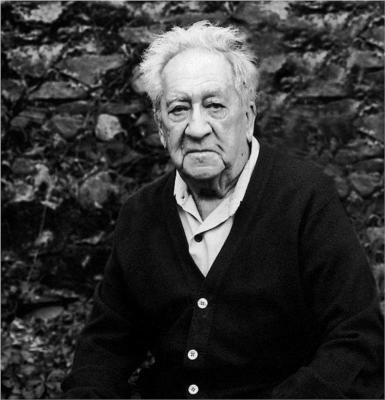
Biography
His shift in direction coincided with his move to Chicago in 1951[1], where he joined the faculty of the Illinois Institute of Technology's Institute of Design. The images he made around that transition were exhibited at the Charles Egan Gallery alongside de Kooning, Franz Kline, Joseph Cornell, and Philip Guston. Abstract Expressionist critics who rarely wrote about photography, including Harold Rosenberg, Elaine de Kooning, and Thomas Hess, took his work seriously.
Harold Rosenberg's 1953[1] essay Evidences remains the sharpest account of Siskind's position. Rosenberg argued that the photographs were inseparable from painting yet had nothing to do with art photography's bid for institutional respectability. They were not simulating painting; they were discovering in the physical world images that painting had only recently learned to see. One documented work from this period is Chicago 30, 1949 (1950), a gelatin silver print measuring 13 13/16 x 17 5/8 inches.
He spent the last two decades of his career at the Rhode Island School of Design. He died in 1991[1], aged 87.
Timeline
- 1903Born in 1903.
- 1930Began photographing tenement life in Harlem for the Photo League.
- 1940Abandoned documentary photography.
- 1949Created 'Chicago 30'.
- 1950Exhibited at Charles Egan Gallery with de Kooning, Kline, Cornell, Guston.
- 1951Moved to Chicago, joined Illinois Institute of Technology faculty.
- 1953Harold Rosenberg's essay 'Evidences' was published.
- 1991Died at age 87.
Notable Works
Tap to view larger.
Next stop
Browse the movements →
Every movement in the collection, from the Renaissance to Pop art.
Related Artists




Frequently Asked Questions
What is Aaron Siskind known for?
Aaron Siskind is known for his photography that shifted from social documentation to abstract images of everyday surfaces. His work was exhibited alongside Abstract Expressionist painters and was taken seriously by art critics such as Harold Rosenberg.What is Aaron Siskind's most famous work?
It is difficult to name one single work as Aaron Siskind's "most famous". He produced a large body of photographs, and his reputation rests on several series made over decades. Siskind began as a social documentary photographer in the 1930s, working with the New York Photo League. His series Harlem Document (1932[1]-1940[1]) is an important example of this early work. Around 1940, Siskind's style shifted towards abstraction. He began making close-up photographs of details such as peeling paint, graffiti, and torn posters on walls. These photographs, often devoid of context, transform the surfaces into abstract compositions. Siskind continued to explore this style in series such as Pleasures and Terrors of Levitation (1954-1961) and Homage to Franz Kline (1970s). These later works further detached the image from its source, emphasising form and texture.What should I know about Aaron Siskind's prints?
Aaron Siskind (1903[1]-1991[1]) was an American[1] photographer whose work found an audience among Abstract Expressionist painters, even before photography was widely accepted in galleries. He was associated with the Charles Egan Gallery, where artists such as de Kooning, Joseph Cornell, Franz Kline, and Philip Guston also exhibited. Siskind's photography often captured weathered surfaces and signage. He transformed these everyday scenes into abstract compositions. Critics such as Elaine de Kooning, Harold Rosenberg, and Thomas Hess, more accustomed to writing about painting, responded favourably to his approach. Siskind aimed to create photographs that were self-contained objects, defined by order, distinct from the changing and disordered world. The Center for Creative Photography holds a significant collection of Siskind's work, including over 870 fine prints. The Aaron Siskind Archive contains his personal papers, photographs, audiovisual materials, and memorabilia from approximately 1925[1] to 1991. These materials offer insight into his career, correspondence, and involvement with organisations such as the Photo League.What style or movement did Aaron Siskind belong to?
Aaron Siskind (1903[1]-1991[1]) was an American[1] photographer whose work has connections with both Abstract Expressionism and Surrealism. Although Siskind began his career as a documentary photographer in New York in the 1930s, he became more interested in photography as a visual language, one that could express metaphors and dreams. Siskind's approach has sometimes perplexed critics, who have interpreted his photographs as the work of an Abstract Expressionist painter, rather than examining his particular photographic style. Siskind found inspiration and encouragement from the Abstract Expressionist community in New York in the 1940s. However, it is somewhat limiting to view his pictures as simple abstractions of real-world objects. Siskind's main interest was not abstraction; he wanted to find a poetic language that could connect experience and memory, sight and surprise. He wanted to connect ordinary objects with unknown symbols. His work was exhibited at the Charles Egan Gallery, where Abstract Expressionist painters such as de Kooning, Joseph Cornell, Franz Kline, and Philip Guston were represented.What techniques or materials did Aaron Siskind use?
Aaron Siskind, born in 1903[1], began using a camera in the early 1930s. Initially, he worked as a documentary photographer in New York City. He joined the Film and Photo League in 1932[1], attending lectures and discussions. Siskind's photography moved towards abstraction. His work often featured weathered surfaces and signage, finding an abstract play of forms in everyday scenes. These images resonated with Abstract Expressionist painters. Siskind aimed to create photographs that were new objects, complete and self-contained. He saw photography as a visual language capable of conveying metaphors and symbols. He drew inspiration from writers such as Marcel Proust, James Joyce, T. S. Eliot, and William Blake. In 1954, Siskind produced *Terrors and Pleasures of Levitation*, a series inspired by divers in Lake Michigan. He captured their bodies in mid-air, exploring themes of freedom and lightness. Siskind explored genres from architectural photography to still life, from social documentary to abstraction.When did Aaron Siskind live and work?
Aaron Siskind was born on 4 December 1903[1] in New York City, and he died on 8 February 1991[1] in Providence, Rhode Island. Siskind's photography gained recognition long before photography was commonly exhibited in galleries. Abstract Expressionist painters valued his work, and he regularly exhibited at the Charles Egan Gallery; other artists represented there included de Kooning, Joseph Cornell, Franz Kline, and Philip Guston. Siskind often photographed weathered surfaces and signage. He found an abstract play of forms in these everyday subjects. Critics, including Elaine de Kooning, Harold Rosenberg, and Thomas Hess, responded positively to this aspect of his work. The Aaron Siskind Archive, which contains the artist's papers, photographic materials, and memorabilia from around 1925[1] to 1991, is available for research. It includes correspondence with other photographers, curators, and writers, as well as drafts of writings, exhibition files, and materials related to the Photo League. The Collection of Aaron Siskind includes 870 fine prints.Where can I see Aaron Siskind's work?
You can view Aaron Siskind's photography in several prominent collections. In New York City, visit the Metropolitan Museum of Art, the Museum of Modern Art, the Solomon R. Guggenheim Museum, or the Whitney Museum of American[1] Art. Other locations include the Yale University Art Gallery in New Haven, the Philadelphia Museum of Art, and the Carnegie Museum of Art in Pittsburgh. You can also find his work at the National Gallery of Art and the National Museum of American Art in Washington, DC. These museums offer opportunities to study Siskind's contributions to photography, particularly his abstract expressionist style. Each institution provides a unique context for appreciating his work, alongside other significant artists and movements.Where was Aaron Siskind from?
Aaron Siskind (1903[1]-1991[1]) was an American[1] photographer whose work gained recognition from Abstract Expressionist painters. His photographs were regularly exhibited at the Charles Egan Gallery, alongside artists such as de Kooning, Joseph Cornell, Franz Kline, and Philip Guston. Siskind's photography often captured weather-worn surfaces and signage. These ordinary scenes became abstract compositions in his work. Critics such as Elaine de Kooning, Harold Rosenberg, and Thomas Hess responded to this abstract quality. Beyond his work as a photographer, Siskind also contributed to the field through education. In 1951[1], he began teaching at the Chicago Institute of Design, where he and Harry Callahan developed the first master's degree programme in photography. That same year, he taught at Black Mountain College. Later, in 1971, he joined the Department of Photography at the Rhode Island School of Design. He was also involved with the Society for Photographic Education, helping to establish photography as a subject for discussion and education. His teaching and his belief in photography as a means of self-discovery have made him an important figure in American photography.Who did Aaron Siskind influence?
Aaron Siskind (1903[1]-1991[1]) had an impact as both a photographer and an educator. In autumn 1951[1], he began teaching at the Chicago Institute of Design, where he and Harry Callahan established the core curriculum for the first master's degree in photography. That same year, Siskind also taught photography at Black Mountain College. Later, in 1971, he joined the Department of Photography at the Rhode Island School of Design. Siskind was also active in the early years of the Society for Photographic Education, helping to establish photography as a field for discussion and implementing educational activities. His photography, which often focused on weathered surfaces and signage, found an audience among Abstract Expressionist painters. His work was exhibited at the Charles Egan Gallery, where artists such as de Kooning, Joseph Cornell, Franz Kline, and Philip Guston were also represented. Critics such as Elaine de Kooning, Harold Rosenberg, and Thomas Hess responded to the abstract qualities Siskind found in everyday scenes.Who influenced Aaron Siskind?
Aaron Siskind (1903[1]-1991[1]) found an audience among Abstract Expressionist painters, and his photographs were regularly exhibited at the Charles Egan Gallery. This gallery also represented artists such as de Kooning, Joseph Cornell, Franz Kline, and Philip Guston; critics such as Elaine de Kooning, Harold Rosenberg, and Thomas Hess also responded to his work. Siskind's photography often captured weathered surfaces and signage. He found abstract forms in everyday scenes. In his own words, Siskind aimed to create photographs that were "altogether new object[s], complete and self-contained". Siskind also influenced other photographers through his teaching. In 1951[1], he began teaching at the Chicago Institute of Design, where he and Harry Callahan developed the master's degree photography curriculum. Siskind also taught at Black Mountain College in 1951, and in 1971, he joined the Department of Photography at the Rhode Island School of Design. He participated in the Society for Photographic Education and promoted photography as a means of self-knowledge.Who was Aaron Siskind?
Aaron Siskind (1903[1]-1991[1]) was an American[1] photographer whose work gained recognition from Abstract Expressionist painters. His photographs were exhibited at the Charles Egan Gallery, where artists such as de Kooning, Joseph Cornell, Franz Kline, and Philip Guston also showed their work. Siskind began using a camera in the early 1930s in New York City. Initially, he worked as a documentary photographer. He was interested in photography as a visual language able to convey metaphors and symbols. His approach has sometimes puzzled critics, who have interpreted his photographs as abstract expressionist paintings, without looking at the photographic language. Siskind found inspiration and encouragement from the Abstract Expressionist community in New York in the 1940s. His main concern was not abstraction; he intended to find a poetic language that could link experience with memory, sight with surprise, and common objects with unknown signs. He played piano and wrote poetry before working with a camera. His background was in literature, and he recognised Marcel Proust, James Joyce, T. S. Eliot, and William Blake as influences.Why are Aaron Siskind's works important today?
Aaron Siskind (1903[1]-1991[1]) is significant for his photography and his teaching. His work was admired by Abstract Expressionist painters, and it was regularly exhibited at the Charles Egan Gallery, where artists such as de Kooning, Joseph Cornell, Franz Kline, and Philip Guston also showed their work. Critics who did not usually comment on photography, such as Elaine de Kooning, Harold Rosenberg, and Thomas Hess, responded positively to Siskind's images. He often photographed weathered surfaces and signage, finding abstract forms in everyday scenes. Siskind aimed to create photographs that were new, complete, self-contained, and ordered, in contrast to the changing and disordered world. Beyond his photography, Siskind contributed to photographic education. In 1951[1], he and Harry Callahan created the first master's degree programme in photography at the Chicago Institute of Design. He also taught at Black Mountain College in 1951, and he joined the Department of Photography at the Rhode Island School of Design in 1971. His teaching and his belief in photography as a means of self-knowledge have made him an important figure in American[1] photography.
Sources
Editorial draws on the following primary and tertiary references for Aaron Siskind.
- [1] wikipedia Wikipedia: Aaron Siskind Used for: biography, birth dates, death dates, identifiers, movement attribution, nationality.
- [2] book guggenheim-arshi00wald Used for: biography.
- [3] book guggenheim-onehundredpainti00thom Used for: biography.
- [4] book guggenheim-secondenlargedca1937gugg Used for: biography.
Editorial overseen by Solis Prints. Sources verified 2026-10-15. Click a source for details, or hover over [N] in the page above to preview.
Editorial standardsMethodologyCorrectionsAI disclosureAbout the editorial team