

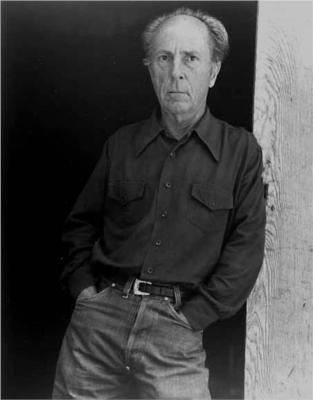
Edward Weston
Edward Weston abandoned pictorialism the day he trained his camera on the Armco Steel rolling mills in Middletown, Ohio. The 1922[1] photographs were stark, unmanipulated, almost abstract in their formal precision: a declaration of intent that he would spend the next three decades fulfilling.
Biography
Born in Highland Park, Illinois, in 1886[1], Weston had run a respectable commercial portrait studio in Glendale since 1911[1]. Mexico changed him. Between 1923 and 1926 he lived in Mexico City with photographer Tina Modotti, making portraits of Diego Rivera and José Clemente Orozco while learning from Mexican folk art's directness and clarity. Back in California, he turned his attention to objects closer to hand: shells, peppers, kelp, a toilet bowl, finding in the banal a formal intensity that others had missed.
In 1932[1] Weston co-founded Group f/64 with Ansel Adams and Imogen Cunningham. The name referred to the smallest aperture on a large-format camera, producing maximum depth of field and absolute sharpness from foreground to horizon. Their landmark exhibition at the M. H. de Young Museum that year drove a stake through the soft-focus aesthetics of pictorialism. Point Lobos, the rock-strewn stretch of coastline south of Carmel, became his primary subject from 1928 onwards. He built a home and darkroom there in 1938 and called it Wildcat Hill.
Parkinson's disease forced him to set down the camera in 1948[1]. He spent his final decade at Wildcat Hill, supervising his sons' printing of his archive. When he died on New Year's Day 1958[1], the Center for Creative Photography inherited a body of work comprising 2,260 fine prints and some 3,000 large-format negatives. His influence on how Americans understand landscape photography is incalculable.
Timeline
- 1886Born in Highland Park, Illinois.
- 1911Opened a commercial portrait studio in Glendale, California, at 25.
- 1922Photographed the Armco Steel rolling mills in Middletown, Ohio, abandoning pictorialism.
- 1923Moved to Mexico City with Tina Modotti, at 37.
- 1932Co-founded Group f/64 with Ansel Adams and Imogen Cunningham. Their exhibition was held at the M. H. de Young Museum.
- 1938Built a home and darkroom at Point Lobos, south of Carmel, California, calling it Wildcat Hill, at 52.
- 1948Forced to stop using the camera due to Parkinson's disease, at 62.
- 1958Died at Wildcat Hill, aged 71. The Center for Creative Photography inherited his archive.
Notable Works
Tap to view larger.
Next stop
Browse the movements →
Every movement in the collection, from the Renaissance to Pop art.
Related Artists



Frequently Asked Questions
What is Edward Weston known for?
Edward Weston is known for defining the direction of American art photography after World War I. He developed a modernist aesthetic for photography that embraced both nature and the machine age. He is also known for still lifes of natural objects, such as vegetables and shells.What is Edward Weston's most famous work?
Edward Weston is well known for his still-life photography, especially his close-up images of vegetables. One of his most recognisable photographs is *Pepper No. 30*, taken in 1930[1]. Weston created a series of pepper photographs, experimenting with lighting and composition. Weston's approach involved carefully arranging the pepper to emphasise its form and texture. He used natural light to create dramatic shadows and highlights, giving the pepper a sculptural quality. The photograph is celebrated for its sharp focus and tonal range. Weston aimed to capture the essence of the pepper, transforming an ordinary object into a work of art. Weston's other notable works include his photographs of shells, nudes, and the California coast. He co-founded Group f/64, promoting straight photography, which favoured sharp focus and unmanipulated images. His work had a significant impact on the development of fine art photography.What should I know about Edward Weston's prints?
Edward Weston was a 20th-century American photographer, known for his sharp focus and close-up compositions. He worked primarily with an 8x10 view camera, producing contact prints from his large negatives. Weston's printing process was meticulous. He favoured glossy papers to capture fine detail and a full tonal range. His early work often has a soft, diffused quality, but by the 1920s he had moved to a more direct, unmanipulated style. He sought to capture the essential form and texture of his subjects, whether shells, vegetables, or nudes. Collectors should be aware of the different periods in Weston's career, as well as the print's provenance. Weston sometimes reprinted his earlier negatives later in life, and these later prints may differ in tonality or contrast from his vintage prints. The Weston estate, managed by his son Cole Weston, produced prints after Edward's death in 1958[1]. These estate prints are generally less valuable than prints made by Edward himself. Condition is also a factor: look for prints that are free from scratches, fading, or other damage.What style or movement did Edward Weston belong to?
Edward Weston's career began in the pictorialist style, common at the start of the 20th century. However, by 1918[1]-1919[1], his work showed influences from modernist painting, with some pieces verging on abstraction and others adapting cubist principles to photography. A turning point came in 1922 during a trip to the East Coast, where he created architectural studies of Armco Steel Mills. These images, with their stark simplicity and rich detail, represented modern industry, devoid of pictorialism's romantic qualities. In Mexico City (1923-1926), Weston developed his "straight" photographic style. Inspired by Mexican folk art, he sought to capture both form and passion. His portraits became heroic, his nudes more explicit, and everyday objects became worthy of contemplation. Upon returning to the United States, Weston translated his experiences into American subjects. He continued nudes and portraits but shifted from still lifes of man-made objects to natural forms like vegetables, shells, and rocks. By 1931, he abandoned arrangements for photographing nature in situ. Weston, Ansel Adams, and other West Coast photographers formed Group f/64 in 1932, promoting images of maximum clarity with minimal darkroom manipulation.What was Edward Weston known for?
Edward Weston (born in Illinois, 1886[1]; died in California, 1958[1]) was a photographer known for his modernist aesthetic, which combined an appreciation for both nature and the machine age. Initially, Weston worked in the pictorialist style, producing softly focused images. A trip to the East Coast in 1922[1] marked a transition. He created stark architectural studies of the Armco Steel Mills, devoid of pictorialism's romantic qualities. From 1923 to 1926, living in Mexico City, he adopted a "straight" photographic style. Inspired by Mexican folk art, he sought to depict form and passion. His portraits were heroic, his nudes became more explicit, and everyday objects became worthy of contemplation. Upon returning to the United States, Weston's work influenced the direction of 20th-century photography. In 1932, he co-founded Group f/64, an informal association that promoted images of maximum clarity with minimal darkroom manipulation. Weston's photographs transformed the coastline of Point Lobos, California, into images that celebrated the natural world. In 1938, he received a Guggenheim Fellowship and extensively photographed California and the West. In 1941, he began a photographic tour of the United States to illustrate Walt Whitman's *Leaves of Grass*. Forced to retire in 1948 due to Parkinson's disease, Weston oversaw the printing of over eight hundred of his favourite images, known as the "project prints".When did Edward Weston live and work?
Edward Weston was born on 24 March 1886[1] in Highland Park, Illinois. He died on 1 January 1958[1] in Carmel, California. He was an American photographer, now known for his work in California. Weston began his photography career in the early 20th century, initially focusing on pictorialism, with soft-focus effects. By the early 1920s, he moved toward straight photography, emphasising sharp focus and natural forms. He co-founded Group f/64 in 1932[1], advocating for photographic precision. Throughout the 1920s and 1930s, Weston worked extensively in Mexico, collaborating with Tina Modotti and exploring Mexican culture. He received the first Guggenheim Fellowship awarded to a photographer in 1937, which allowed him to photograph extensively across the American West. He spent much of his later life in Carmel, California. He continued to work until the late 1940s, when Parkinson's disease made it too difficult.Where can I see Edward Weston's work?
Many institutions hold Edward Weston's photographs. The Center for Creative Photography in Tucson, Arizona, maintains the Edward Weston Archive, containing his papers, photographic materials, and some personal items. The archive includes letters to and from Weston, manuscript versions of his Daybooks, financial records, and items related to his Guggenheim project and trips to Mexico. It also holds thousands of negatives and a collection of fine prints, including work by Ansel Adams, Tina Modotti, and Brett Weston. The Center also possesses Weston's master set of his "project prints". Weston's writings, particularly his Daybooks, provide insights into his life and the artistic circles in which he moved. His correspondents included Arnold Schoenberg, Richard Neutra, Ansel Adams, Tina Modotti, Alfred Stieglitz, and Charles Sheeler. Weston's photographs are also held in the collections of the Metropolitan Museum of Art and the Museum of Modern Art, both in New York.Where was Edward Weston from?
Edward Weston was born in Highland Park, Illinois, on 24 March 1886[1]. At the age of twenty-one, he moved to California. By 1911[1], he had established a commercial photography studio just outside Los Angeles. Weston became involved in the artistic photography scene and the bohemian art scene in Los Angeles. These included dancers, musicians, actors, and other photographers. In the 1930s, Weston, Ansel Adams, and other West Coast photographers formed Group f/64. This group promoted straight photography, emphasising clarity and minimal darkroom manipulation. In 1938, Weston received a Guggenheim Fellowship and travelled around California and the West with his second wife, Charis Wilson Weston. Ten years earlier, in 1928, Weston first saw Point Lobos, south of Carmel, California. He had a house built there a decade later. Weston died in Carmel, California, on 1 January 1958[1].Who did Edward Weston influence?
Edward Weston (1886[1]-1958[1]) significantly shaped American art photography after World War I. He created a modernist aesthetic, embracing both nature and the machine age. Weston's life mirrored the American theme of purity and simplicity, reminiscent of Walt Whitman and Henry David Thoreau. His influence extended to many other photographers. These included Ansel Adams, Tina Modotti, Paul Strand, Beaumont and Nancy Newhall, Harry Callahan, Aaron Siskind, Richard Avedon, Lee Friedlander, Louise Dahl-Wolfe, W. Eugene Smith, and Garry Winogrand. His son, Brett Weston, also became a photographer. Edward's generosity allowed Brett access to the tools and techniques of photography, such as the "by guess and by god" exposure method. Weston also moved in a wide circle of artists, architects, dancers, composers, writers, designers, and collectors. Correspondence in his archive includes Arnold Schoenberg, Richard Neutra, Ansel Adams, Robinson Jeffers, Merle Armitage, Walter Arensberg, Jean Charlot, Tina Modotti, Alfred Stieglitz, Beatrice Wood, and Charles Sheeler.Who influenced Edward Weston?
Edward Weston's photography moved from pictorialism to realism, and he was part of a bohemian art scene in Los Angeles that included dancers, musicians, actors, and other photographers. Ramiel McGehee, Johan Hagemeyer, Tina Modotti, and Margrethe Mather were among his associates; he shared a studio with Mather for a time. Around 1918[1] and 1919, influences from modernist painting began to appear in Weston's work. Some images approached abstraction, while others seemed like attempts to adapt cubism to photography. A trip to the East Coast in 1922 resulted in architectural studies of Armco Steel Mills. From 1923 to 1926, Weston lived in Mexico City with Tina Modotti, participating in the capital's artistic life. Inspired by Mexican folk art, Weston sought to depict both form and passion with a camera. His son, Brett Weston, also acknowledged the influence of Paul Strand, Charles Sheeler, and Henri Cartier-Bresson, but believed other artists influenced his work as much as photographers did. Brett admired paintings by The Blue Four, German expressionists known for colour and emotion. He was also moved by the sculptures of Brancusi and Henry Moore.Who was Edward Weston?
Edward Weston (1886[1]-1958[1]) was an American photographer. He is known for his sharply focused, close-up images of natural forms, such as shells, vegetables, and nudes. Weston began his photography career in the early 1900s, working in a pictorialist style. Pictorialism used soft focus and manipulated printing techniques to mimic painting. By the 1920s, Weston had rejected pictorialism. He adopted a style he called "straight photography". Straight photography valued clarity, precision, and the unmanipulated print. In 1932[1], Weston, Ansel Adams, Imogen Cunningham, and others formed Group f/64. The group promoted straight photography as a rejection of pictorialism's artifice. The name f/64 refers to a small aperture setting on a camera lens. This small aperture produces a large depth of field, rendering the image sharply in focus from foreground to background. Weston's work had a considerable effect on the development of fine art photography in America. His emphasis on form and detail continues to influence photographers today.Why are Edward Weston's works important today?
Edward Weston (1886[1]-1958[1]) was an American photographer. He is known for his close-up, sharply focused images, especially of natural forms. Weston's work is important for several reasons. He helped elevate photography to fine art status. His approach, which emphasised clarity and detail, influenced many subsequent photographers. Weston co-founded Group f/64 in 1932[1]. This association of photographers promoted "pure" or "straight" photography, favouring unmanipulated prints. They believed photographs should celebrate, not disguise, their medium. His series of nudes, still lifes, and California landscapes are particularly celebrated. Weston's photographs of shells, peppers, and human bodies reveal the abstract forms within these subjects. His images are not merely records; they are interpretations that invite viewers to see the world differently. Weston received a Guggenheim Fellowship in 1937. This allowed him to photograph extensively across the American West. These images further cemented his reputation as a master of the medium. His technical skill and artistic vision continue to inspire.
Sources
Editorial draws on the following primary and tertiary references for Edward Weston.
- [1] wikipedia Wikipedia: Edward Weston Used for: biography, birth dates, death dates, identifiers, movement attribution, nationality.
- [2] book Horst Woldemar Janson; Anthony F. Janson, A Basic History of Art Used for: biography, stylistic analysis.
- [3] book Ansel Adams; Beaumont Newhall; Nancy Newhall; Louise Dahl-Wolfe; Aaron Siskind; Richard Avedon; Harry Callahan; Lee Friedlander; Tina Modotti; W. Eugene Smith; Paul Strand; Edward Weston; Garry Winogrand; Amy Rule, Ansel Adams; Beaumont Newhall; Nancy Newhall; Louise Dahl-Wolfe; Aaron Siskind; Richard Avedon; Harry Callahan; Lee Friedlander; Tina Modotti; W. Eugene Smith; Paul Strand; Edward Weston; Garry Winogrand; Amy Rule - Original sources _ art and ar Used for: biography, stylistic analysis.
- [4] book Beard, Lee, 1973- author, Butler, Adam, author; Van Cleave, Claire, author; Fortenberry, Diane, author; Stirling, Susan, author, Beard, Lee, 1973- author, Butler, Adam, author; Van Cleave, Claire, author; Fortenberry, Diane, author; Stirling, Susan, author - The Art Book_ New Edition, Mini Format Used for: biography, stylistic analysis.
- [5] book Penelope J.E. Davies, Walter B. Denny, Frima Fox Hofrichter, Joseph Jacobs, Ann S. Roberts, David L. Simon, Janson's History of Art_ The Western Tradition (8th Edition) Used for: biography.
Editorial overseen by Solis Prints. Sources verified 2026-09-30. Click a source for details, or hover over [N] in the page above to preview.
Editorial standardsMethodologyCorrectionsAI disclosureAbout the editorial team