

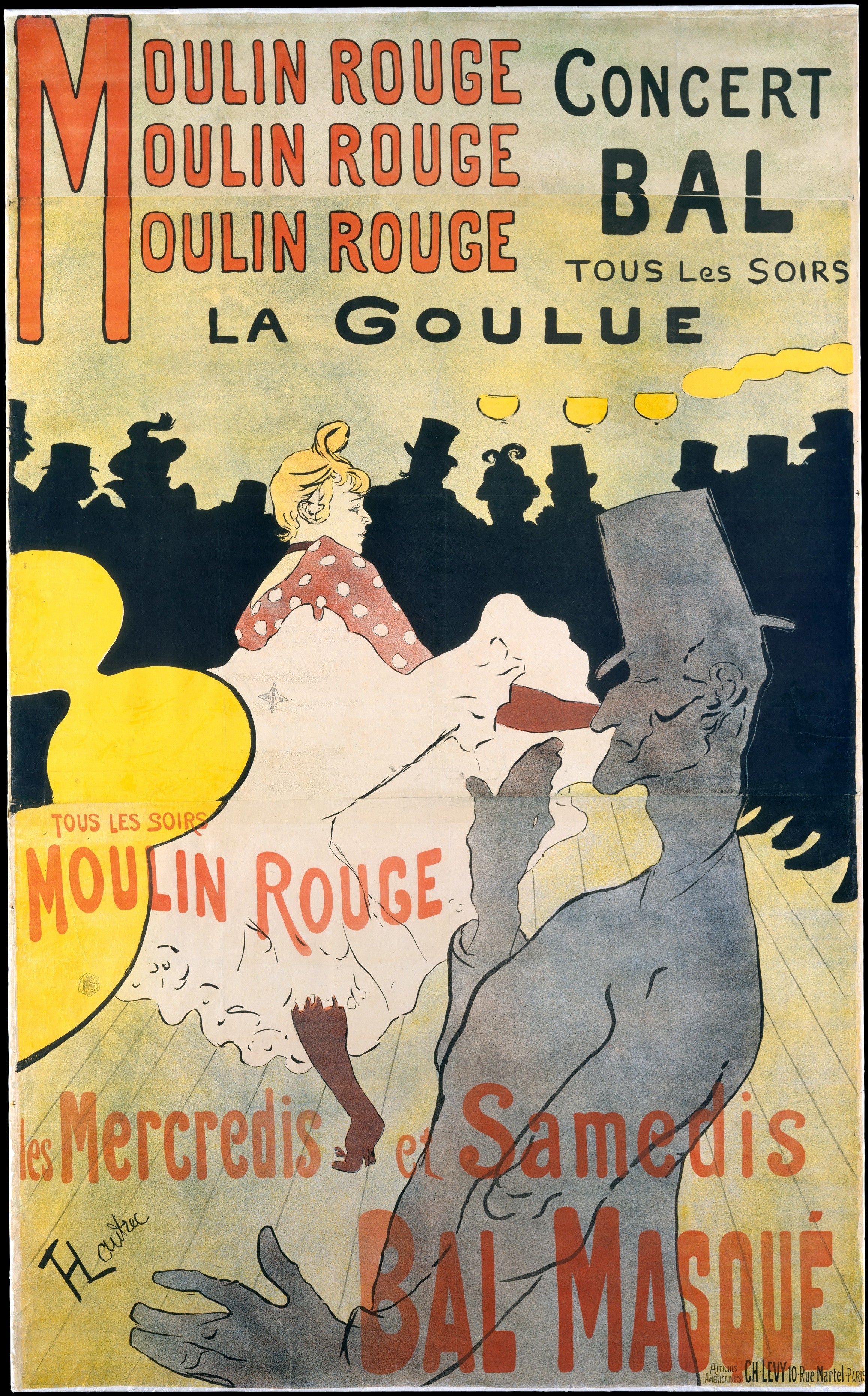
In 1891, a poster appeared on the walls of Paris advertising the Moulin Rouge dance hall. It showed the cancan dancer Louise Weber, known as La Goulue ("The Glutton"), kicking her leg beneath the silhouette of her partner Valentin le Désossé. The colours were flat, the composition was bold, and the artist's name was printed at the bottom: Toulouse-Lautrec. Overnight, Parisians began peeling the posters off walls to keep them.
Lautrec and the Lithographic Line
Henri de Toulouse-Lautrec (1864 to 1901) came from one of the oldest aristocratic families in France. Two childhood accidents broke both his legs, and they never grew properly, leaving him with the torso of a man and the legs of a child. He moved to Montmartre, the entertainment district of Paris, and made it his subject.
His poster style drew on Japanese woodblock prints (which were circulating widely in Paris by the 1880s) and the technical possibilities of colour lithography. Lithography allowed an artist to draw directly on a stone surface with a greasy crayon, then print from it in multiple colours using separate stones for each. Lautrec mastered the process, using flat areas of colour, strong outlines, and cropped compositions that made his posters jump off the wall at a distance.
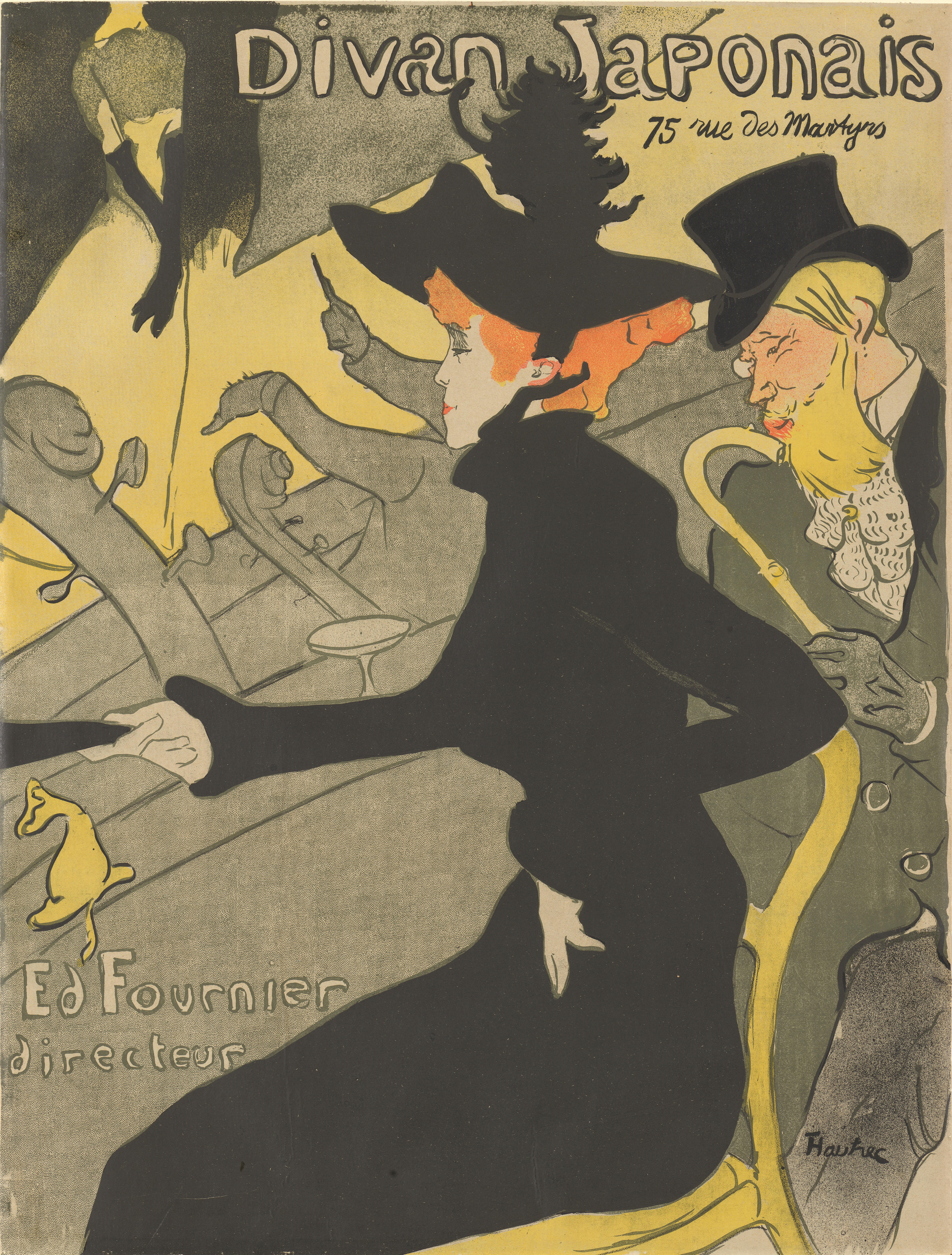
The Divan Japonais poster advertises a café-concert, but the performer is cropped at the neck: you cannot see her face. The focus is on the audience, specifically the woman in black (the dancer Jane Avril) and her companion. Lautrec was interested in the viewers, not the viewed. The composition was radical: it treated the poster surface like a snapshot, capturing a moment from an unexpected angle.
Mucha and the Art Nouveau Poster
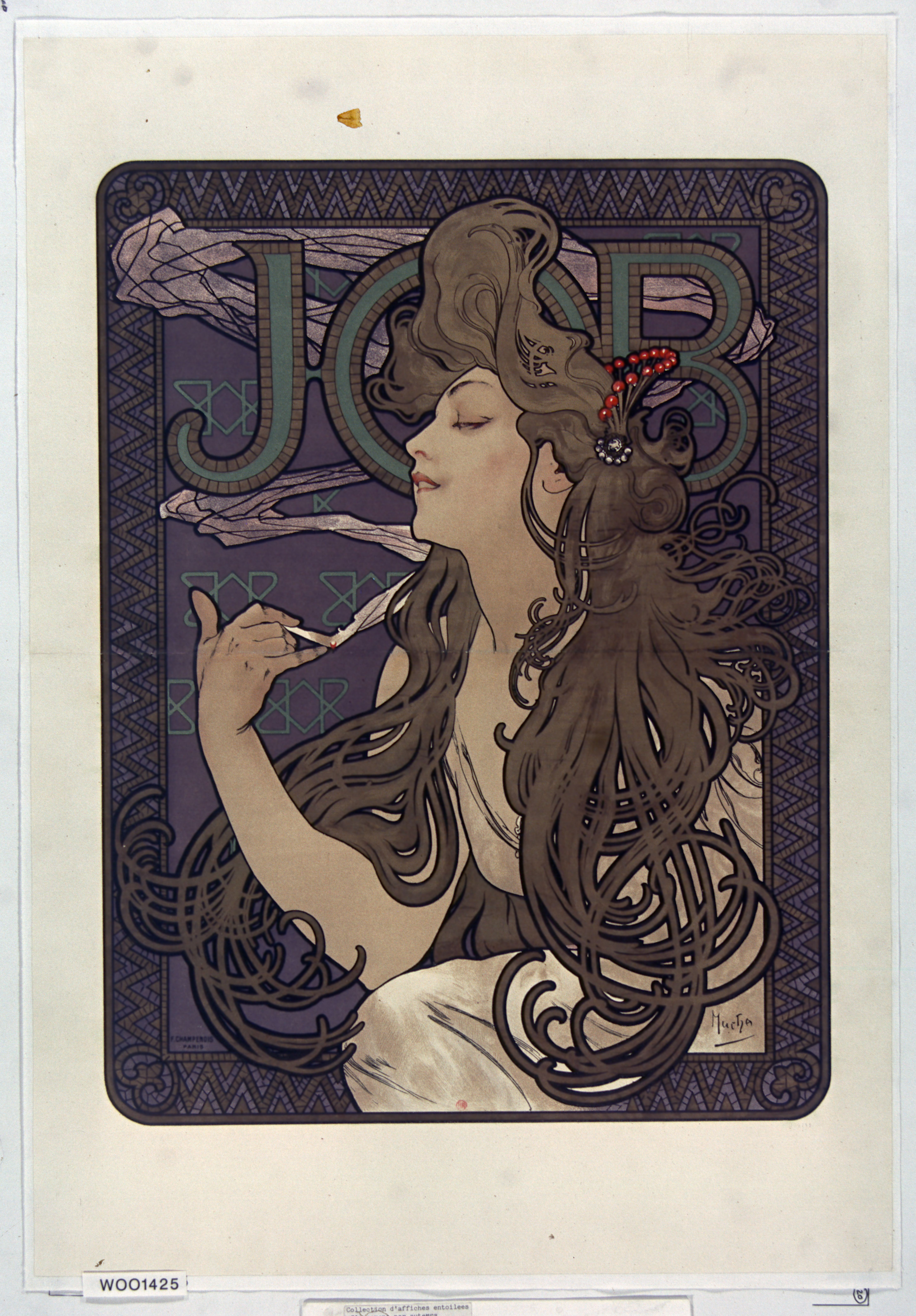
Alphonse Mucha (1860 to 1939), a Czech artist working in Paris, took the poster in a different direction. Where Lautrec was angular and urban, Mucha was sinuous and decorative. His women float in halos of flowing hair surrounded by organic patterns drawn from flowers, leaves, and Byzantine mosaics. The style became synonymous with Art Nouveau.
Mucha's breakthrough came in 1894 when he designed a poster for Sarah Bernhardt's play Gismonda at short notice. The result, a life-sized figure surrounded by a mosaic arch, was so popular that Bernhardt gave Mucha an exclusive six-year contract. His subsequent posters for cigarettes, biscuits, champagne, and railway companies turned advertising into a collectible art form.
Between them, Lautrec and Mucha proved that art did not have to hang in a gallery to matter. The street was a gallery. The poster was the frame. And the audience was everyone who walked past.


