


The political poster was the social media of the twentieth century: cheap to produce, impossible to ignore, and designed to provoke an immediate emotional response. The best propaganda posters work because they are good graphic design. They simplify a complex message into a single image that can be read at walking speed, from across a street, by someone who may not be able to read the text.
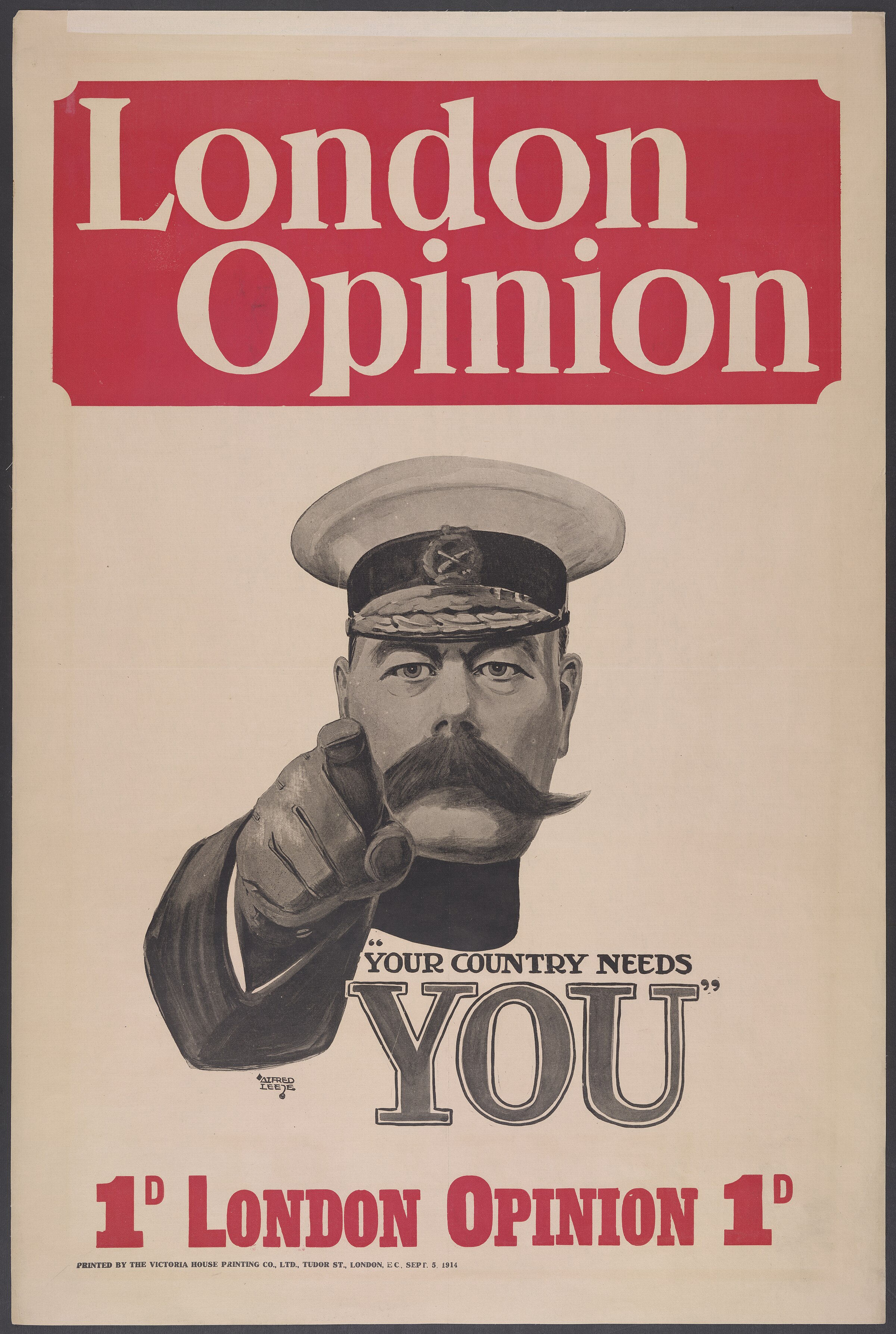
The Pointing Finger
Alfred Leete's cover for London Opinion in September 1914, showing Lord Kitchener pointing directly at the viewer with the words "Your Country Needs You," established the template that recruitment posters would follow for the next century. The direct address (you, not "men of Britain"), the pointing finger (which seems to follow the viewer), and the simplified portrait (strong features, moustache, stern expression) all became standard devices.
The American version, James Montgomery Flagg's Uncle Sam ("I Want YOU for U.S. Army"), used the same composition in 1917. The Soviet Union adapted it repeatedly. The design principle is confrontation: the poster does not ask, it demands. The viewer cannot look at it without feeling personally addressed.
Rosie and the Home Front

"We Can Do It!" was produced by J. Howard Miller in 1943 for the War Production Co-ordinating Committee, intended to boost morale among factory workers at Westinghouse Electric. It was displayed for two weeks. The woman in the poster, often called "Rosie the Riveter" (though that name originally belonged to a different image by Norman Rockwell), has become one of the most reproduced images of the twentieth century.
The poster's effectiveness comes from its graphic simplicity: a strong diagonal arm, a direct gaze, primary colours (blue, yellow, red), and a three-word message. The woman is not asking for permission. She is stating a fact. The combination of confidence and urgency is what makes the image work both as wartime propaganda and as the feminist icon it later became.
Propaganda posters are a reminder that graphic design is never neutral. The same principles that sell products sell wars: simplicity, repetition, emotional directness, and the elimination of everything that might slow down the message. The best propaganda posters are also the best design. That is what makes them dangerous.


