

Nicolas Poussin (1594 to 1665) painted slowly, lived modestly, and avoided large public commissions. He spent most of his life in Rome, painting cabinet-sized canvases for a small group of French collectors. He was the most influential French painter of the seventeenth century, but he produced no large altarpieces, ran no studio of pupils, and wrote no theoretical treatise. His influence travelled through the paintings themselves.
Three centuries later, Cézanne told the painter Émile Bernard that he wanted to "do Poussin again, after nature." Picasso, working in occupied Paris during the Second World War, made a careful copy of Poussin's Triumph of Pan. Both painters had reasons for studying a man whose style had been considered outdated since the eighteenth century.
The Roman Career
Poussin was born in Normandy and worked his way to Paris as a young man. He arrived in Rome in 1624 at thirty, and except for an unhappy two-year period back in Paris in the 1640s, he never left. He found a small group of patrons in Rome (mostly fellow expatriates and Italian intellectuals) who paid him regularly for paintings on classical subjects.
His method was deliberate. He read his sources carefully (Ovid, Tacitus, Plutarch, Livy), made small wax models of his figures, arranged them on miniature stage sets to study lighting, and then painted from the models rather than from life. The figures in his paintings have a sculptural solidity that comes from being painted from sculpture, in essence, even when the subjects are nude bodies in motion.
Et in Arcadia Ego
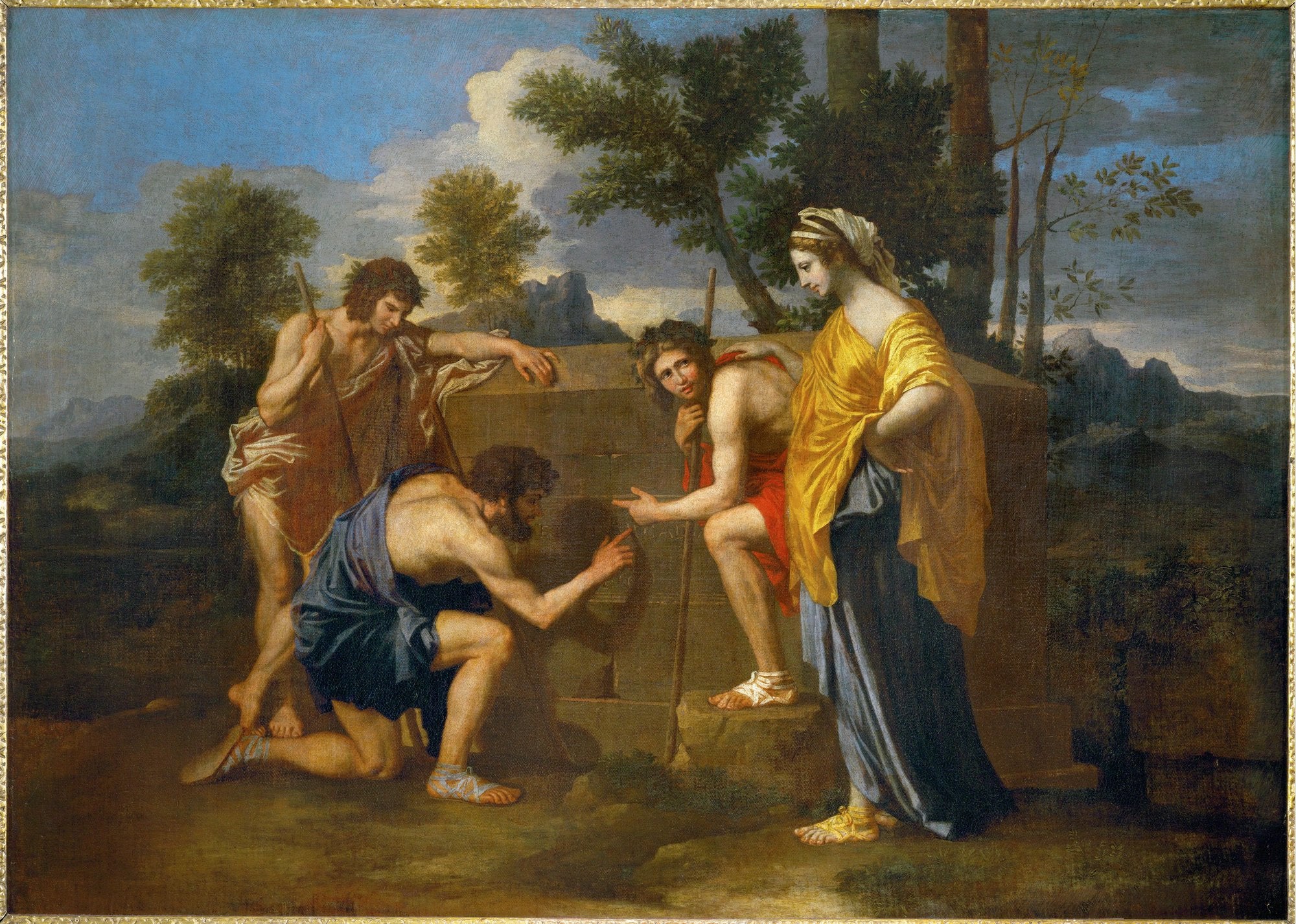
Poussin painted two versions of Et in Arcadia Ego, the second around 1638 to 1640 and now in the Louvre. Three shepherds and a shepherdess gather around a tomb in an idealised landscape. One shepherd kneels, tracing the inscription on the tomb with his finger: ET IN ARCADIA EGO. The Latin is ambiguous. It can be read as "I too was once in Arcadia" (spoken by the dead person) or "Even in Arcadia, here I am" (spoken by Death itself).
The painting is a classical meditation on mortality. Even in paradise, death is present. The shepherds discovering the tomb are confronting something they had assumed Arcadia would protect them from. Their reactions are calm rather than horrified, but the calm is part of the painting's seriousness.
The Architecture of Drama
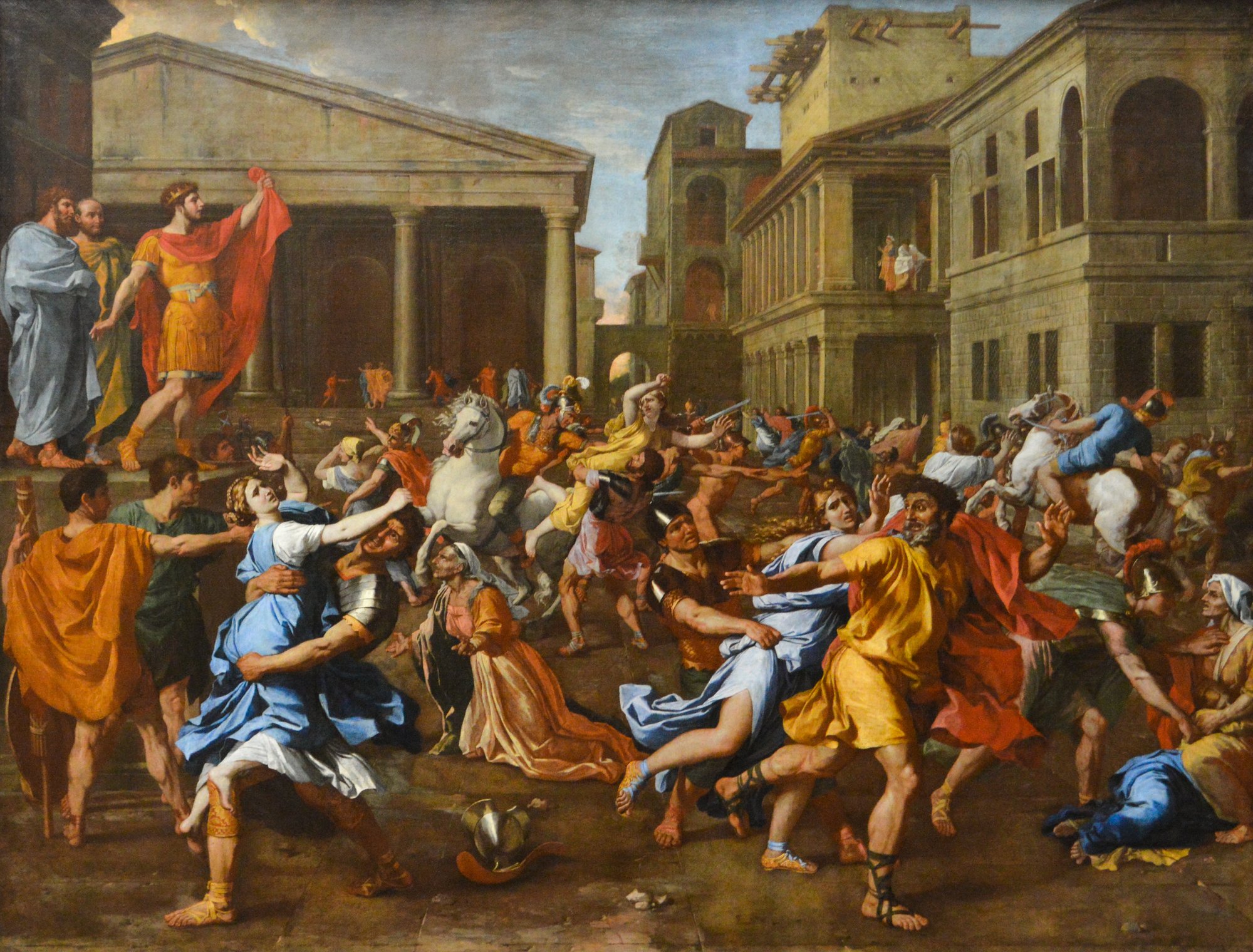
Poussin's compositions are built like buildings. Figures stand in stable triangular groupings. Diagonal lines move the eye through the action. Background architecture echoes the geometry of the foreground figures. Nothing is accidental.
The Rape of the Sabine Women, painted around 1633 to 1634, shows the moment from Roman foundation legend when Romulus's soldiers seize the Sabine women as wives. The composition is a controlled chaos: dozens of figures, each individuated, each with a specific posture, each placed in relation to the others according to a logic the viewer cannot articulate but can feel.
The technique would influence Jacques-Louis David's Neoclassical history paintings 150 years later. David's Oath of the Horatii (1784) borrows Poussin's architectural staging directly.
The Self-Portrait
Poussin made one undisputed self-portrait, in 1650, now in the Louvre. He shows himself in his early fifties, wearing a black robe, holding a portfolio of drawings. Behind him, framed paintings stand stacked against a wall: one shows the painter's allegory (a woman embraced by two arms, representing the friendship of painters), another the suggestion of a landscape.
The portrait is severe. Poussin does not smile. His gaze is direct but not warm. The painting was made for his patron Paul Fréart de Chantelou and was meant to represent the painter as a thinker rather than a craftsman. The image stuck. It is essentially how Poussin's reputation has been understood ever since.

Why Cézanne and Picasso Both Studied Him
Cézanne wanted to make Impressionism solid. Poussin had solved a related problem two centuries earlier: how to combine the visual energy of classical subjects with the formal stability of architectural composition. Cézanne saw in Poussin a model for what painting could do when it took structure as seriously as it took observation.
Picasso's interest was different. During the German occupation of Paris, he made a series of copies and variations after old master paintings, including Poussin's Triumph of Pan. The exercise seems to have been part of his way of working through what painting could still do under conditions where most other forms of cultural activity had been suspended. Poussin's discipline, his attention to construction, his refusal to take shortcuts, were qualities Picasso found useful in 1944.
The Reputation Cycle
Poussin's reputation followed a long cycle. He was admired in his lifetime, declared the founder of French classical painting after his death, attacked as cold and outdated by the Romantics in the early nineteenth century, partially rehabilitated by Cézanne and the Cubists, and is now firmly established as one of the most important Western painters.
He never painted for popular audiences. He painted for educated patrons who shared his interest in classical antiquity, his commitment to formal rigour, and his belief that painting was a serious intellectual activity. The patrons died. The paintings remained, and other painters kept finding them necessary.
The man who avoided large commissions has more paintings in major museums than most of his more public contemporaries. Slow work survived faster work.


