

Katsushika Hokusai changed his name more than thirty times, moved house over ninety times, and worked for more than seventy years without stopping. He called himself "the old man mad about painting." He was not exaggerating.
Born in 1760 as Tokitaro, Hokusai began training as a woodblock carver before switching to print design at eighteen. He was expelled from the Katsukawa school after his master's death, a setback that freed him to develop his own style. He abandoned the traditional ukiyo-e subjects of courtesans and kabuki actors, turning instead to landscapes populated by ordinary people going about their lives. It was a shift that would redefine the genre.
The Wave That Changed Everything
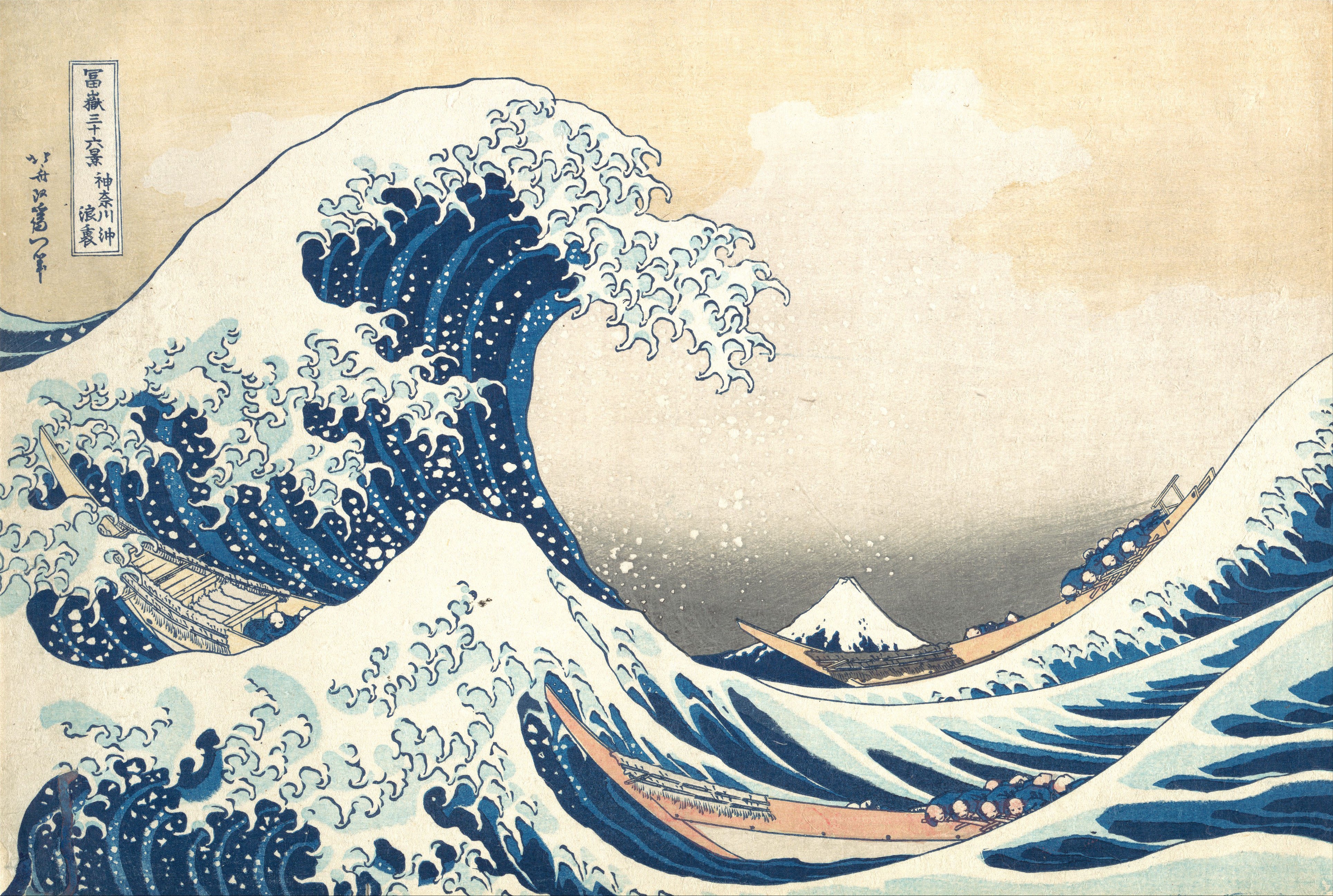
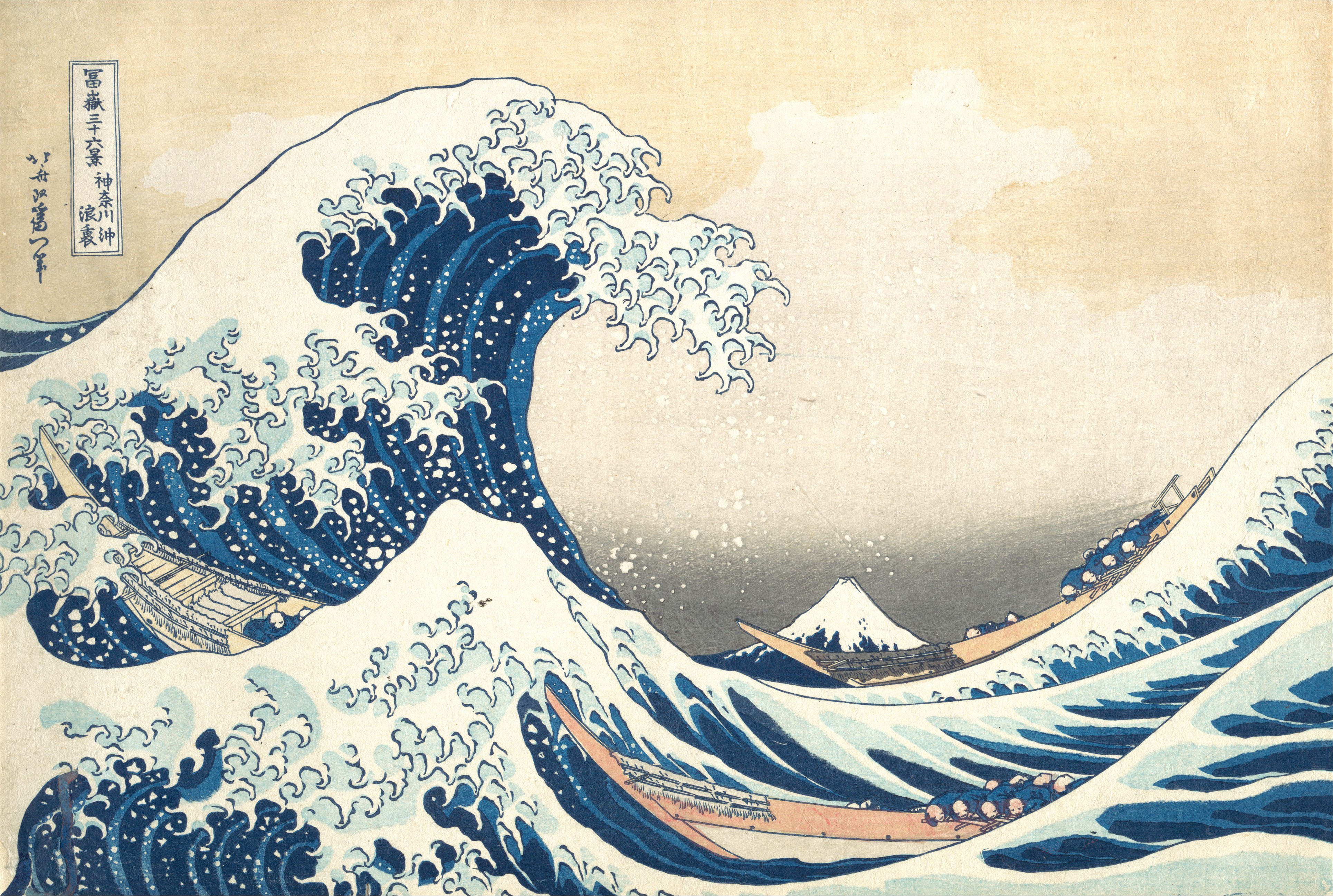
Between 1829 and 1833, Hokusai produced "Thirty-six Views of Mount Fuji," the series that made him an international figure. The most famous image, The Great Wave off Kanagawa, shows three fishing boats about to be engulfed by a towering wave, with Mount Fuji sitting small and still in the background. The composition is deceptively simple: the dynamic curve of the wave against the static triangle of the mountain, rendered in a limited palette of blues and off-whites.
The print grew out of the ukiyo-e tradition, meaning "pictures of the floating world," a genre that had thrived during the Edo period (1603 to 1868) thanks to the commercial possibilities of woodblock printing. A growing merchant class could afford to own prints, and publishers competed to produce images that would sell. Hokusai gave them something they had not seen before: landscapes treated with the same seriousness as portraits of famous beauties.
Fuji in Every Light
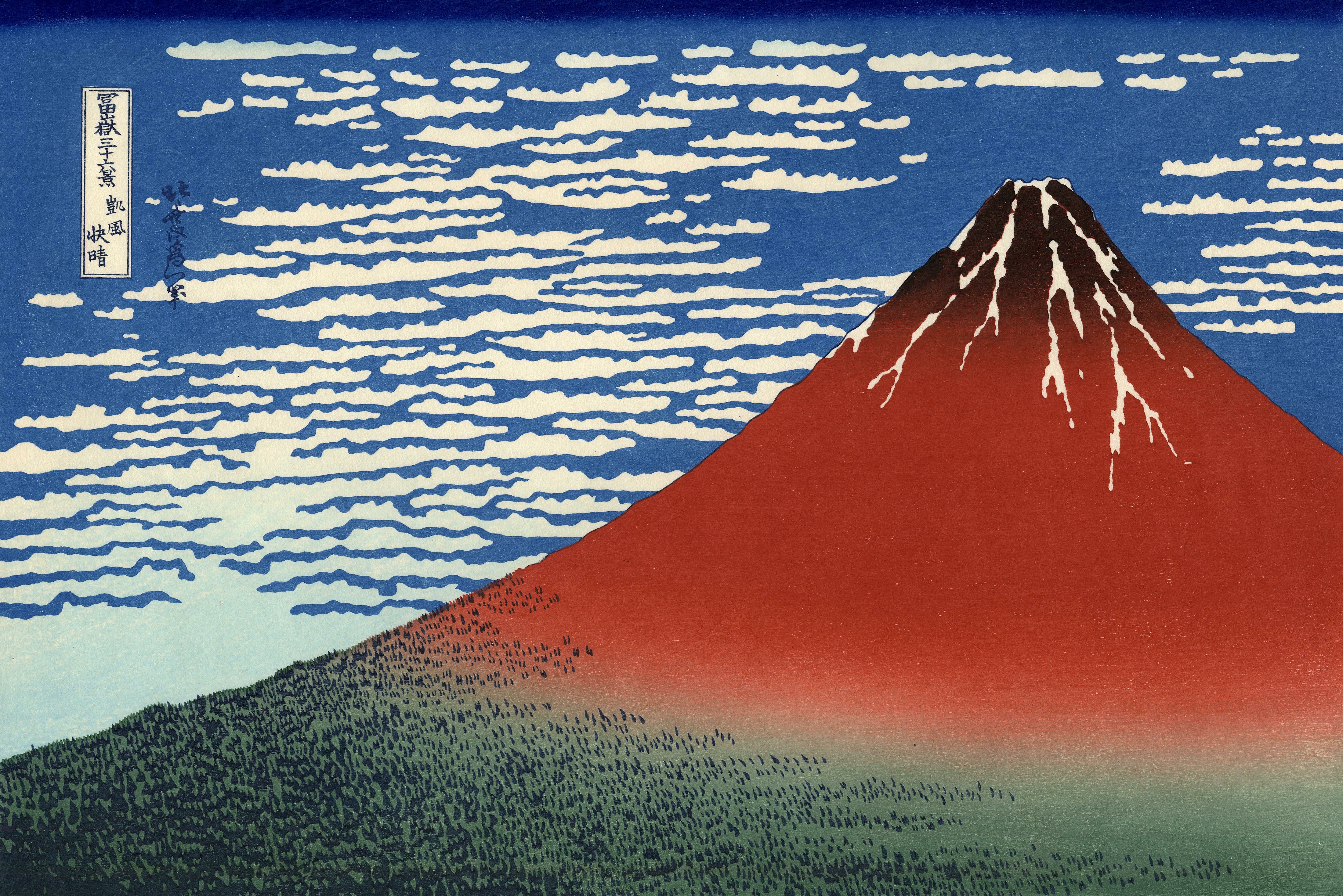
"South Wind, Clear Sky," known as Red Fuji, is the opposite of the Great Wave in almost every respect. Where the Wave is all movement and threat, Red Fuji is still. The mountain fills the composition, its slopes turned red by the early morning sun, its peak dusted with snow against a sky streaked with thin clouds. There is nothing else in the picture. It is a study of a single subject under a single condition of light, an approach that European painters would not pursue systematically until the Impressionists, fifty years later.
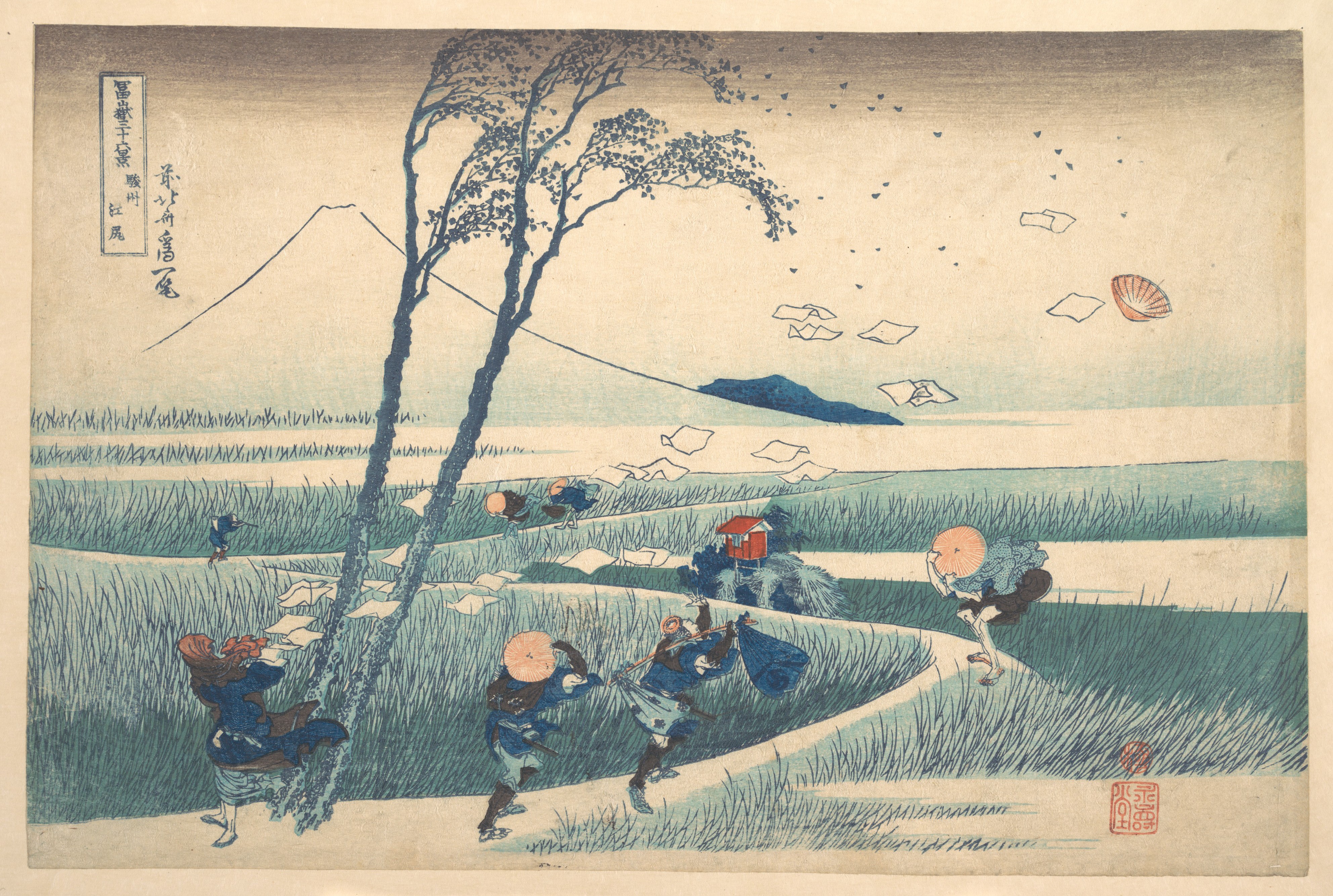
"Ejiri in Suruga Province" captures a gust of wind scattering papers and hats across a marshy plain. Travellers clutch their belongings; a tree bends nearly double. Fuji is visible in the distance, unmoved. The print is about the contrast between human vulnerability and natural permanence, a theme that runs through the entire series. Fuji is always there. People are always passing through.
Seventy Years of Work
Hokusai's career spanned more than seven decades, the longest of any Japanese print artist. He produced thousands of prints, paintings, sketches, and book illustrations, working for over thirty different publishers. His fifteen-volume Hokusai Manga, published from 1814, contained thousands of sketches of animals, people, landscapes, and objects, and served as a pattern book for other artists. When the volumes reached Europe in the 1850s, they became one of the catalysts for the Japonisme movement that influenced Monet, Degas, and Van Gogh.
At the age of seventy-five, Hokusai wrote that nothing he had produced before the age of seventy was worth counting. He hoped that by eighty his art would have improved further, and that by ninety he might begin to understand the true nature of things. He died at eighty-nine, reportedly saying on his deathbed that if heaven would grant him just ten more years, or even five, he could become a real painter.
He was, characteristically, not satisfied.


