

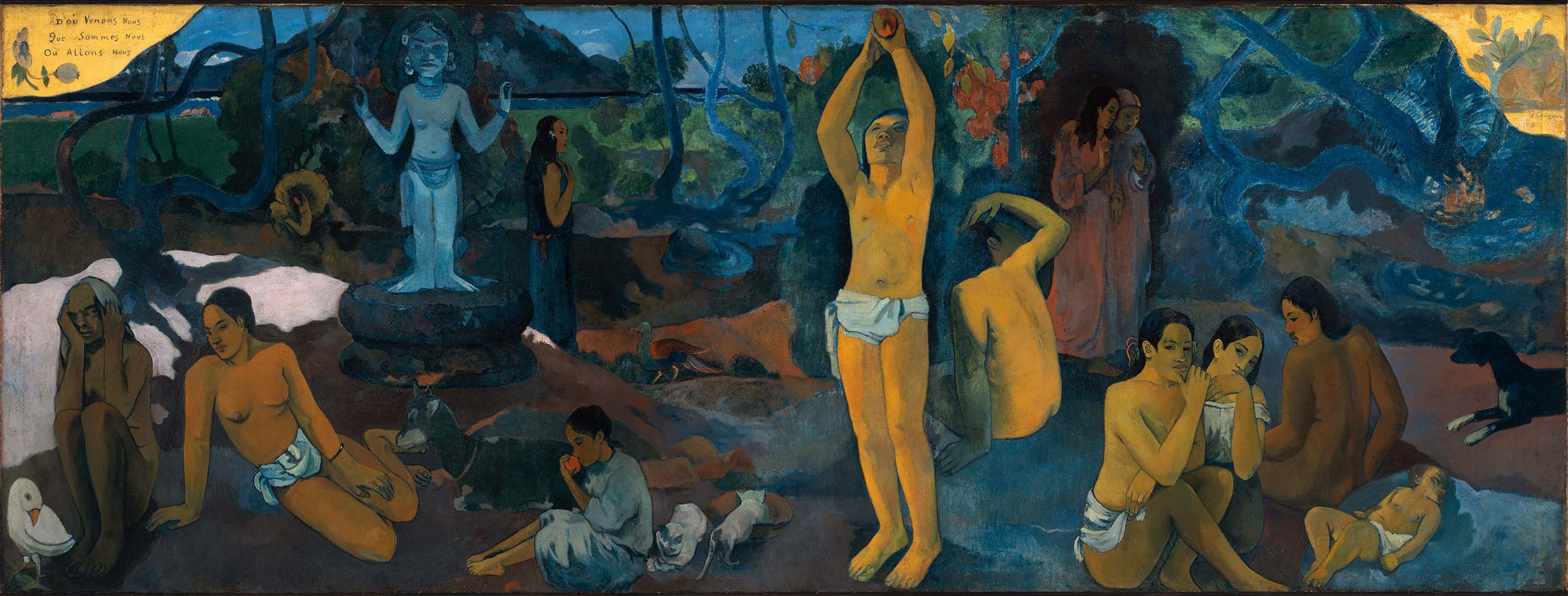
Paul Gauguin (1848 to 1903) was a stockbroker who painted on Sundays until, at thirty-five, he abandoned his career, his wife, and his five children to become a full-time artist. He spent the rest of his life looking for a place where civilisation had not yet ruined everything. He did not find it, but the search produced some of the most original paintings of the nineteenth century.
Before Tahiti: The Vision at Pont-Aven
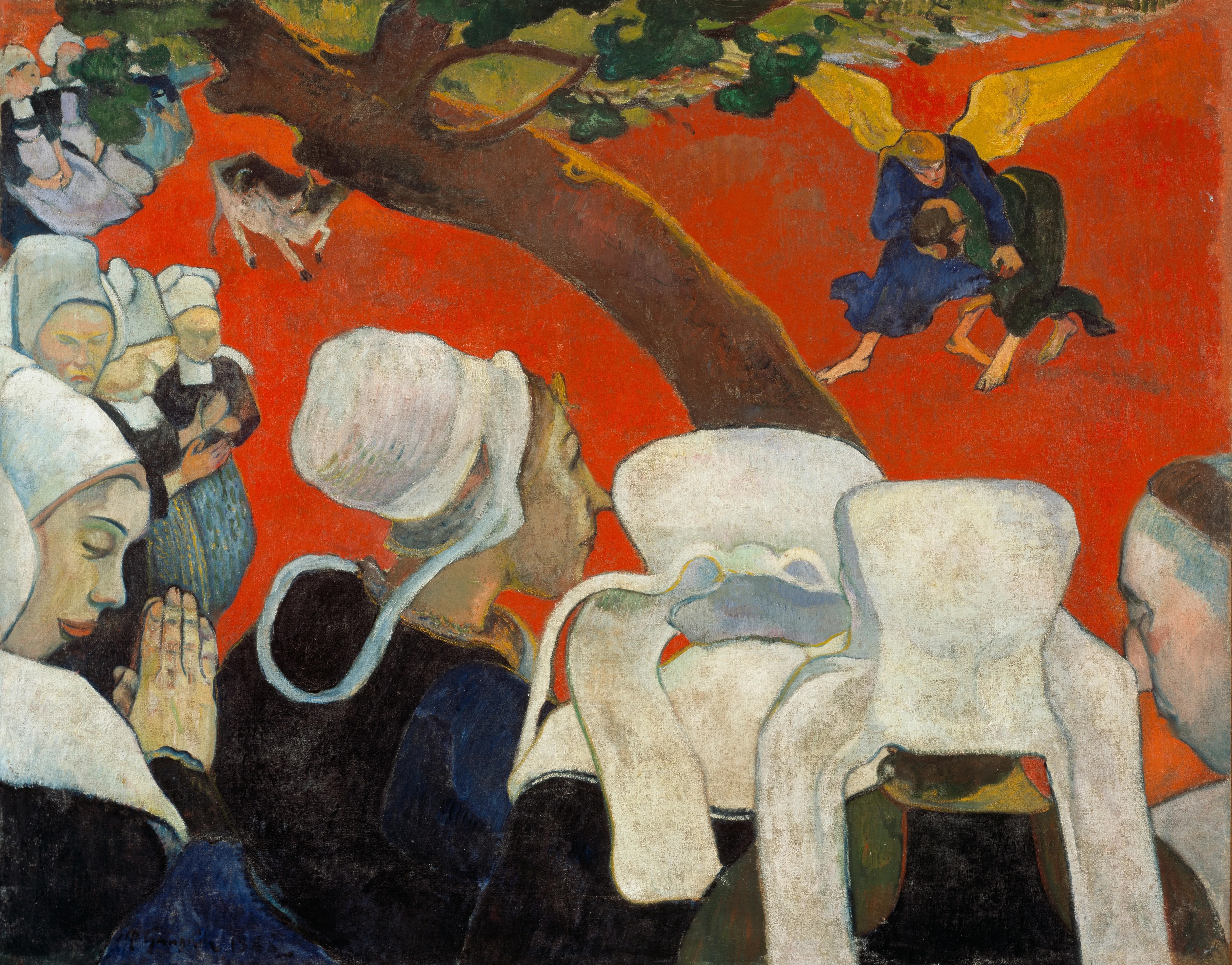
Vision After the Sermon, painted in Brittany in 1888, was Gauguin's declaration of independence from Impressionism. A group of Breton women in white bonnets watch Jacob wrestling with an angel on a field of flat, unnatural red. There is no atmospheric perspective, no gradation of tone, no attempt to create a realistic space. The colours are symbolic, not observed. The ground is red because Gauguin decided it should be red.
The painting drew on Japanese woodblock prints (the diagonal tree trunk dividing the composition comes directly from Hiroshige), medieval stained glass (the flat colours and strong outlines), and Gauguin's growing belief that art should represent inner visions rather than external appearances. He called his approach Synthetism: the synthesis of observed form, emotional experience, and decorative arrangement.
Tahiti: Paradise and Its Discontents
Gauguin arrived in Tahiti in June 1891, expecting to find an unspoiled paradise. What he found was a French colony with a colonial administration, a Catholic mission, and a population whose traditional culture had been largely suppressed. The "primitive" world he had imagined did not exist. He invented it instead.
His Tahitian paintings use saturated, non-naturalistic colour (pink beaches, purple shadows, orange skin), flattened space, and subjects drawn from Polynesian mythology that Gauguin had read about in books rather than observed firsthand. The women in his paintings sit in attitudes borrowed from Egyptian tomb painting, Javanese temple reliefs, and photographs of Cambodian dancers. The result is a visual language that looks Polynesian but is actually a European construction, assembled from fragments of many cultures.
The Final Question
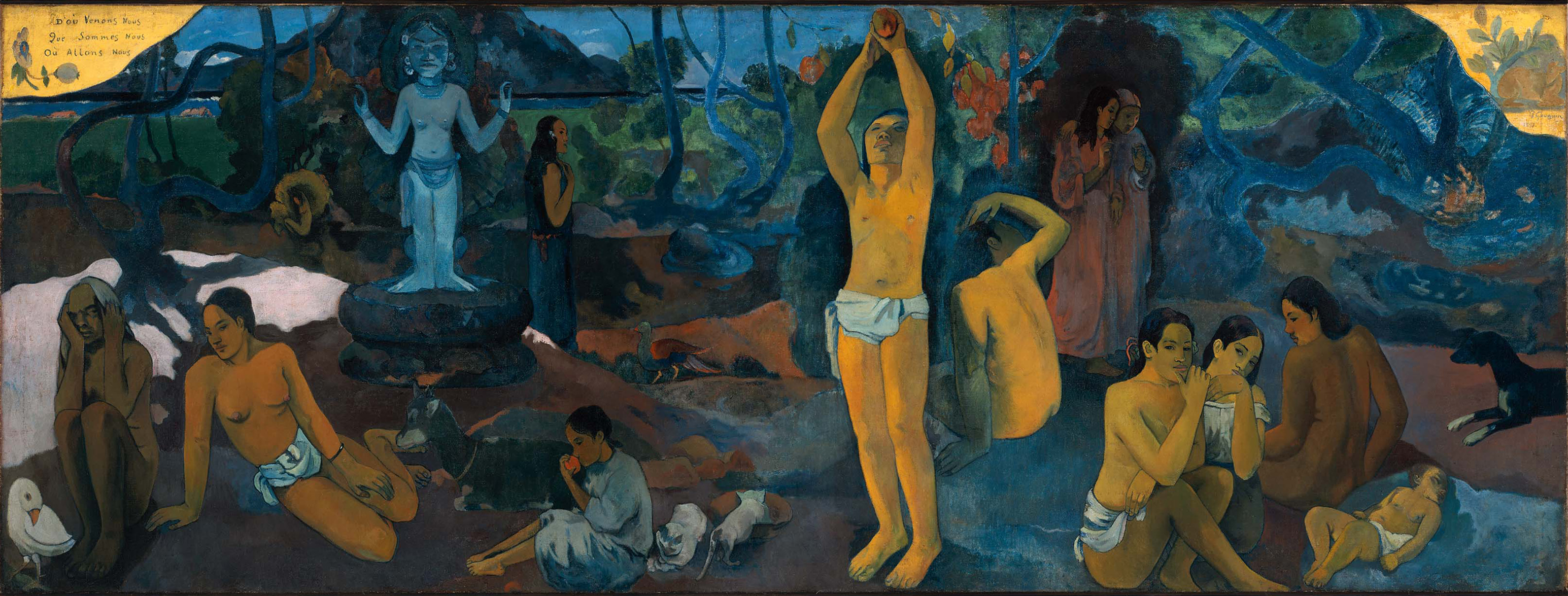
Gauguin painted Where Do We Come From? What Are We? Where Are We Going? in December 1897, reportedly in a frenzy of work before a suicide attempt that failed. The painting reads from right to left: a sleeping infant (where do we come from), a standing figure reaching for fruit (what are we), and an old woman approaching death (where are we going). A blue idol watches from the background.
The painting is 139 by 375 centimetres, the largest canvas Gauguin ever attempted. He described it as his "testament" and believed it was his finest work. Whether it is or not, it asks the questions that his entire career had been circling: what would art look like if it freed itself from European conventions? What would colour do if it no longer had to describe what the eye sees?
Gauguin died in the Marquesas Islands in 1903, in debt and in trouble with the colonial authorities. The Fauves, who would detonate modern art two years later with their exhibition at the Salon d'Automne, took their cue directly from his colour. Matisse owned one of his paintings. The line from Gauguin to Matisse to Abstract Expressionism is direct and unbroken.


