

Pieter Bruegel the Elder (c. 1525 to 1569) painted ordinary people doing ordinary things. Peasants reap wheat, eat wedding feasts, dance at fairs, slip on icy ponds, fight with sticks. The settings are the Flemish countryside in the second half of the sixteenth century, observed in extraordinary detail.
His patrons were not peasants. Most of his major paintings were commissioned by Antwerp bankers and Habsburg court officials, including Cardinal Antoine Perrenot de Granvelle, the chief minister of the Spanish Netherlands. Twelve of his paintings now in the Kunsthistorisches Museum in Vienna entered the Habsburg collection within a generation of his death. The class distance between Bruegel's subjects and his audience was not incidental. It was the point.
The Series for Niclaes Jonghelinck
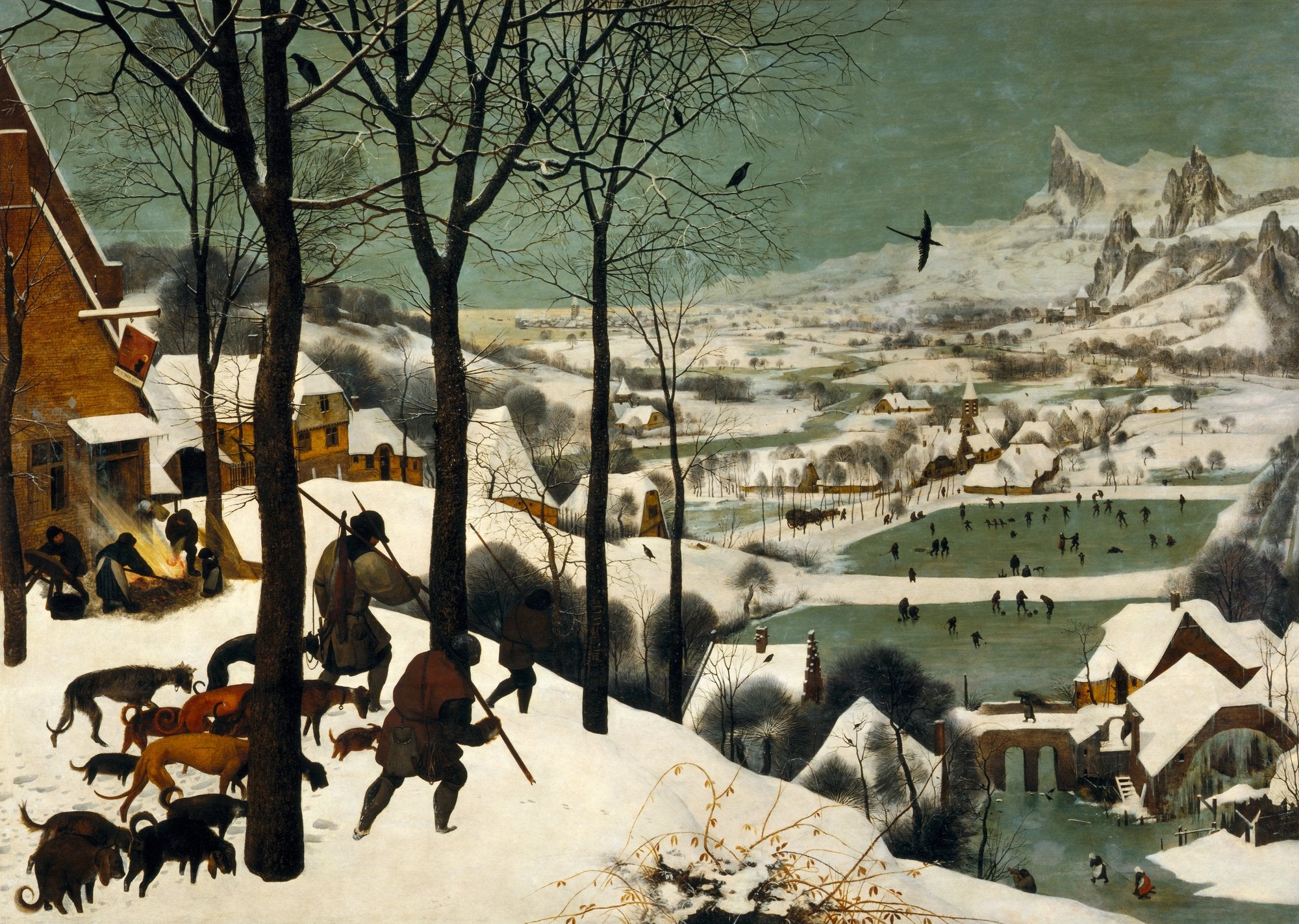
In 1565, the Antwerp banker Niclaes Jonghelinck commissioned a series of six paintings of the seasons (or possibly twelve, depending on which scholar you read). Five survive: The Hunters in the Snow (December to January), The Gloomy Day (February to March), Haymaking (June to July), The Harvesters (August to September), and The Return of the Herd (October to November).
The Hunters in the Snow is probably the most reproduced Bruegel painting. Three hunters return to a village with a single dead fox between them, walking through deep snow with their hounds. The composition takes the eye down a hillside through the village, across frozen ponds where peasants are skating, to mountains in the distance. The whole landscape is laid out as if seen from a higher hill behind the hunters.
The Peasant Genre
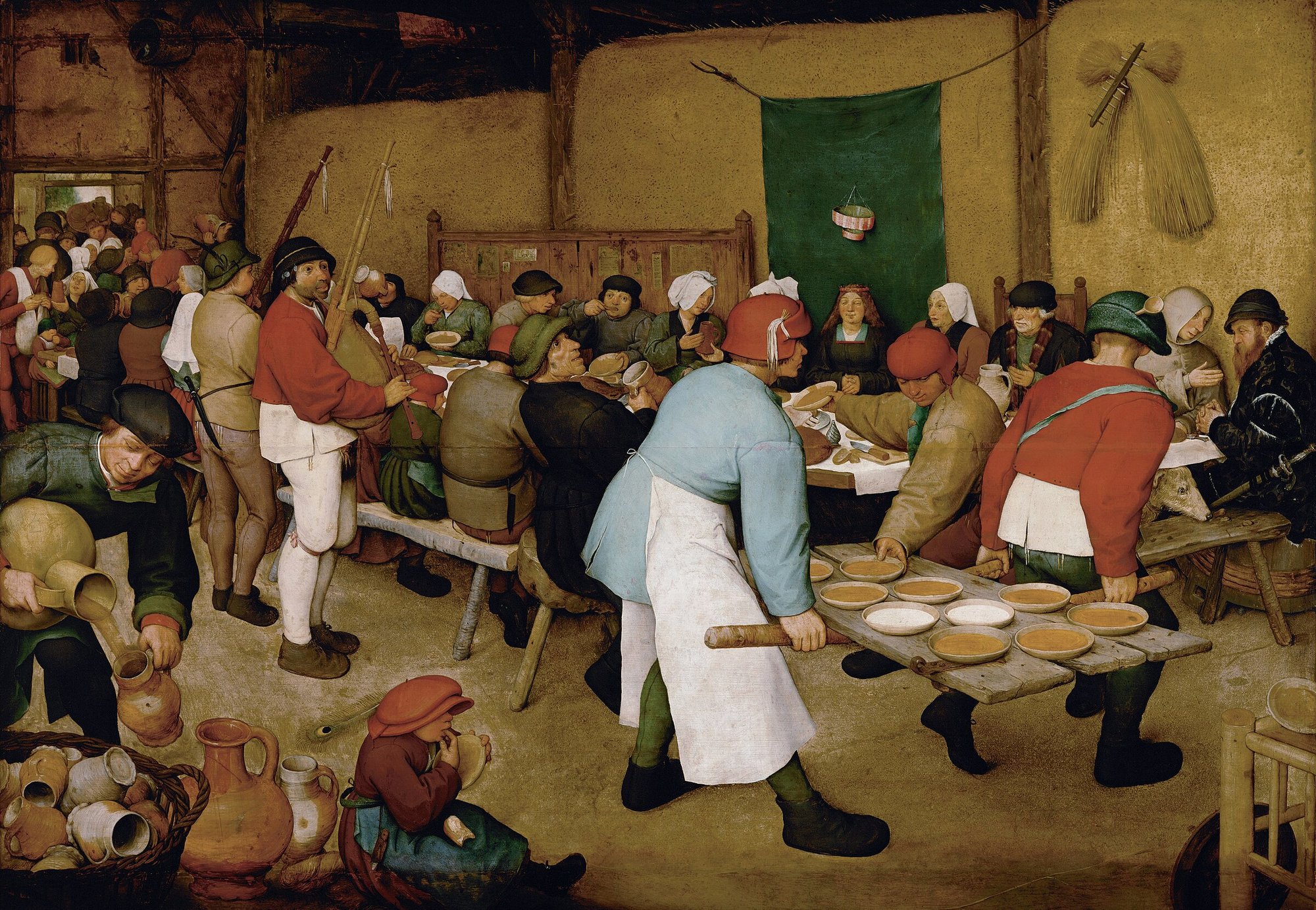
The Peasant Wedding (c. 1567) shows around twenty figures crammed into a barn for a wedding feast. Plates of porridge are being passed along a board. The bride sits passively at the back, hands folded in her lap, beneath a paper crown. The groom is harder to identify; he may be the figure pouring drink, or he may be entirely absent (one tradition has it that the groom is not allowed to attend his own wedding feast).
The painting is detailed enough to function as ethnography. The pottery, the food, the clothing, the seating arrangements, the musical instruments are all recognisably Flemish peasant culture of the 1560s. Bruegel had spent time in peasant villages, reportedly disguising himself in country clothes to attend weddings as an observer.
The accuracy combines with something less straightforward. The peasants are not idealised. Some are eating greedily; one figure in the lower right is mostly visible from the back, stretching for a plate. The composition has the formal organisation of a religious painting (the bride sits where Mary would sit; the long table recalls the Last Supper) but the subjects are anything but religious.
The Tower of Babel
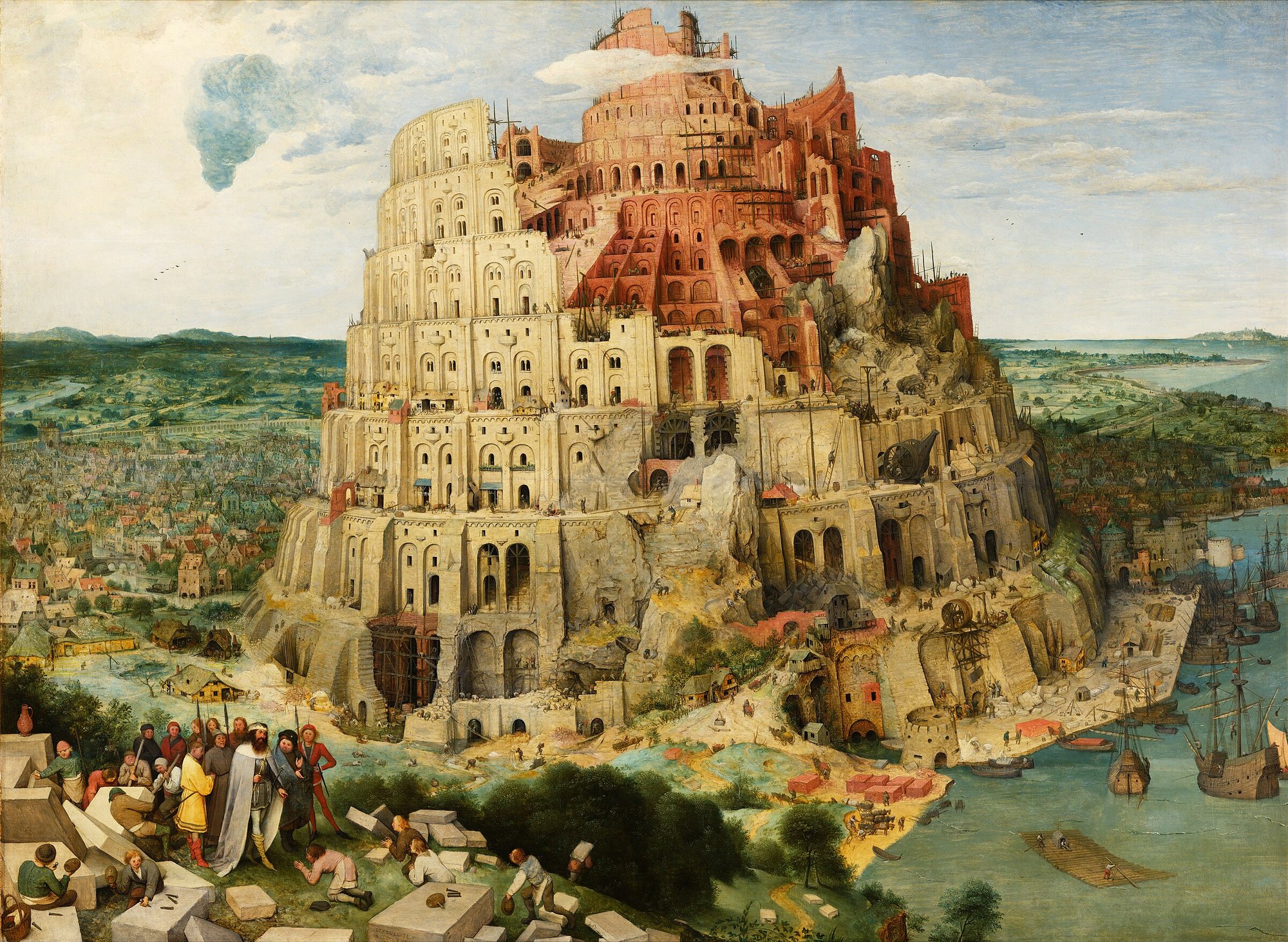
Bruegel painted the Tower of Babel at least twice, possibly three times. The Vienna version (c. 1563) shows the unfinished tower as a vast spiral structure, partly built into the side of a hill, surrounded by harbour buildings and dock cranes. King Nimrod, who was supposed to have ordered the tower built, stands in the foreground inspecting the work.
The painting reads on multiple levels. As a biblical illustration, it shows the moment before God confused human languages and abandoned the project. As a piece of architectural fantasy, it imagines what a building large enough to reach heaven might actually look like (Bruegel has clearly studied the Roman Colosseum, which he had drawn during his trip to Italy in the 1550s). As a political allegory, it can be read as a comment on the over-ambition of the Habsburg empire, then in its imperial expansion phase.
The Politics
Bruegel lived in the Spanish Netherlands during the early stages of the Dutch Revolt against Habsburg rule. Religious tensions between Catholics and Protestants were turning into open war by the 1560s. The Council of Troubles, set up by the Duke of Alba in 1567, executed thousands of suspected Protestants in the territory.
How much Bruegel sympathised with the Protestants is debated. He painted at least one work, the Massacre of the Innocents, that has been read as a coded reference to Spanish atrocities (the Habsburg soldiers wear contemporary armour, not biblical costumes). On his deathbed in 1569, he reportedly asked his wife to burn certain sketches that he feared might get her into trouble.
He survived to paint his great late works because his patrons were powerful enough to protect him. Cardinal Granvelle, the chief minister, was one of his collectors. So were the merchant princes of Antwerp who held effective control of the city's economy.
The Dynasty
Bruegel had two sons, Pieter the Younger (1564 to 1638) and Jan (1568 to 1625), both of whom became successful painters. Pieter the Younger built a profitable career making copies of his father's compositions, which had become valuable collector's items by the early seventeenth century. Jan developed his own style, focusing on flower paintings and detailed mythological scenes, sometimes collaborating with Rubens.
The Bruegel dynasty continued for several generations. Jan's son Jan the Younger and his grandson Abraham both painted, as did several cousins and in-laws. The family workshop, founded by a man who painted peasants for aristocrats, became one of the longest-running studios in Flemish art.
The aristocracy went on collecting. Five centuries later, the paintings are still in the Habsburg's old Vienna palace, the only major collection that has remained more or less intact. The peasants Bruegel painted have been dust for half a millennium. The rooms where the Habsburgs ate their meals are still hanging Bruegel's reapers harvesting wheat.


