

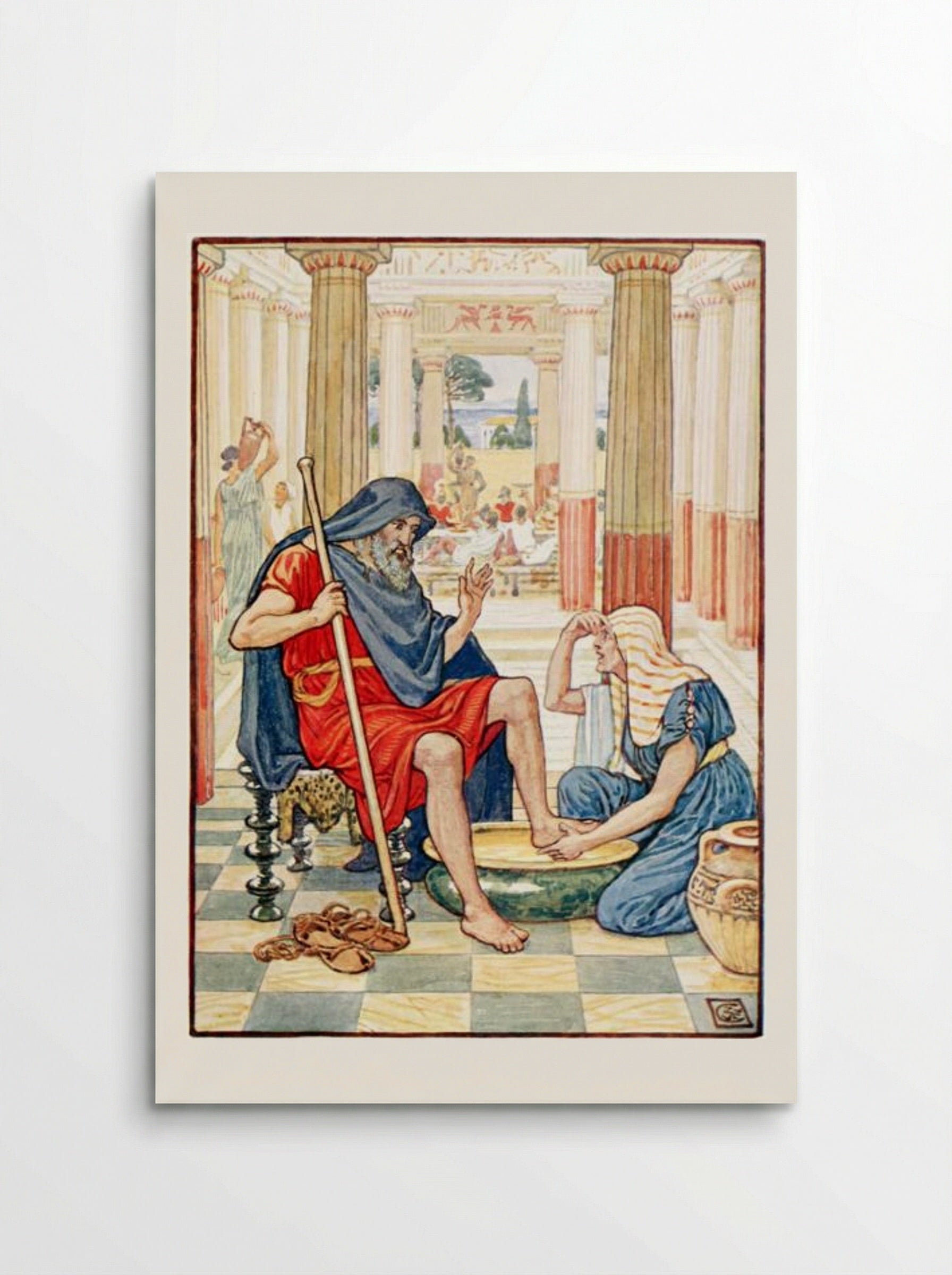
Yea, Verily, thou art odysseus - Walter Crane
Archival giclée
Frames arrive ready to hang
Secure checkout
Made to order
Description
This illustration by Walter Crane depicts a scene from Homer's Odyssey, where Odysseus is recognised by his nurse. The artwork features a classical setting and a restrained colour palette, characteristic of Crane's style.
Walter Crane (1845-1915) was an English artist and book illustrator. He is considered one of the most influential children's book creators of his generation. Crane was associated with the Arts and Crafts movement, and his work often featured decorative borders and flat, stylised figures. He drew inspiration from a variety of sources, including classical mythology, medieval romances, and Japanese prints. His illustrations are characterised by their attention to detail, use of colour, and strong sense of design. 'Yea, Verily, thou art odysseus' depicts a scene from Homer's Odyssey. Odysseus, disguised as a beggar, is recognised by his old nurse, Eurycleia, who identifies him by a scar on his leg while washing his feet. The composition is arranged within a classical architectural setting, with columns and a distant view of the sea. The figures are rendered in a linear style, with clear outlines and minimal shading. The colour palette is restrained, with muted tones of red, blue, and ochre. The overall effect is one of clarity and simplicity, typical of Crane's illustrative style.
Return policy
Because every print is made to order, we don't offer change-of-mind returns, refunds or exchanges. If your order arrives faulty, damaged or incorrect, we'll replace it free of charge — just contact us within 48 hours of delivery. See our refunds page for full details.
Shipping
We ship worldwide, printing at the production hub nearest to your delivery address. Delivery times and costs vary by destination — you'll see the options available to you at checkout.
Manufacturing
Each print is produced to order using 12-colour giclée printing on FSC-certified archival paper. Designed in Britain and printed at your nearest production hub to reduce waste and speed up delivery.
Yea, Verily, thou art odysseus - Walter Crane

Artist Biography
Walter Crane
He began as a children's book illustrator, apprenticed to the wood engraver W.J. Linton. His Toy Books for the publisher Routledge, produced from 1865 onward, used flat areas of colour, strong outlines and decorative borders influenced by Japanese woodblock prints and the Pre-Raphaelites. They were among the first mass-produced children's books to treat illustration as a design problem rather than an afterthought.
During a lecture tour of the United States he spoke in favour of clemency for the anarchists sentenced to death after the Haymarket Affair. His wealthy American patrons cancelled engagements. Crane did not retract.
He became Vice President of the Healthy and Artistic Dress Union, a movement promoting loose-fitting clothing in opposition to tight Victorian corsetry. He wrote The Claims of Decorative Art, arguing that decorative art was not a lesser form. He was Art Director of the Art Workers' Guild and the first president of the Arts and Crafts Exhibition Society.
He wanted to be taken seriously as a painter of allegorical canvases, but the galleries would not exhibit them. The children's books and the socialist cartoons are what lasted. Morris would have appreciated the irony.
Our Features
Designed for Lasting Impact
Specific Features
Every Solis piece is made to order with archival, gallery-quality materials built to last.
- Museum-grade giclée printing for rich, fade-resistant colour
- Archival matte fine-art paper, FSC-certified
- Multiple sizes and framing options available
- Frames in black, natural wood, dark wood or white
- Framed prints arrive ready to hang
Care & Cleaning
To keep your artwork looking its best:
- Dust gently with a soft, dry cloth
- Avoid prolonged direct sunlight
- Never use liquid cleaners on the print or canvas surface
- Keep in a dry, room-temperature space
- Handle prints with clean, dry hands
Materials & Sizing
Museum-grade giclée on FSC-certified archival matte paper, with framed and canvas options.
- Paper sizes: A4, A3, A2, A1, A0 and B2 (50×70 cm)
- Canvas: XS (20×30 cm) to Large (60×90 cm)
- Frames: black, natural wood, dark wood or white
Why Choose Us ?
Damage-free delivery guarantee
Fast Shipping
Museum-Quality Materials
Artist Biography
Walter Crane
He began as a children's book illustrator, apprenticed to the wood engraver W.J. Linton. His Toy Books for the publisher Routledge, produced from 1865 onward, used flat areas of colour, strong outlines and decorative borders influenced by Japanese woodblock prints and the Pre-Raphaelites. They were among the first mass-produced children's books to treat illustration as a design problem rather than an afterthought.
During a lecture tour of the United States he spoke in favour of clemency for the anarchists sentenced to death after the Haymarket Affair. His wealthy American patrons cancelled engagements. Crane did not retract.
He became Vice President of the Healthy and Artistic Dress Union, a movement promoting loose-fitting clothing in opposition to tight Victorian corsetry. He wrote The Claims of Decorative Art, arguing that decorative art was not a lesser form. He was Art Director of the Art Workers' Guild and the first president of the Arts and Crafts Exhibition Society.
He wanted to be taken seriously as a painter of allegorical canvases, but the galleries would not exhibit them. The children's books and the socialist cartoons are what lasted. Morris would have appreciated the irony.
You May Also Like