

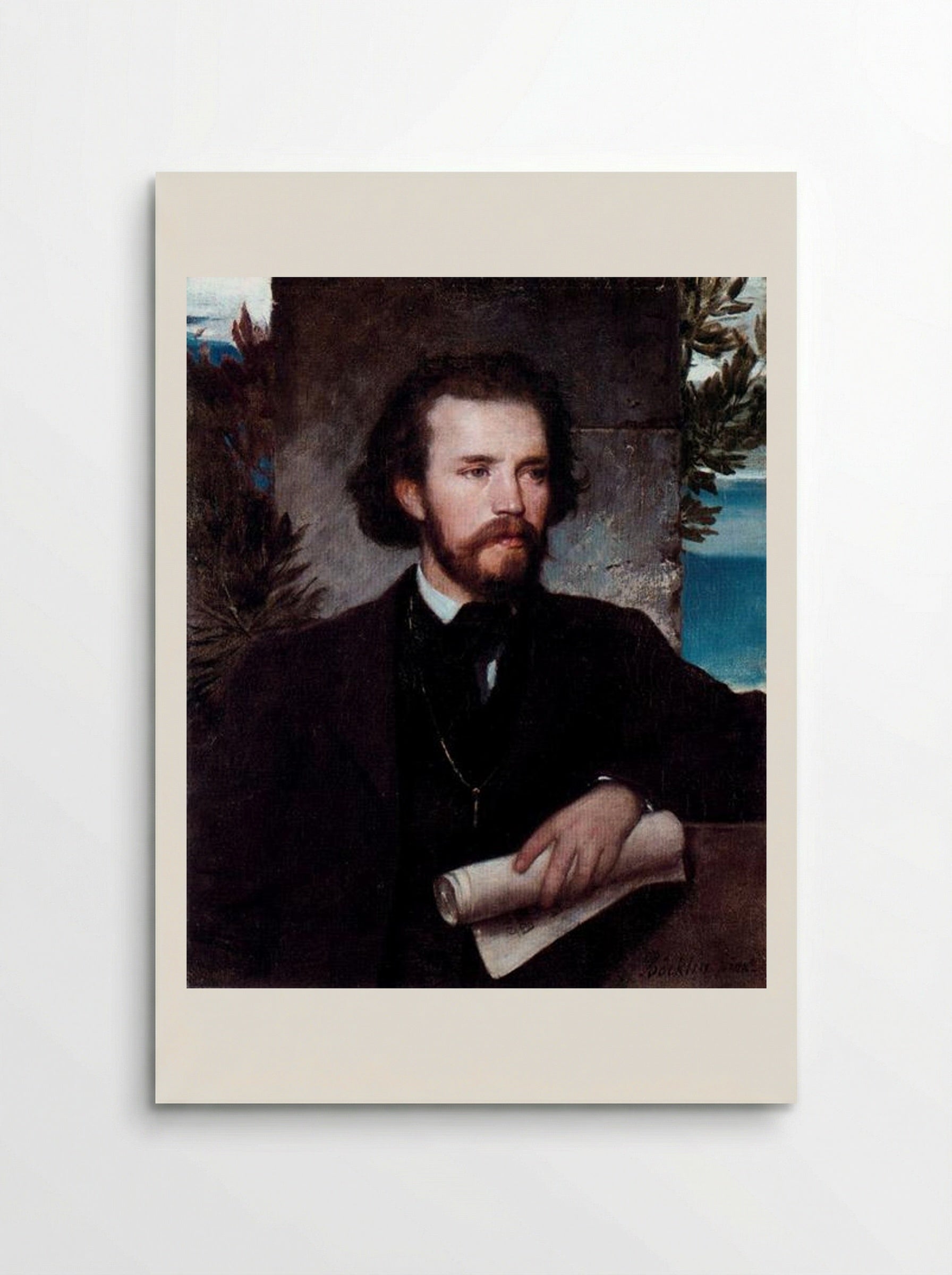
Portrait of the singer Karl Wallenreiter - Arnold Böcklin
Archival giclée
Frames arrive ready to hang
Secure checkout
Made to order
Description
A portrait of Karl Wallenreiter by Swiss symbolist painter Arnold Böcklin, known for his mythological and allegorical works. This portrait captures Wallenreiter in a moment of quiet contemplation, with a subdued colour palette and balanced composition.
This portrait by Arnold Böcklin (1827-1901), a Swiss symbolist painter, depicts Karl Wallenreiter, a singer. Böcklin's symbolist style often incorporated mythological and allegorical figures into his works, exploring themes of life, death, and the human condition. Although this portrait is more straightforward, it still possesses a certain romantic sensibility. The painting shows Wallenreiter in a dark suit, holding a rolled-up manuscript or musical score, suggesting his profession. He leans against a stone structure, with a glimpse of a blue sea and sky visible in the background. The colour palette is subdued, dominated by dark browns and blacks, which contrasts with the pale skin of the sitter and the bright blue of the distant sea. The composition is balanced, with Wallenreiter positioned slightly off-centre, creating a sense of naturalism. The overall effect is one of quiet contemplation and understated elegance.
Return policy
Because every print is made to order, we don't offer change-of-mind returns, refunds or exchanges. If your order arrives faulty, damaged or incorrect, we'll replace it free of charge — just contact us within 48 hours of delivery. See our refunds page for full details.
Shipping
We ship worldwide, printing at the production hub nearest to your delivery address. Delivery times and costs vary by destination — you'll see the options available to you at checkout.
Manufacturing
Each print is produced to order using 12-colour giclée printing on FSC-certified archival paper. Designed in Britain and printed at your nearest production hub to reduce waste and speed up delivery.
Portrait of the singer Karl Wallenreiter - Arnold Böcklin

Artist Biography
Arnold Bocklin
He was born in Basel in 1827 and studied in Dusseldorf, Antwerp, Brussels and Paris, but found his real inspiration in Italy, where he lived intermittently and where he spent his final years. His landscapes are not observed but invented: mythological creatures inhabit rocky coastlines, centaurs stand in forests, mermaids play in the sea. The Romanticism of his training was filtered through Italian light and classical allusion into a Symbolism that anticipated both the Metaphysical painters and the Surrealists.
Isle of the Dead hung in reproduction in seemingly every middle-class home in Germany at the turn of the century. Sigmund Freud kept a copy in his office. When Marcel Duchamp was asked to name his favourite painter, he named Bocklin, whether sincerely or provocatively remains unclear.
Bocklin also painted a counterpart, Island of Life (1888), which has remained far less well known. He died in San Domenico di Fiesole, near Florence, in 1901, at seventy-three.
Our Features
Designed for Lasting Impact
Specific Features
Every Solis piece is made to order with archival, gallery-quality materials built to last.
- Museum-grade giclée printing for rich, fade-resistant colour
- Archival matte fine-art paper, FSC-certified
- Multiple sizes and framing options available
- Frames in black, natural wood, dark wood or white
- Framed prints arrive ready to hang
Care & Cleaning
To keep your artwork looking its best:
- Dust gently with a soft, dry cloth
- Avoid prolonged direct sunlight
- Never use liquid cleaners on the print or canvas surface
- Keep in a dry, room-temperature space
- Handle prints with clean, dry hands
Materials & Sizing
Museum-grade giclée on FSC-certified archival matte paper, with framed and canvas options.
- Paper sizes: A4, A3, A2, A1, A0 and B2 (50×70 cm)
- Canvas: XS (20×30 cm) to Large (60×90 cm)
- Frames: black, natural wood, dark wood or white
Why Choose Us ?
Damage-free delivery guarantee
Fast Shipping
Museum-Quality Materials
Artist Biography
Arnold Böcklin
He was born in Basel in 1827 and studied in Dusseldorf, Antwerp, Brussels and Paris, but found his real inspiration in Italy, where he lived intermittently and where he spent his final years. His landscapes are not observed but invented: mythological creatures inhabit rocky coastlines, centaurs stand in forests, mermaids play in the sea. The Romanticism of his training was filtered through Italian light and classical allusion into a Symbolism that anticipated both the Metaphysical painters and the Surrealists.
Isle of the Dead hung in reproduction in seemingly every middle-class home in Germany at the turn of the century. Sigmund Freud kept a copy in his office. When Marcel Duchamp was asked to name his favourite painter, he named Bocklin, whether sincerely or provocatively remains unclear.
Bocklin also painted a counterpart, Island of Life (1888), which has remained far less well known. He died in San Domenico di Fiesole, near Florence, in 1901, at seventy-three.
You May Also Like