

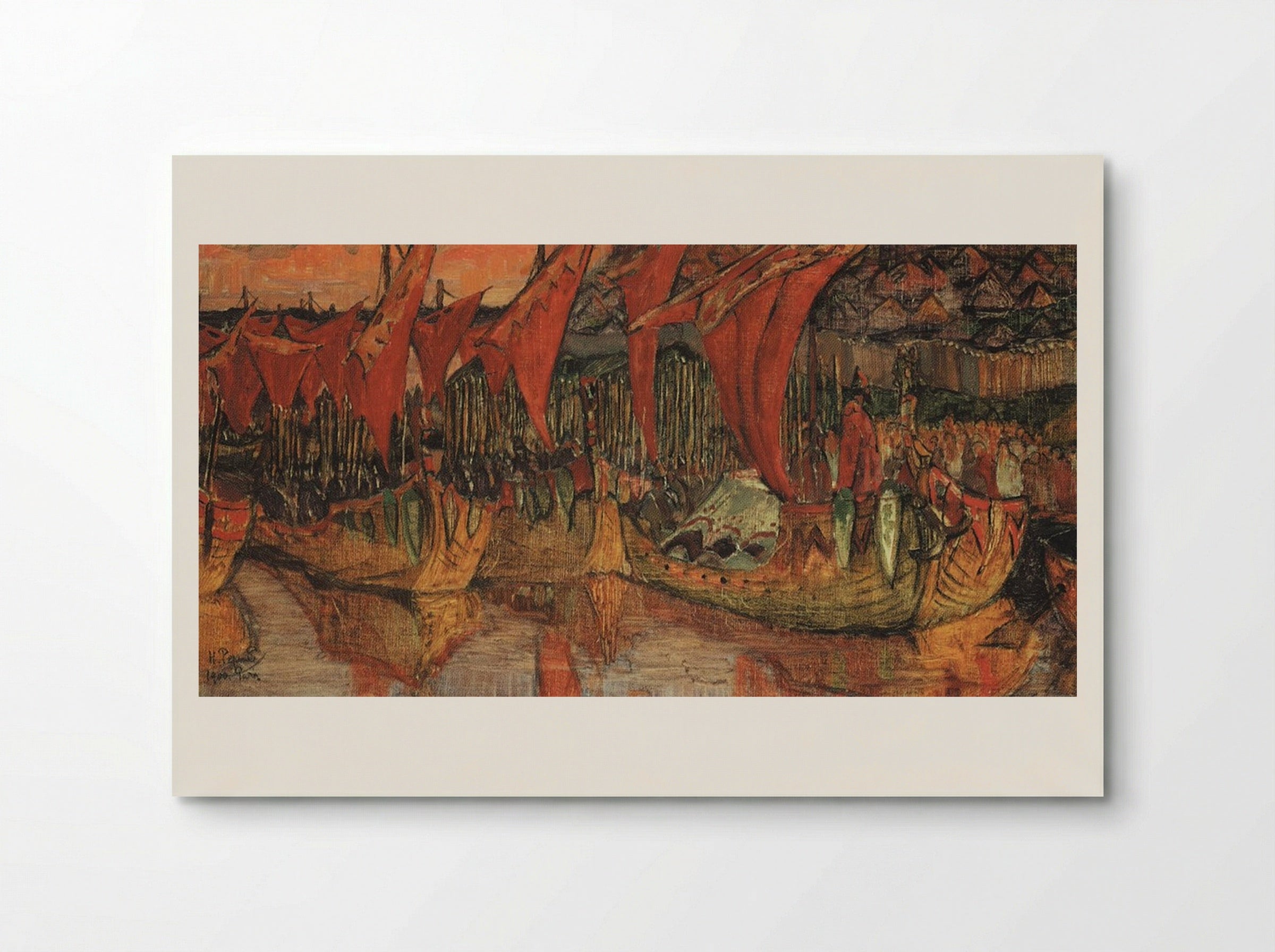
Vladimir campaign to Korsun (Red Sails) - Nicholas Roerich
Archival giclée
Frames arrive ready to hang
Secure checkout
Made to order
Description
A 1900 oil painting by Nicholas Roerich depicting a fleet of ancient vessels with striking red sails, capturing a moment of historical military preparation.
Nicholas Roerich painted this work in 1900 during his early period, which focused heavily on the ancient history and folklore of the Slavic people. The composition depicts a fleet of traditional wooden vessels, often associated with the Varangians or early Kievan Rus, preparing for a military expedition. The most striking element is the series of large, crimson sails that dominate the upper portion of the frame, creating a sense of urgency and movement against the sky. Roerich employs a specific colour palette here, favouring earthy ochres and deep browns for the hulls of the ships, which contrast sharply with the saturated red of the sails. The water reflects these tones, grounding the scene in a sombre, atmospheric reality. The figures on board are rendered with a degree of abstraction, suggesting a collective force rather than individual portraits. This approach aligns with the artist's interest in the mythic past, where the narrative of the group takes precedence over the specific identity of the participants. The brushwork is textured and deliberate, typical of Roerich's early technical approach. He avoids fine detail in favour of capturing the mood and the weight of the historical moment. The ships are arranged in a dense formation, filling the frame and suggesting the scale of the campaign. By focusing on the visual rhythm of the sails and the repetition of the vessel forms, Roerich creates a composition that feels both static and ready for action. This work reflects his academic training at the Imperial Academy of Arts in Saint Petersburg, while simultaneously showing his departure toward the more stylised, symbolic language that would define his later career. It remains a clear example of his fascination with the origins of Russian culture and the aesthetic power of historical storytelling.
Return policy
Because every print is made to order, we don't offer change-of-mind returns, refunds or exchanges. If your order arrives faulty, damaged or incorrect, we'll replace it free of charge — just contact us within 48 hours of delivery. See our refunds page for full details.
Shipping
We ship worldwide, printing at the production hub nearest to your delivery address. Delivery times and costs vary by destination — you'll see the options available to you at checkout.
Manufacturing
Each print is produced to order using 12-colour giclée printing on FSC-certified archival paper. Designed in Britain and printed at your nearest production hub to reduce waste and speed up delivery.
Vladimir campaign to Korsun (Red Sails) - Nicholas Roerich

Artist Biography
Nicholas Roerich
He was born in St Petersburg in 1874 and studied law and art simultaneously before choosing art. After the Revolution, he left Russia and eventually settled in the Kullu Valley of India, where he established a research institute. His paintings of Central Asian mountains, produced in enormous quantities, glow with a flat, saturated colour that reflects his interest in theosophy and Eastern spiritual traditions.
The Roerich Pact, his treaty for protecting cultural sites during wartime, was the precursor to the 1954 Hague Convention. He died in Naggar, Himachal Pradesh, in 1947, at seventy-three.
Our Features
Designed for Lasting Impact
Specific Features
Every Solis piece is made to order with archival, gallery-quality materials built to last.
- Museum-grade giclée printing for rich, fade-resistant colour
- Archival matte fine-art paper, FSC-certified
- Multiple sizes and framing options available
- Frames in black, natural wood, dark wood or white
- Framed prints arrive ready to hang
Care & Cleaning
To keep your artwork looking its best:
- Dust gently with a soft, dry cloth
- Avoid prolonged direct sunlight
- Never use liquid cleaners on the print or canvas surface
- Keep in a dry, room-temperature space
- Handle prints with clean, dry hands
Materials & Sizing
Museum-grade giclée on FSC-certified archival matte paper, with framed and canvas options.
- Paper sizes: A4, A3, A2, A1, A0 and B2 (50×70 cm)
- Canvas: XS (20×30 cm) to Large (60×90 cm)
- Frames: black, natural wood, dark wood or white
Why Choose Us ?
Damage-free delivery guarantee
Fast Shipping
Museum-Quality Materials
Artist Biography
Nicholas Roerich
He was born in St Petersburg in 1874 and studied law and art simultaneously before choosing art. After the Revolution, he left Russia and eventually settled in the Kullu Valley of India, where he established a research institute. His paintings of Central Asian mountains, produced in enormous quantities, glow with a flat, saturated colour that reflects his interest in theosophy and Eastern spiritual traditions.
The Roerich Pact, his treaty for protecting cultural sites during wartime, was the precursor to the 1954 Hague Convention. He died in Naggar, Himachal Pradesh, in 1947, at seventy-three.
You May Also Like