

The Garden - James McNeill Whistler
Archival giclée
Frames arrive ready to hang
Secure checkout
Made to order
Description
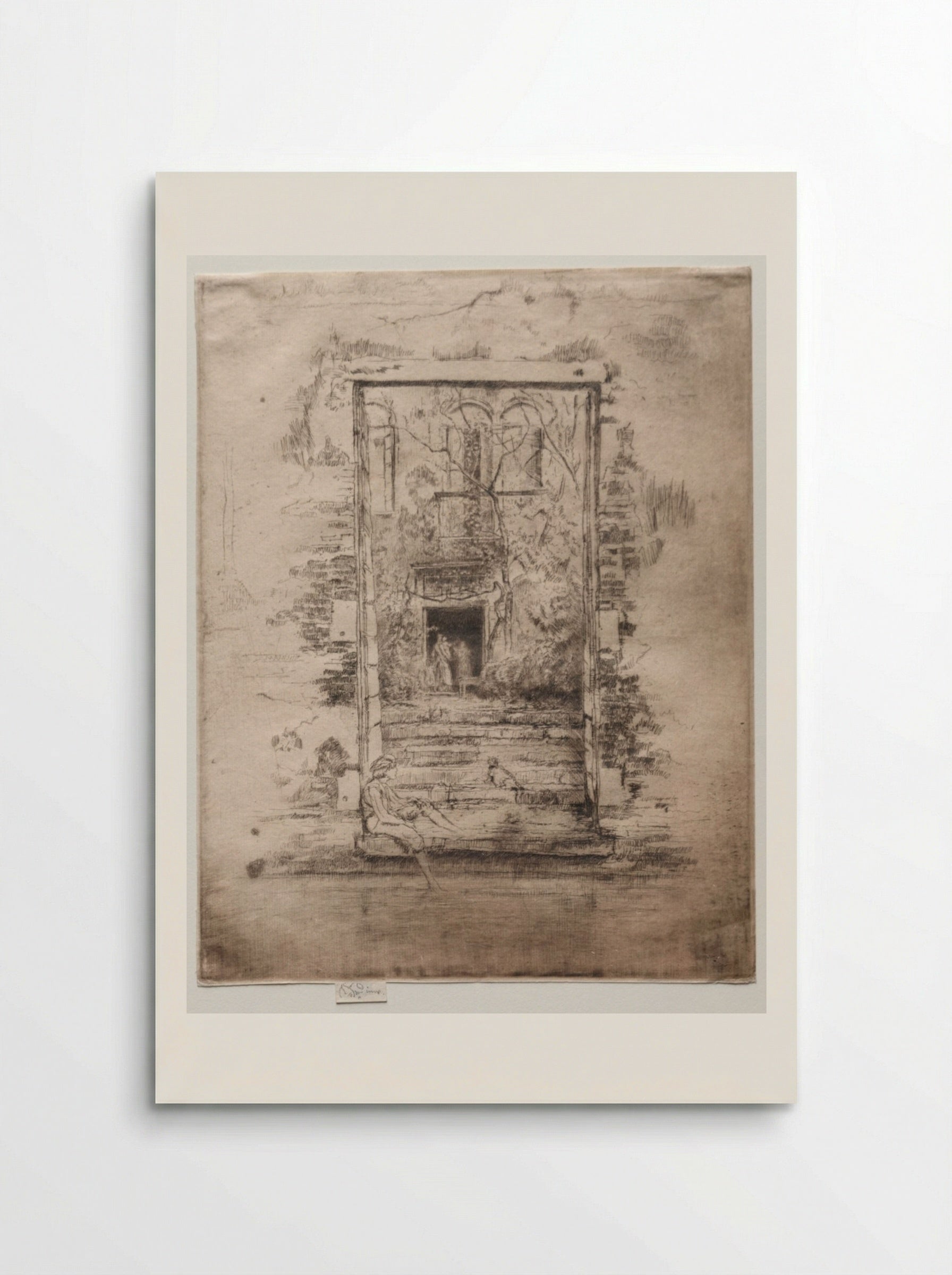
An atmospheric etching from Whistler's Venetian period, capturing a quiet garden doorway with delicate line work and soft, tonal shadows.
This etching, titled The Garden, belongs to the series of works produced by James McNeill Whistler during his stay in Venice between 1879 and 1880. Commissioned by the Fine Art Society in London, this period allowed the artist to refine his approach to printmaking, moving away from the dense, architectural detail of his earlier London etchings toward a more atmospheric and suggestive style. The composition centres on a doorway framed by crumbling masonry and overgrown foliage. A figure sits at the threshold, their form rendered with economical, delicate lines that define posture rather than anatomical precision. The surrounding walls are suggested through light, layered hatching, which creates a sense of texture and age. Whistler employs the technique of plate tone, leaving a thin film of ink on the copper plate during the wiping process, which results in the soft, sepia-toned shadows that envelop the scene. This method allows the paper to retain its luminosity, providing a contrast to the darker, etched lines. Whistler was interested in the interplay between light and shadow, often prioritising the mood of a location over its topographical accuracy. In this work, the garden is not a botanical study but a quiet, contemplative space. The verticality of the doorway acts as a frame within a frame, drawing the eye toward the shadowed interior. The artist's signature butterfly monogram is visible in the lower margin, a mark of his personal branding that became synonymous with his aesthetic philosophy. This print demonstrates his mastery of the etching needle, where every mark serves a specific purpose in building the overall tonal harmony of the image. It remains a representative example of his Venetian period, capturing the decaying elegance of the city through a restrained and sensitive hand.
Return policy
Because every print is made to order, we don't offer change-of-mind returns, refunds or exchanges. If your order arrives faulty, damaged or incorrect, we'll replace it free of charge — just contact us within 48 hours of delivery. See our refunds page for full details.
Shipping
We ship worldwide, printing at the production hub nearest to your delivery address. Delivery times and costs vary by destination — you'll see the options available to you at checkout.
Manufacturing
Each print is produced to order using 12-colour giclée printing on FSC-certified archival paper. Designed in Britain and printed at your nearest production hub to reduce waste and speed up delivery.
The Garden - James McNeill Whistler
Our Features
Designed for Lasting Impact
Specific Features
Every Solis piece is made to order with archival, gallery-quality materials built to last.
- Museum-grade giclée printing for rich, fade-resistant colour
- Archival matte fine-art paper, FSC-certified
- Multiple sizes and framing options available
- Frames in black, natural wood, dark wood or white
- Framed prints arrive ready to hang
Care & Cleaning
To keep your artwork looking its best:
- Dust gently with a soft, dry cloth
- Avoid prolonged direct sunlight
- Never use liquid cleaners on the print or canvas surface
- Keep in a dry, room-temperature space
- Handle prints with clean, dry hands
Materials & Sizing
Museum-grade giclée on FSC-certified archival matte paper, with framed and canvas options.
- Paper sizes: A4, A3, A2, A1, A0 and B2 (50×70 cm)
- Canvas: XS (20×30 cm) to Large (60×90 cm)
- Frames: black, natural wood, dark wood or white
Why Choose Us ?
Damage-free delivery guarantee
Fast Shipping
Museum-Quality Materials

Artist Biography
James McNeill Whistler
He was born in 1834 in Lowell, Massachusetts. His father, a civil engineer, took the family to St Petersburg to advise on the railroad to Moscow. The young Whistler took drawing classes at the Imperial Academy of Sciences. After the West Point disaster, he briefly worked for the US Coast and Geodetic Survey, learning the etching techniques he would use for the rest of his career, then left for Paris. He never lived in America again.
The painting everyone knows as Whistler's Mother is actually called Arrangement in Grey and Black No. 1. He named his works with musical terms (Nocturnes, Arrangements, Harmonies, Symphonies) to insist that painting was about tonal composition, not subject matter. The painting of his mother was about grey and black. That it also depicted his mother was, in principle, secondary.
In 1877, John Ruskin reviewed his Nocturne in Black and Gold: The Falling Rocket and wrote that he never expected to hear a coxcomb ask two hundred guineas for flinging a pot of paint in the public's face. Whistler sued for libel. The case was heard over two days in November 1878. He won, and was awarded damages of one farthing, the least valuable coin in the realm. The legal costs bankrupted him.
He signed his work with a butterfly. It started as a monogram inspired by the potter's marks on Chinese ceramics he collected, gradually evolving into an abstract butterfly shape. Around 1880, he added a stinger to it, representing both the delicate and the combative sides of his personality. The Peacock Room, his masterpiece of decorative art, extended his obsession with total harmony from a single painting to an entire architectural space.
You May Also Like