

Fine Art Poster
From £28
A giclée print on 200gsm matte fine art paper, using a twelve-colour process for accurate, fade-resistant colour. Supplied unframed, delivered flat or rolled.



Archival giclée
Frames arrive ready to hang
Secure checkout
Made to order
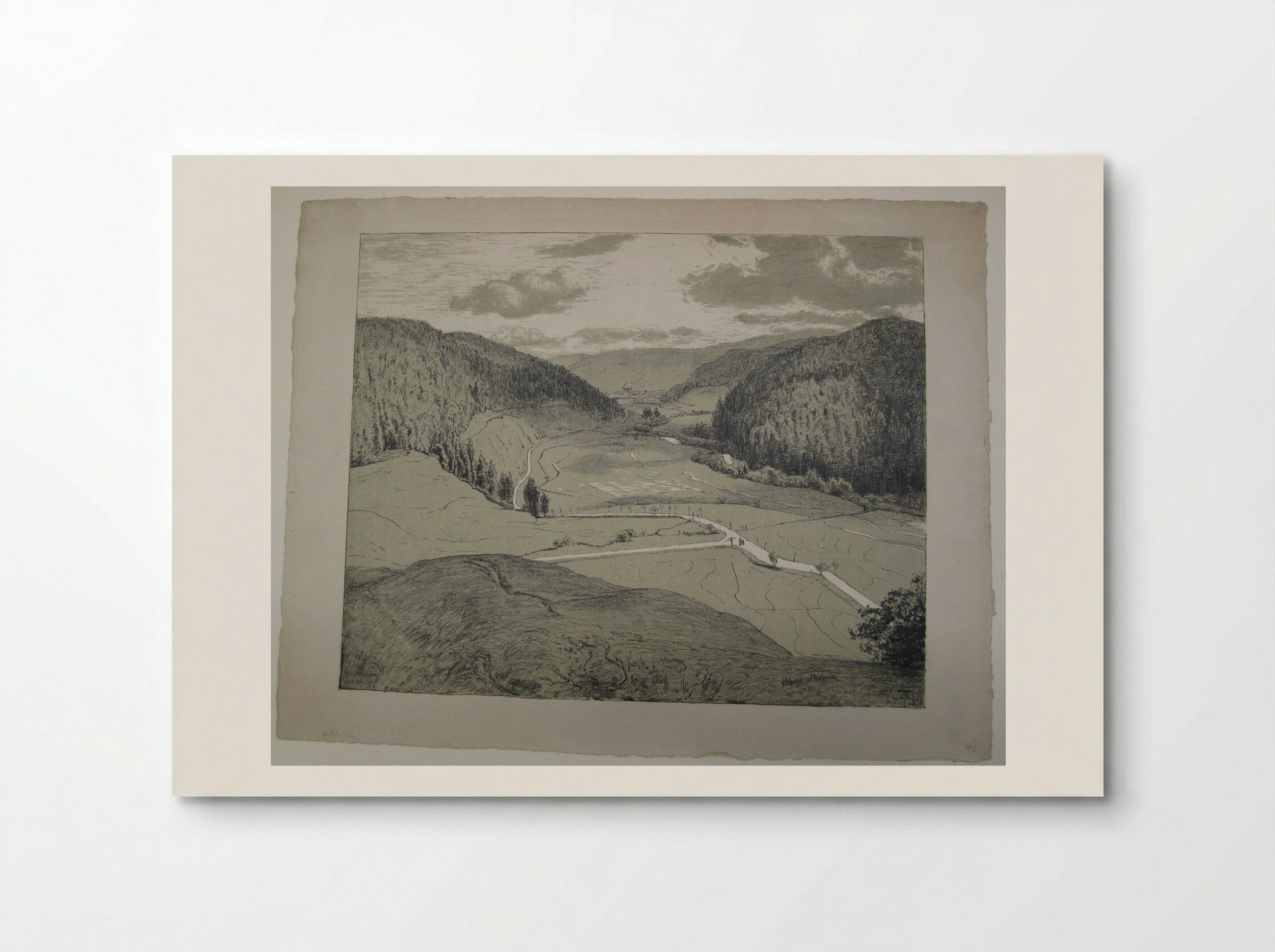
A detailed etching by Hans Thoma depicting the quiet, rolling topography of the St. Blaise valley in the Black Forest.
Hans Thoma, a figure associated with the Black Forest region of Germany, produced this etching depicting the valley of St. Blaise. The composition captures the rolling topography of the area, with the eye drawn from the foreground slopes down into the valley floor where the village sits. Thoma employs a precise, linear technique, using varied hatching to define the textures of the forested hillsides and the open fields. The print reflects the artist's deep connection to his native environment. Thoma often returned to these motifs, finding a sense of order and quietude in the rural geography of the Black Forest. Unlike the more dramatic or turbulent interpretations of nature found in other nineteenth-century works, this etching maintains a steady, observational quality. The sky is rendered with soft, horizontal strokes, providing a sense of atmosphere that balances the structured lines of the terrain below. Technically, the work demonstrates Thoma's proficiency with the etching needle. He creates depth through the contrast between the dark, dense foliage of the hills and the lighter, more open areas of the valley. The inclusion of a small road winding through the centre of the frame provides a sense of scale and human presence within the vastness of the natural setting. This piece is characteristic of Thoma's later graphic output, where he moved away from the more allegorical subjects of his youth toward a more direct, grounded representation of the German countryside. The print offers a clear view of the regional architecture and the agricultural layout of the valley, documenting the area as it appeared at the end of the nineteenth century.
Because every print is made to order, we don't offer change-of-mind returns, refunds or exchanges. If your order arrives faulty, damaged or incorrect, we'll replace it free of charge — just contact us within 48 hours of delivery. See our refunds page for full details.
We ship worldwide, printing at the production hub nearest to your delivery address. Delivery times and costs vary by destination — you'll see the options available to you at checkout.
Each print is produced to order using 12-colour giclée printing on FSC-certified archival paper. Designed in Britain and printed at your nearest production hub to reduce waste and speed up delivery.

Artist Biography
Our Features
Designed for Lasting Impact
Every Solis piece is made to order with archival, gallery-quality materials built to last.
To keep your artwork looking its best:
Museum-grade giclée on FSC-certified archival matte paper, with framed and canvas options.
Made to order
Every piece is printed to order. These are the five finishes, and what makes each one different.
From £28
A giclée print on 200gsm matte fine art paper, using a twelve-colour process for accurate, fade-resistant colour. Supplied unframed, delivered flat or rolled.

From £45
The same fine art print in a solid wood frame with UV-protective acrylic glaze and rigid backing. Five frame colours. Arrives ready to hang.

From £85
A deeper solid wood frame: 33mm deep with a 20mm face and Perspex glaze. The print sits unmounted for a clean gallery presentation. Black, white or natural.

From £30
Hand-stretched canvas with neat gallery-wrapped edges, giving the artwork surface texture and depth. Arrives ready to hang.

From £135
Stretched canvas set in a floating wood frame, our most substantial finish. Arrives ready to hang.
Why Choose Us ?
Damage-free delivery guarantee
Fast Shipping
Museum-Quality Materials
Artist Biography
Hans Thoma
You May Also Like
Cookies show us which prints people love, so we hang the right art. Help us fill it?
Essential cookies only if you prefer · Privacy Policy