


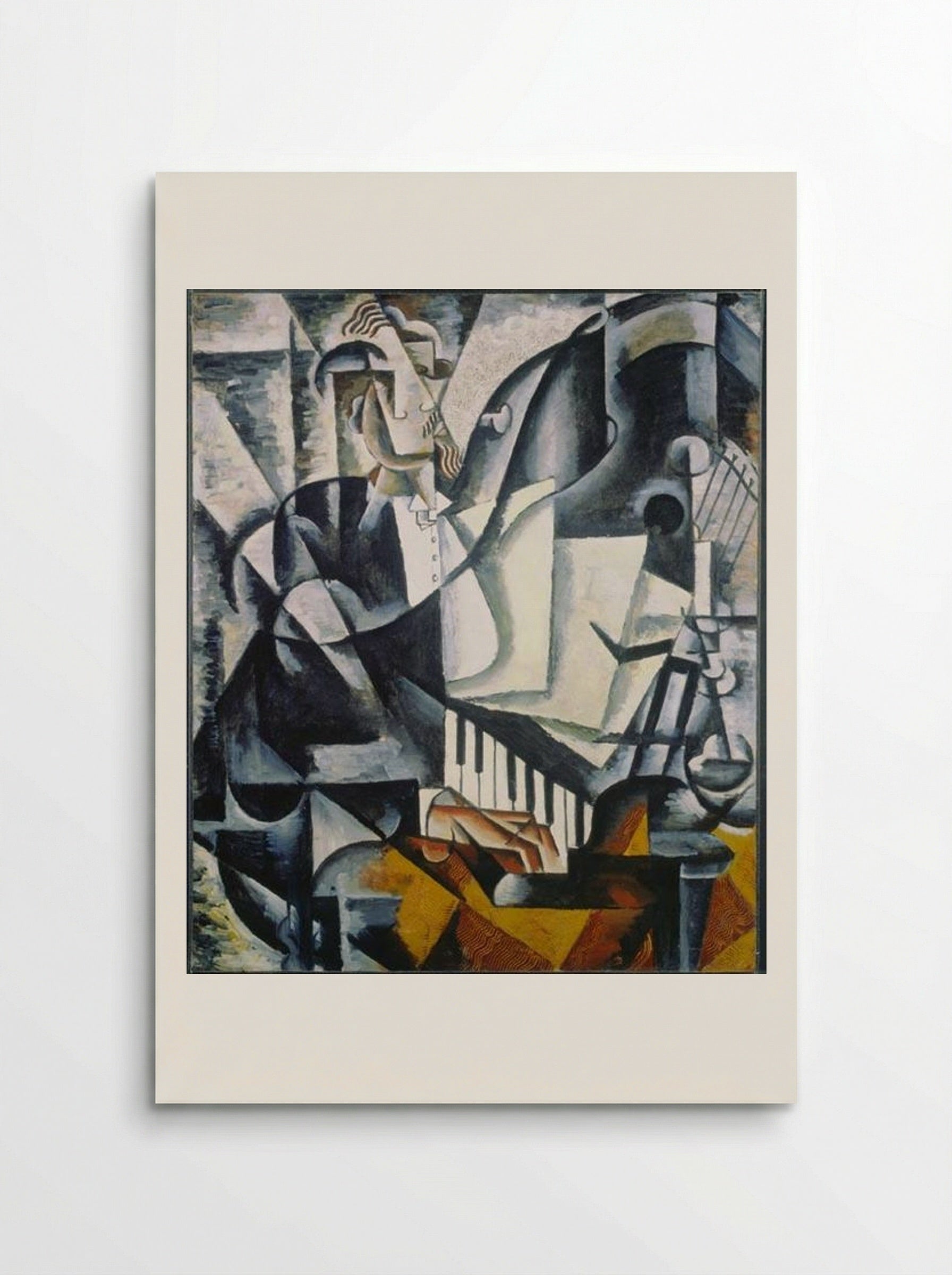
The Pianist - Lyubov Popova
- UK delivery calculated at checkout
- Guaranteed High Quality Prints
- Secure payments
- Sustainable materials
- Made in the UK
A 1914 Cubist oil painting by Lyubov Popova, featuring a fragmented, geometric depiction of a musician at a piano.
Lyubov Popova painted The Pianist in 1914, a period when her work engaged directly with the formal experiments of Parisian Cubism. Following her travels to France and Italy, Popova integrated the analytical methods of Georges Braque and Pablo Picasso into her own practice. This composition demonstrates her interest in the fragmentation of form and the spatial tension between the subject and the surrounding environment. The painting depicts a musician at a piano, though the figure is largely subsumed by the geometric structure of the scene. Popova breaks the human form and the instrument into a series of overlapping planes, angles, and facets. The keys of the piano are rendered as a rhythmic sequence of vertical lines, providing a stable anchor amidst the surrounding angular shapes. Her palette is restrained, relying on a range of greys, blacks, and whites, with occasional ochre tones that provide a subtle contrast to the monochromatic scheme. Popova avoids the decorative tendencies of some of her contemporaries, opting instead for a rigorous examination of volume and light. The composition does not attempt to replicate the physical reality of a pianist, but rather to construct a visual equivalent of the musical experience through geometric order. The interplay of light and shadow across the faceted surfaces creates a sense of movement, suggesting the kinetic energy of performance. This work represents a specific moment in the development of Russian avant-garde art, where artists sought to reconcile the influence of Western European modernism with their own developing aesthetic theories. The painting remains a clear example of the analytical approach that defined Popova's early career, showing her ability to deconstruct complex subjects into a coherent, structured visual language.
The Pianist - Lyubov Popova
Sale price£28.00
Regular price (/)
Crafted for a Lifetime
-
Premium materials
Solid wood frames, UV-protected acrylic glaze, and archival backing for lasting durability.
-
Museum-grade prints
12-colour giclée printing on FSC-certified 200gsm fine art paper, with lifetime fade resistance.
-
Crafted in the UK
Sustainably sourced materials, precision manufactured locally, reducing carbon footprint.
-
Ready to hang
Each frame is sealed with rigid backing and fixings attached, no extra effort required.

Find the finish that fits your home


What our customers say
Real reviews from real customers

Received the beautiful hummingbird print in black frame. Great service, stunning print, I will post a picture when the room is finished. Thank you

Delighted with this print! The colours are extremely vibrant, the imagine crystal clear and beautifully displayed in an attractive frame. Delivery was prompt and securely packaged. Highly recommended and will be using again!

So pleased with my print and the frame it’s housed in. Fantastic quality and really adds character to the room. Communication was great and it was delivered quicker than estimated. Overall I’m extremely pleased and will recommend to friends. I’m already eying up my next purchase!

Beautiful print, great quality and love it with the white frame. Delivery was really fast. I've had loads of compliments from visitors as I've hung it in my hallway as the first thing you see when you enter the house. Couldn't be happier.

Lyubov Popova
declaring easel painting dead for Constructivist textile design, compressing Cubism, Suprematism and industrial art into a decade before dying at thirty-five
This product has no reviews yet.