

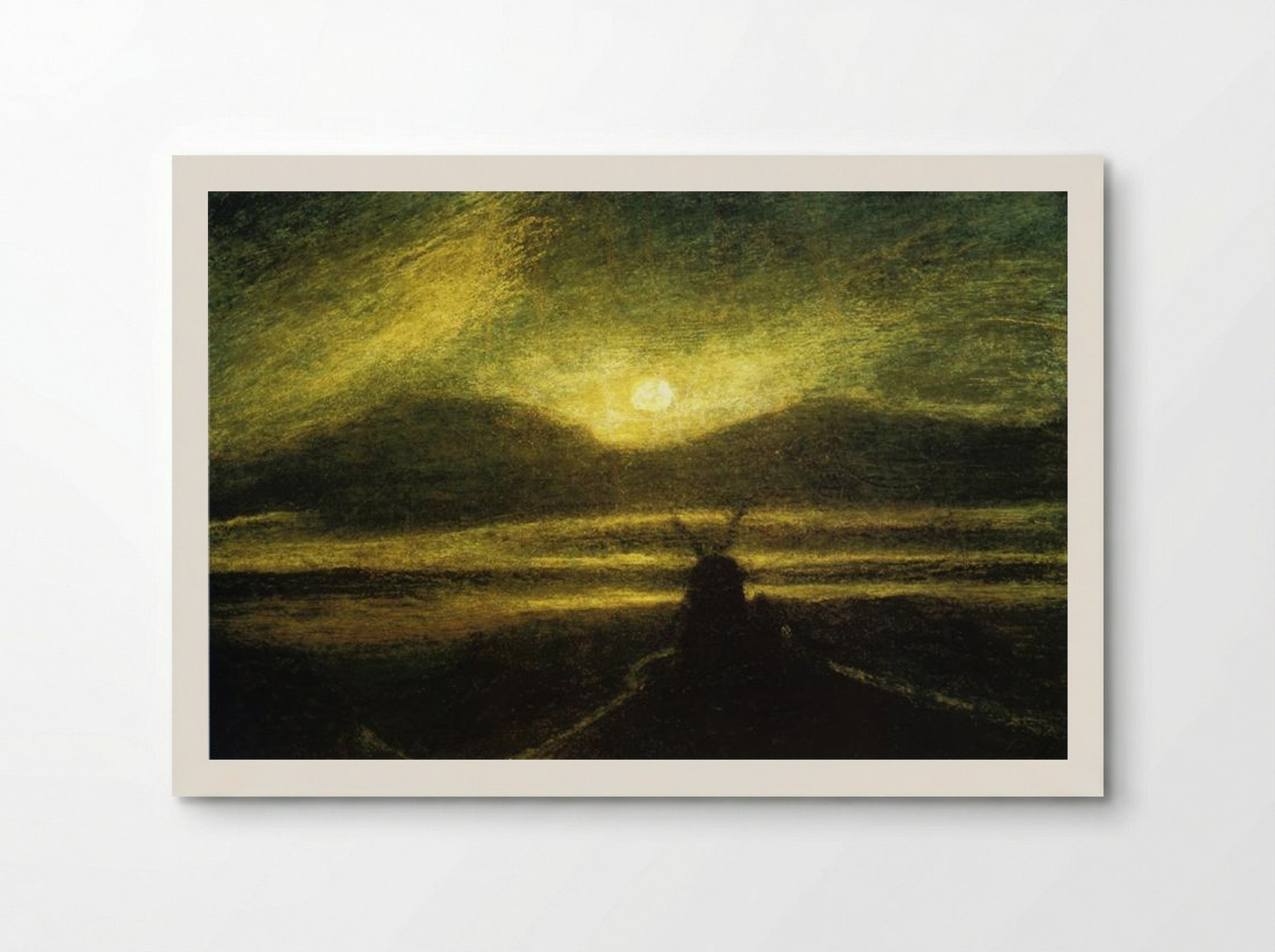
The Old Mill by Moonlight - Albert Pinkham Ryder
Archival giclée
Frames arrive ready to hang
Secure checkout
Made to order
Description
Albert Pinkham Ryder's 'The Old Mill by Moonlight' captures a silhouetted windmill under a radiant moon, rendered in muted tones and thick layers of paint. This work exemplifies Ryder's visionary style and his contribution to American Tonalism.
Albert Pinkham Ryder (1847-1917) was an American painter best known for his poetic and visionary style. He is associated with the American Tonalism movement, which favoured subdued colours and atmospheric effects. Ryder's works often explore themes of nature, mythology, and literature, rendered with a distinctive, dreamlike quality. His unique technique involved building up layers of paint over many years, resulting in surfaces with a luminous depth. 'The Old Mill by Moonlight' exemplifies Ryder's characteristic style. The painting depicts a silhouetted windmill against a nocturnal sky, illuminated by a radiant moon. The scene is simplified and abstracted, reducing the forms to their essential shapes. The colour palette is dominated by muted greens, yellows, and dark browns, creating a sense of mystery and tranquility. The thick application of paint gives the surface a textured, almost sculptural quality, enhancing the painting's ethereal atmosphere. The composition is carefully balanced, with the moon acting as a focal point, drawing the viewer's eye into the scene.
Return policy
Because every print is made to order, we don't offer change-of-mind returns, refunds or exchanges. If your order arrives faulty, damaged or incorrect, we'll replace it free of charge — just contact us within 48 hours of delivery. See our refunds page for full details.
Shipping
We ship worldwide, printing at the production hub nearest to your delivery address. Delivery times and costs vary by destination — you'll see the options available to you at checkout.
Manufacturing
Each print is produced to order using 12-colour giclée printing on FSC-certified archival paper. Designed in Britain and printed at your nearest production hub to reduce waste and speed up delivery.
Care and materials
Specific Features
Every Solis piece is made to order with archival, gallery-quality materials built to last.
- Museum-grade giclée printing for rich, fade-resistant colour
- Archival matte fine-art paper, FSC-certified
- Multiple sizes and framing options available
- Frames in black, natural wood, dark wood or white
- Framed prints arrive ready to hang
Care & Cleaning
To keep your artwork looking its best:
- Dust gently with a soft, dry cloth
- Avoid prolonged direct sunlight
- Never use liquid cleaners on the print or canvas surface
- Keep in a dry, room-temperature space
- Handle prints with clean, dry hands
Materials & Sizing
Museum-grade giclée on FSC-certified archival matte paper, with framed and canvas options.
- Paper sizes: A4, A3, A2, A1, A0 and B2 (50×70 cm)
- Canvas: XS (20×30 cm) to Large (60×90 cm)
- Frames: black, natural wood, dark wood or white
The Old Mill by Moonlight - Albert Pinkham Ryder

Artist Biography
Albert Pinkham Ryder
Born in New Bedford, Massachusetts in 1847, Ryder came from a whaling port, and the sea informed his work throughout. He moved to New York in 1867 to study at the National Academy of Arts, but by the early 1880s had abandoned any interest in accurate description. His subject was emotional truth, rendered through moonlit water, simplified forms, and figures drawn from literature rather than observation. Poe, Chaucer, and maritime legend supplied him with imagery; what mattered, in his own view, was not that a storm cloud was accurate in colour but that the storm itself was present in the picture.
The technical consequences of this method were severe. He built canvases up slowly and obsessively, applying paint over wet underlayers and returning to pictures across months or years, reportedly incorporating unconventional materials including candle wax. All approximately 150 canvases he produced are now significantly cracked, and colours that contemporaries compared to precious stones have largely faded. Jonah (c.1885, 69.2 x 87.3 cm) and Flying Dutchman (c.1887, 36.1 x 43.8 cm), both at the Smithsonian American Art Museum, are among his best-known works. Arthur Dove, Marsden Hartley, and Jackson Pollock all acknowledged his influence.
Why Choose Us ?
Damage-free delivery guarantee
Fast Shipping
Museum-Quality Materials
You May Also Like