

Fine Art Poster
From £28
A giclée print on 200gsm matte fine art paper, using a twelve-colour process for accurate, fade-resistant colour. Supplied unframed, delivered flat or rolled.



Archival giclée
Frames arrive ready to hang
Secure checkout
Made to order
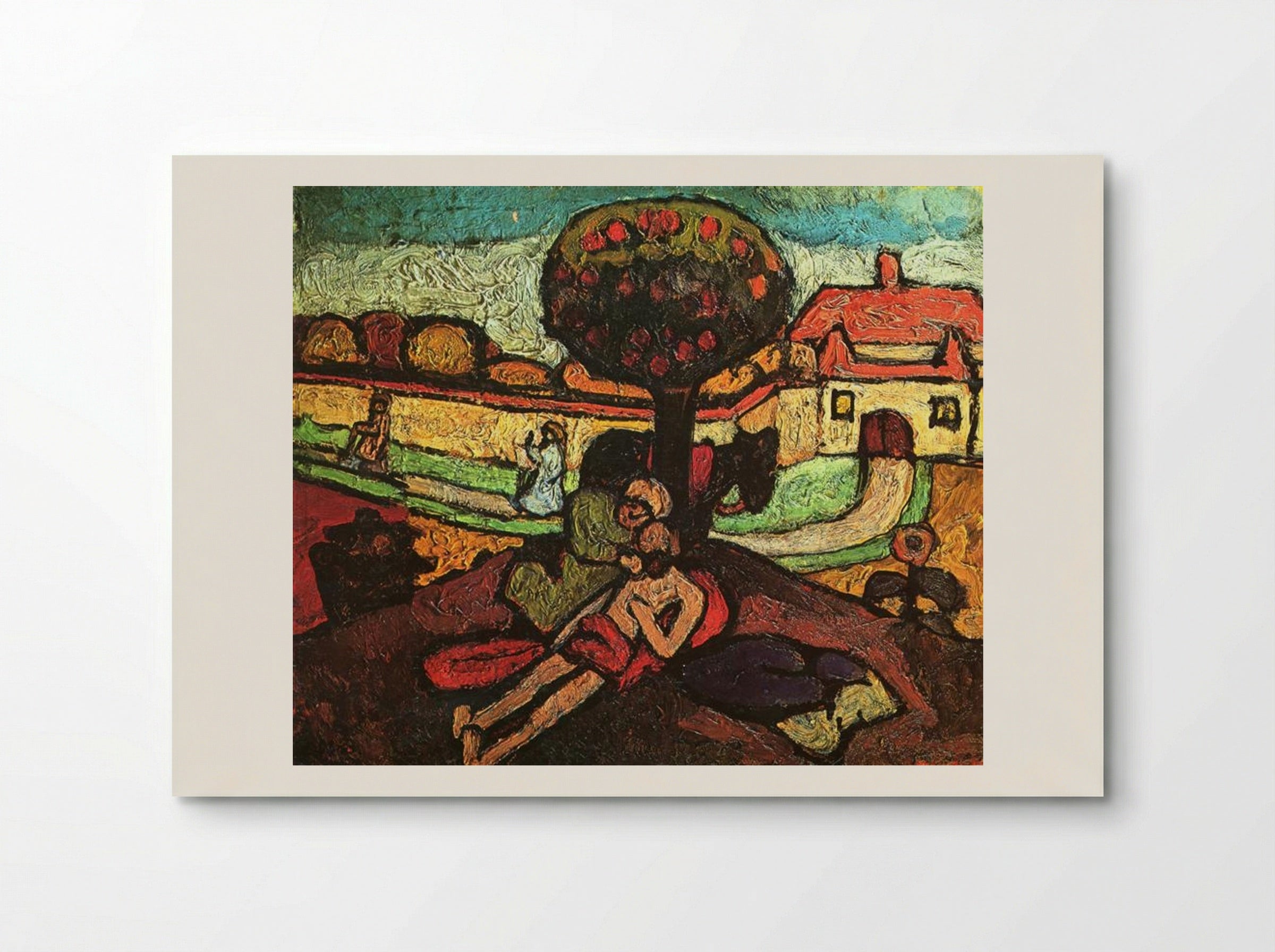
A powerful example of early German Expressionism, this 1907 work by Paula Modersohn-Becker uses thick impasto and simplified forms to reinterpret a biblical narrative.
Paula Modersohn-Becker painted The Good Samaritan in 1907, the final year of her life. This work demonstrates her departure from the naturalistic traditions of the Worpswede colony, moving instead towards a simplified, expressive form of representation. The composition is structured around a central tree, which acts as a vertical anchor for the figures gathered beneath it. Modersohn-Becker employs a heavy impasto technique, where the paint is applied in thick, tactile layers that give the surface a sculptural quality. The narrative subject, derived from the biblical parable, is treated with a deliberate lack of conventional sentimentality. The figures are rendered with blocky, simplified anatomy, reflecting the influence of Paul Cézanne and the works of Paul Gauguin, both of whom she studied during her time in Paris. The colour palette is earthy and grounded, dominated by deep browns, ochres, and muted greens, punctuated by the stark red of the house roof and the fruit in the tree. Unlike the academic painters of her era, Modersohn-Becker prioritised the emotional weight of the form over anatomical precision. The space is flattened, creating a decorative, almost primitive effect that directs the viewer's attention to the interaction between the figures. The donkey, positioned near the tree, serves as a quiet witness to the scene. This painting is representative of her late style, where she sought to capture the essence of human experience through reduced forms and a raw, direct application of pigment. Her work remains a significant example of early German Expressionism, showing a clear break from the artistic conventions of the nineteenth century.
Because every print is made to order, we don't offer change-of-mind returns, refunds or exchanges. If your order arrives faulty, damaged or incorrect, we'll replace it free of charge — just contact us within 48 hours of delivery. See our refunds page for full details.
We ship worldwide, printing at the production hub nearest to your delivery address. Delivery times and costs vary by destination — you'll see the options available to you at checkout.
Each print is produced to order using 12-colour giclée printing on FSC-certified archival paper. Designed in Britain and printed at your nearest production hub to reduce waste and speed up delivery.
Specific Features
Every Solis piece is made to order with archival, gallery-quality materials built to last.
Care & Cleaning
To keep your artwork looking its best:
Materials & Sizing
Museum-grade giclée on FSC-certified archival matte paper, with framed and canvas options.

Artist Biography
Made to order
Every piece is printed to order. These are the five finishes, and what makes each one different.
From £28
A giclée print on 200gsm matte fine art paper, using a twelve-colour process for accurate, fade-resistant colour. Supplied unframed, delivered flat or rolled.

From £45
The same fine art print in a solid wood frame with UV-protective acrylic glaze and rigid backing. Five frame colours. Arrives ready to hang.

From £85
A deeper solid wood frame: 33mm deep with a 20mm face and Perspex glaze. The print sits unmounted for a clean gallery presentation. Black, white or natural.

From £30
Hand-stretched canvas with neat gallery-wrapped edges, giving the artwork surface texture and depth. Arrives ready to hang.

From £135
Stretched canvas set in a floating wood frame, our most substantial finish. Arrives ready to hang.
Why Choose Us ?
Damage-free delivery guarantee
Fast Shipping
Museum-Quality Materials
You May Also Like
We use cookies to measure our marketing and see which prints people love.We use cookies to measure our marketing.
By continuing to browse, you agree · Privacy Policy