

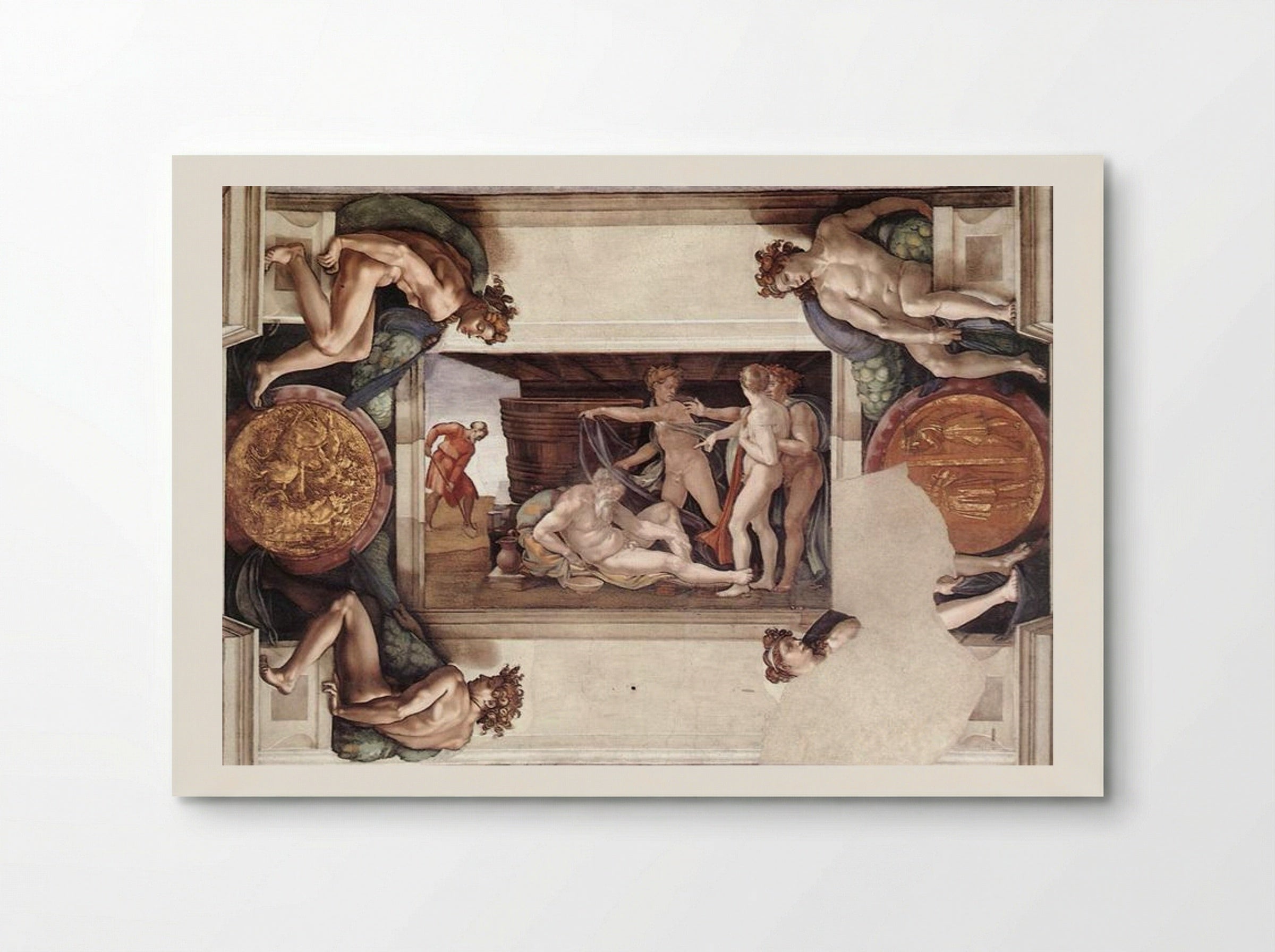
The Drunkenness of Noah - Michelangelo Buonarroti
Archival giclée
Frames arrive ready to hang
Secure checkout
Made to order
Description
A fine art print of Michelangelo's fresco from the Sistine Chapel ceiling, depicting the biblical narrative of Noah.
The Drunkenness of Noah is a fresco panel located on the ceiling of the Sistine Chapel in the Vatican. Michelangelo painted this scene as part of his larger cycle depicting the Book of Genesis. The composition focuses on the narrative of Noah, who is shown in a state of vulnerability after consuming wine from his vineyard. His sons, Shem, Ham, and Japheth, approach him to cover his nakedness, a moment that carries significant moral weight within the biblical account. Michelangelo employs a sculptural approach to the human form, a hallmark of his practice. The figures possess a physical weight and muscular definition that reflect his background as a sculptor. The scene is framed by architectural elements and the iconic ignudi, the nude male figures that populate the corners of the central panels. These surrounding figures provide a sense of structural rhythm to the ceiling, connecting the narrative scenes to the broader decorative scheme of the chapel. The palette remains grounded in earthy tones, with subtle transitions in skin tone and drapery. The spatial arrangement is relatively shallow, focusing the viewer on the interaction between the figures rather than a deep background. This work demonstrates the artist's mastery of anatomy and his ability to convey complex human emotion through gesture and posture. The inclusion of the bronze-coloured medallions and the surrounding figures creates a sense of unity across the vast ceiling surface. This print captures the technical precision of the original fresco, allowing for a close examination of the brushwork and the anatomical studies that define this period of Italian art.
Return policy
Because every print is made to order, we don't offer change-of-mind returns, refunds or exchanges. If your order arrives faulty, damaged or incorrect, we'll replace it free of charge — just contact us within 48 hours of delivery. See our refunds page for full details.
Shipping
We ship worldwide, printing at the production hub nearest to your delivery address. Delivery times and costs vary by destination — you'll see the options available to you at checkout.
Manufacturing
Each print is produced to order using 12-colour giclée printing on FSC-certified archival paper. Designed in Britain and printed at your nearest production hub to reduce waste and speed up delivery.
The Drunkenness of Noah - Michelangelo Buonarroti
Our Features
Designed for Lasting Impact
Specific Features
Every Solis piece is made to order with archival, gallery-quality materials built to last.
- Museum-grade giclée printing for rich, fade-resistant colour
- Archival matte fine-art paper, FSC-certified
- Multiple sizes and framing options available
- Frames in black, natural wood, dark wood or white
- Framed prints arrive ready to hang
Care & Cleaning
To keep your artwork looking its best:
- Dust gently with a soft, dry cloth
- Avoid prolonged direct sunlight
- Never use liquid cleaners on the print or canvas surface
- Keep in a dry, room-temperature space
- Handle prints with clean, dry hands
Materials & Sizing
Museum-grade giclée on FSC-certified archival matte paper, with framed and canvas options.
- Paper sizes: A4, A3, A2, A1, A0 and B2 (50×70 cm)
- Canvas: XS (20×30 cm) to Large (60×90 cm)
- Frames: black, natural wood, dark wood or white
Why Choose Us ?
Damage-free delivery guarantee
Fast Shipping
Museum-Quality Materials

Artist Biography
Michelangelo
He was apprenticed to Domenico Ghirlandaio at thirteen, the standard arrangement for a Florentine boy showing artistic ability. Ghirlandaio ran the largest workshop in the city and was a master of fresco technique. Michelangelo left after one year, claiming there was nothing more to learn. He moved to the sculpture garden of Lorenzo de' Medici, where he studied ancient Roman fragments and attracted the patronage of the Medici family. He was sixteen.
The Pieta was finished when he was twenty-four. David when he was twenty-nine. Both before the age of thirty. He carved David from a block of marble that two previous sculptors had already attempted and abandoned: a narrow, shallow piece that dictated the figure's proportions and made the engineering problem as interesting as the artistic one.
Pope Julius II commissioned the Sistine Chapel ceiling in 1508. Michelangelo did not want the job. He considered himself a sculptor, not a painter, and suspected the commission was a political manoeuvre by rivals to set him up for public failure. He fired his assistants, built his own scaffolding, and painted the entire 65-foot ceiling himself over four years. The image of him lying on his back is a myth; he stood, bending backwards, paint dripping into his eyes.
He outlived both Leonardo and Raphael by more than forty years. His last significant work was the redesign of St Peter's Basilica in Rome. He took no fee.
You May Also Like