

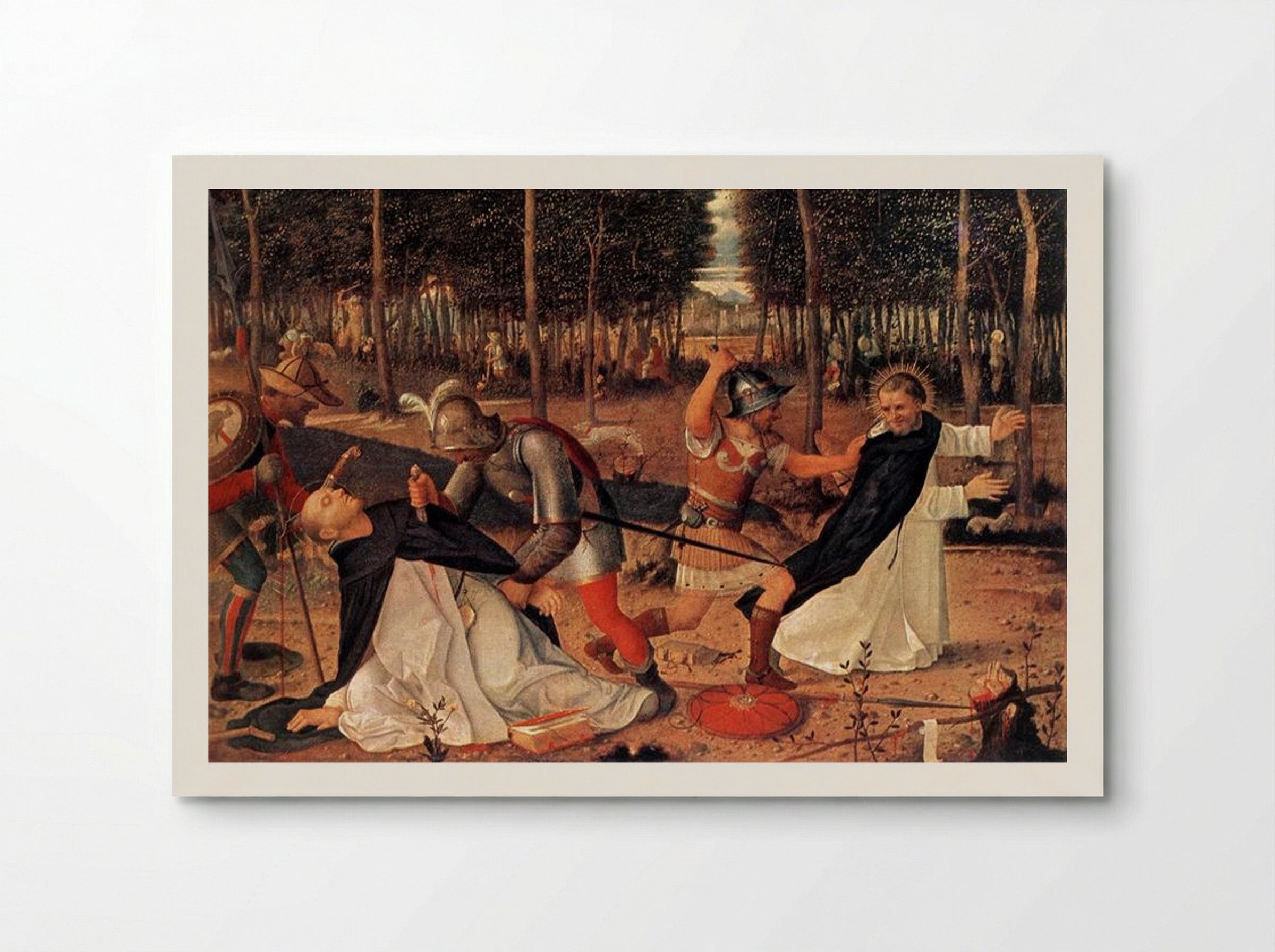
The Assassination of St. Peter Martyr - Giovanni Bellini
Archival giclée
Frames arrive ready to hang
Secure checkout
Made to order
Description
Giovanni Bellini's "The Assassination of St. Peter Martyr" captures the dramatic murder of the Dominican friar in a dense forest, showcasing Bellini's mastery of colour and composition typical of the Venetian Early Renaissance.
Giovanni Bellini's "The Assassination of St. Peter Martyr" depicts the dramatic murder of the Dominican friar, Peter of Verona, in a forest. Painted in 1509, this work shows Bellini's mastery of colour and composition, typical of the Venetian Early Renaissance. The scene unfolds with a theatrical intensity, capturing the moment of violence as assassins attack St. Peter and another friar. The composition is carefully arranged, with the figures positioned to guide the viewer's eye through the unfolding action. The dense forest setting adds to the drama, creating a sense of enclosure and danger. Bellini's use of light and shadow enhances the emotional impact of the scene, casting a sombre mood over the event. The figures are rendered with anatomical precision and emotional expressiveness, conveying both the brutality of the act and the saint's acceptance of his fate. Bellini's painting reflects the religious and artistic sensibilities of the period, combining a narrative with a refined aesthetic sensibility. The work is a powerful example of Bellini's ability to blend human drama with spiritual depth, making it a significant work of the Italian Renaissance.
Return policy
Because every print is made to order, we don't offer change-of-mind returns, refunds or exchanges. If your order arrives faulty, damaged or incorrect, we'll replace it free of charge — just contact us within 48 hours of delivery. See our refunds page for full details.
Shipping
We ship worldwide, printing at the production hub nearest to your delivery address. Delivery times and costs vary by destination — you'll see the options available to you at checkout.
Manufacturing
Each print is produced to order using 12-colour giclée printing on FSC-certified archival paper. Designed in Britain and printed at your nearest production hub to reduce waste and speed up delivery.
Care and materials
Specific Features
Every Solis piece is made to order with archival, gallery-quality materials built to last.
- Museum-grade giclée printing for rich, fade-resistant colour
- Archival matte fine-art paper, FSC-certified
- Multiple sizes and framing options available
- Frames in black, natural wood, dark wood or white
- Framed prints arrive ready to hang
Care & Cleaning
To keep your artwork looking its best:
- Dust gently with a soft, dry cloth
- Avoid prolonged direct sunlight
- Never use liquid cleaners on the print or canvas surface
- Keep in a dry, room-temperature space
- Handle prints with clean, dry hands
Materials & Sizing
Museum-grade giclée on FSC-certified archival matte paper, with framed and canvas options.
- Paper sizes: A4, A3, A2, A1, A0 and B2 (50×70 cm)
- Canvas: XS (20×30 cm) to Large (60×90 cm)
- Frames: black, natural wood, dark wood or white
The Assassination of St. Peter Martyr - Giovanni Bellini

Artist Biography
Giovanni Bellini
His brother-in-law was Andrea Mantegna, who married Jacopo's daughter Nicolosia. The two men influenced each other constantly: Mantegna's hard, sculptural line pushed Bellini toward precision, while Bellini's instinct for colour and atmosphere gradually softened Mantegna's edges. The dialogue between them is one of the most productive in Renaissance art.
He transformed Venetian painting by introducing oil glazes over tempera, a technique he adapted from Antonello da Messina after Antonello visited Venice in 1475. The new method allowed him to build up translucent layers of colour that captured the specific quality of Venetian light: soft, diffused, reflected off water. Before Bellini, Venetian painters worked in the dry, linear style of the rest of Italy. After Bellini, Venice had its own tradition.
Titian and Giorgione both came through his workshop. Titian may have caused him some annoyance; their professional relationship was complicated. But Bellini was painting into his eighties, still the official painter of the Venetian Republic, and still producing work that held its own against pupils forty years younger.
When Albrecht Durer visited Venice in 1505, he said Bellini was very old but still the greatest artist of them all.
Why Choose Us ?
Damage-free delivery guarantee
Fast Shipping
Museum-Quality Materials
You May Also Like