

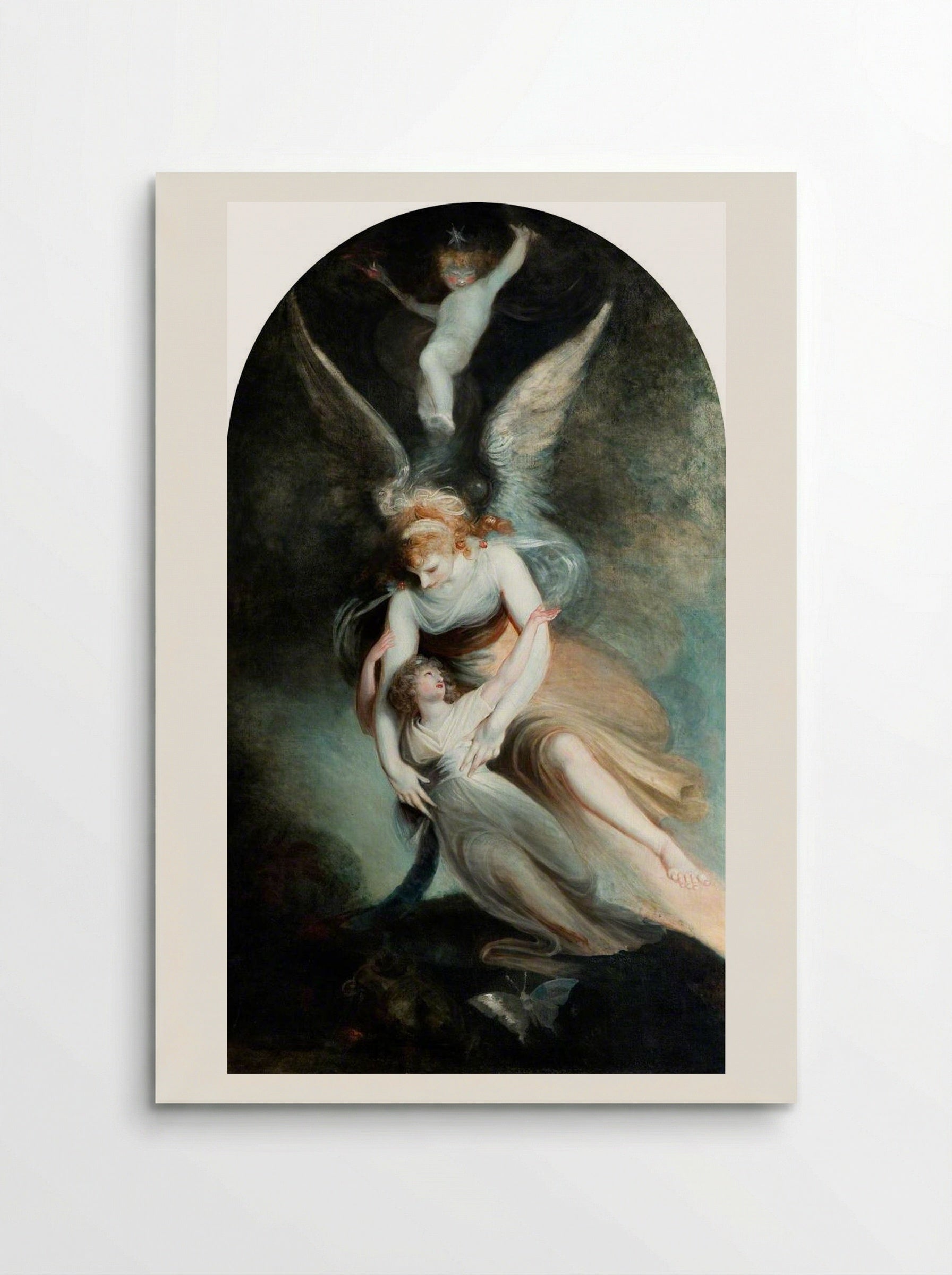
The Apotheosis of Penelope Boothby - Henry Fuseli
Archival giclée
Frames arrive ready to hang
Secure checkout
Made to order
Description
A poignant allegorical painting by Henry Fuseli depicting the soul of Penelope Boothby ascending to the heavens.
Henry Fuseli, a Swiss-born painter active in London, produced this work following the premature death of Penelope Boothby, the daughter of Sir Brooke Boothby. The painting depicts the child being carried heavenward by a winged figure, a common allegorical device in late eighteenth-century funerary art to represent the soul's transition to the afterlife. Fuseli employs a dramatic, theatrical lighting scheme that is characteristic of his broader body of work. The figures emerge from a dark, atmospheric background, their forms illuminated by a soft, ethereal glow. The composition is vertical and arched, guiding the viewer's eye upward toward the celestial figure above the child. The brushwork is fluid, prioritising the emotional weight of the scene over precise anatomical realism. Penelope Boothby was a well-known figure in the period, having been famously painted by Sir Joshua Reynolds. Fuseli's interpretation moves away from the portraiture style of his contemporaries, opting instead for a mythological treatment of her passing. The inclusion of a butterfly near the bottom of the frame serves as a traditional symbol of the soul. The painting reflects the period's preoccupation with sentimentality and the idealisation of childhood innocence. Fuseli's use of shadow and light creates a sense of movement, as the figures appear to drift through a nebulous, dreamlike space. This work remains a clear example of the artist's ability to blend classical themes with the intense, subjective emotionality that defined the early Romantic movement in Britain.
Return policy
Because every print is made to order, we don't offer change-of-mind returns, refunds or exchanges. If your order arrives faulty, damaged or incorrect, we'll replace it free of charge — just contact us within 48 hours of delivery. See our refunds page for full details.
Shipping
We ship worldwide, printing at the production hub nearest to your delivery address. Delivery times and costs vary by destination — you'll see the options available to you at checkout.
Manufacturing
Each print is produced to order using 12-colour giclée printing on FSC-certified archival paper. Designed in Britain and printed at your nearest production hub to reduce waste and speed up delivery.
The Apotheosis of Penelope Boothby - Henry Fuseli

Artist Biography
Henry Fuseli
He was born Johann Heinrich Fussli in Zurich in 1741, the second of eighteen children. He was ordained as a minister in 1761 but forced to leave Switzerland after helping expose a corrupt magistrate. He spent eight years in Rome, changed his name from Fussli to the Italianate Fuseli, and arrived in London with a taste for the violent, the erotic, and the supernatural.
William Blake, not easily impressed, said of him: the only man that e'er I knew who did not make me almost spew. This was a compliment. Blake meant Fuseli was the only person who did not disgust him. Their friendship lasted decades. Fuseli married his model Sophia Rawlins in 1788. He became Keeper of the Royal Academy and grew increasingly conservative in his politics despite having started as a radical. He died in 1825, aged eighty-four, and was buried in St Paul's Cathedral.
Our Features
Designed for Lasting Impact
Specific Features
Every Solis piece is made to order with archival, gallery-quality materials built to last.
- Museum-grade giclée printing for rich, fade-resistant colour
- Archival matte fine-art paper, FSC-certified
- Multiple sizes and framing options available
- Frames in black, natural wood, dark wood or white
- Framed prints arrive ready to hang
Care & Cleaning
To keep your artwork looking its best:
- Dust gently with a soft, dry cloth
- Avoid prolonged direct sunlight
- Never use liquid cleaners on the print or canvas surface
- Keep in a dry, room-temperature space
- Handle prints with clean, dry hands
Materials & Sizing
Museum-grade giclée on FSC-certified archival matte paper, with framed and canvas options.
- Paper sizes: A4, A3, A2, A1, A0 and B2 (50×70 cm)
- Canvas: XS (20×30 cm) to Large (60×90 cm)
- Frames: black, natural wood, dark wood or white
Why Choose Us ?
Damage-free delivery guarantee
Fast Shipping
Museum-Quality Materials
Artist Biography
Henry Fuseli
He was born Johann Heinrich Fussli in Zurich in 1741, the second of eighteen children. He was ordained as a minister in 1761 but forced to leave Switzerland after helping expose a corrupt magistrate. He spent eight years in Rome, changed his name from Fussli to the Italianate Fuseli, and arrived in London with a taste for the violent, the erotic, and the supernatural.
William Blake, not easily impressed, said of him: the only man that e'er I knew who did not make me almost spew. This was a compliment. Blake meant Fuseli was the only person who did not disgust him. Their friendship lasted decades. Fuseli married his model Sophia Rawlins in 1788. He became Keeper of the Royal Academy and grew increasingly conservative in his politics despite having started as a radical. He died in 1825, aged eighty-four, and was buried in St Paul's Cathedral.
You May Also Like