

Skidegate - Emily Carr
Archival giclée
Frames arrive ready to hang
Secure checkout
Made to order
Description
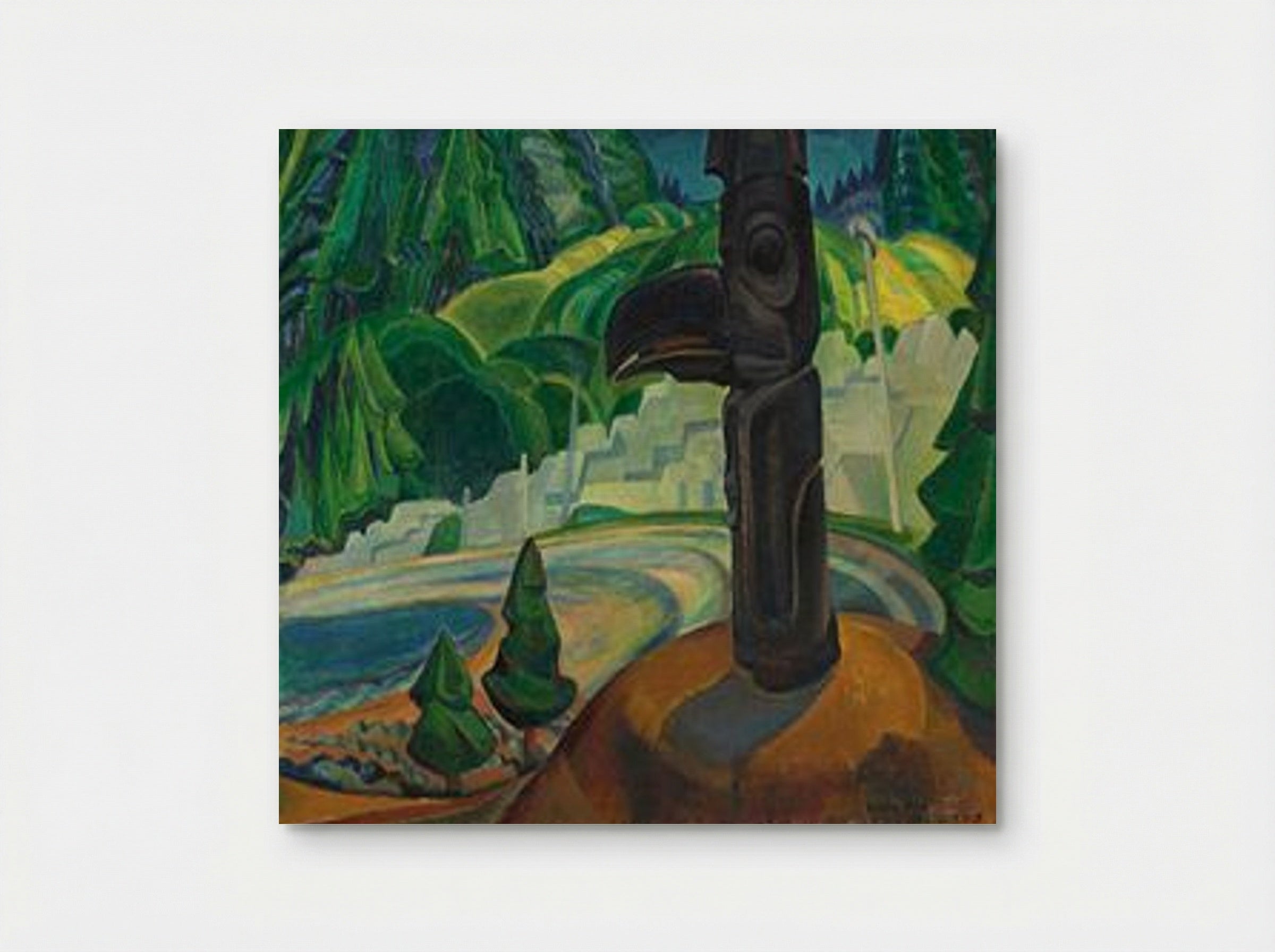
A powerful modernist depiction of a Haida totem pole at Skidegate, rendered in Emily Carr's signature rhythmic, expressive style.
Emily Carr, a central figure in Canadian modernism, produced this work during a period of intense focus on the Indigenous cultures of the Pacific Northwest. Skidegate, a Haida village on the Queen Charlotte Islands, provided the subject for this composition. The painting features a prominent totem pole, rendered with heavy, sculptural forms that dominate the foreground. Carr employs a rhythmic, swirling application of paint to depict the surrounding forest and coastal environment, moving away from literal representation toward a more personal, emotive interpretation of the terrain. The palette relies on deep forest greens, earthy browns, and cool blues, which unify the totem pole with the natural world. Carr often used these rhythmic brushstrokes to suggest the spiritual energy she perceived in the environment. The composition balances the verticality of the carved pole against the sweeping, curved lines of the shoreline and the dense, undulating foliage. By this stage in her career, Carr had moved past her earlier, more descriptive watercolour techniques, adopting a bolder, more assertive oil painting style influenced by her exposure to European modernism and her deep connection to the British Columbia coast. This work reflects her ongoing documentation of Haida and Tsimshian sites, which she visited repeatedly throughout the 1920s. Rather than a static record, the painting functions as an atmospheric study of the relationship between human-made structures and the untamed environment. The heavy, dark form of the totem acts as a grounding element, while the surrounding trees and water appear to pulse with movement. Carr's approach here demonstrates her ability to synthesise the visual language of the forest with the cultural history of the region, creating a distinct aesthetic that remains recognisable as her own.
Return policy
Because every print is made to order, we don't offer change-of-mind returns, refunds or exchanges. If your order arrives faulty, damaged or incorrect, we'll replace it free of charge — just contact us within 48 hours of delivery. See our refunds page for full details.
Shipping
We ship worldwide, printing at the production hub nearest to your delivery address. Delivery times and costs vary by destination — you'll see the options available to you at checkout.
Manufacturing
Each print is produced to order using 12-colour giclée printing on FSC-certified archival paper. Designed in Britain and printed at your nearest production hub to reduce waste and speed up delivery.
Care and materials
Specific Features
Every Solis piece is made to order with archival, gallery-quality materials built to last.
- Museum-grade giclée printing for rich, fade-resistant colour
- Archival matte fine-art paper, FSC-certified
- Multiple sizes and framing options available
- Frames in black, natural wood, dark wood or white
- Framed prints arrive ready to hang
Care & Cleaning
To keep your artwork looking its best:
- Dust gently with a soft, dry cloth
- Avoid prolonged direct sunlight
- Never use liquid cleaners on the print or canvas surface
- Keep in a dry, room-temperature space
- Handle prints with clean, dry hands
Materials & Sizing
Museum-grade giclée on FSC-certified archival matte paper, with framed and canvas options.
- Paper sizes: A4, A3, A2, A1, A0 and B2 (50×70 cm)
- Canvas: XS (20×30 cm) to Large (60×90 cm)
- Frames: black, natural wood, dark wood or white
Skidegate - Emily Carr
Why Choose Us ?
Damage-free delivery guarantee
Fast Shipping
Museum-Quality Materials
You May Also Like