

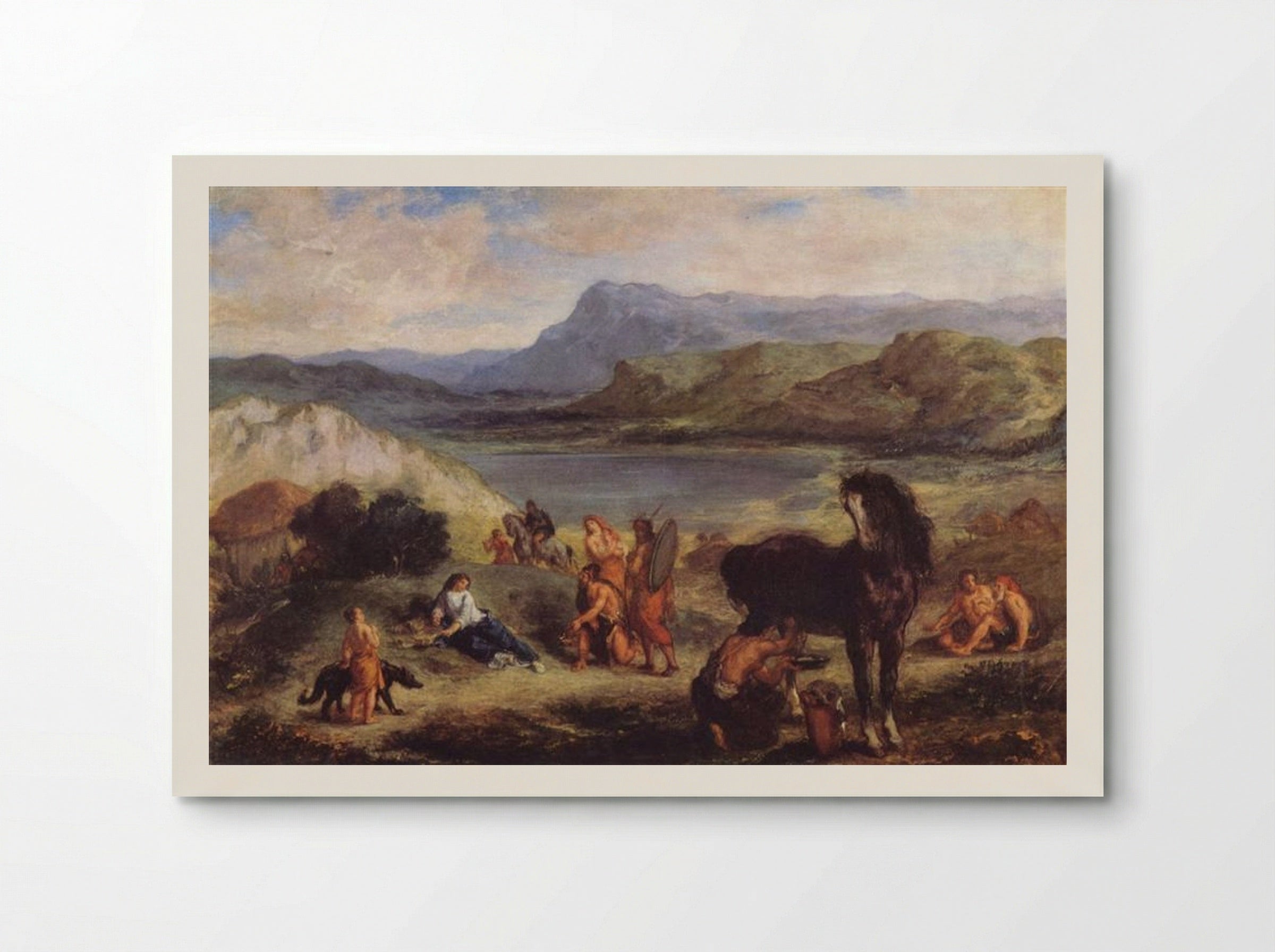
Ovid among the Scythians - Eugène Delacroix
Archival giclée
Frames arrive ready to hang
Secure checkout
Made to order
Description
A contemplative work by Eugène Delacroix depicting the Roman poet Ovid in exile among the Scythian tribes.
Eugène Delacroix painted Ovid among the Scythians in 1859, a work that reflects his fascination with the themes of exile and the collision of civilisations. The composition depicts the Roman poet Ovid, who was banished by Emperor Augustus to the remote Black Sea outpost of Tomis. Delacroix portrays the poet reclining on the ground, surrounded by the local Scythian tribespeople who appear curious and somewhat wary of the stranger in their midst. The scene is set against a vast, rugged terrain, with mountains rising in the distance and a calm body of water occupying the middle ground. Delacroix uses a palette of earthy tones, greens, and muted blues to convey the isolation of the region. The figures are arranged in a loose, naturalistic grouping, with a dark horse standing prominently in the foreground, its presence adding a sense of weight to the composition. The interaction between the Roman intellectual and the nomadic inhabitants suggests a quiet tension, as the two worlds meet in a harsh, unforgiving environment. This painting is characteristic of Delacroix's later period, where he moved away from the dramatic, high-energy scenes of his youth towards more contemplative, literary subjects. The brushwork is fluid and expressive, allowing the light to play across the figures and the landscape. By focusing on the figure of Ovid, Delacroix explores the psychological state of the exile, cut off from the cultural centre of Rome and forced to adapt to a life of primitive simplicity. The work remains a fine example of nineteenth-century French Romanticism, demonstrating the artist's ability to combine historical narrative with a deeply personal sense of atmosphere and mood.
Return policy
Because every print is made to order, we don't offer change-of-mind returns, refunds or exchanges. If your order arrives faulty, damaged or incorrect, we'll replace it free of charge — just contact us within 48 hours of delivery. See our refunds page for full details.
Shipping
We ship worldwide, printing at the production hub nearest to your delivery address. Delivery times and costs vary by destination — you'll see the options available to you at checkout.
Manufacturing
Each print is produced to order using 12-colour giclée printing on FSC-certified archival paper. Designed in Britain and printed at your nearest production hub to reduce waste and speed up delivery.
Care and materials
Specific Features
Every Solis piece is made to order with archival, gallery-quality materials built to last.
- Museum-grade giclée printing for rich, fade-resistant colour
- Archival matte fine-art paper, FSC-certified
- Multiple sizes and framing options available
- Frames in black, natural wood, dark wood or white
- Framed prints arrive ready to hang
Care & Cleaning
To keep your artwork looking its best:
- Dust gently with a soft, dry cloth
- Avoid prolonged direct sunlight
- Never use liquid cleaners on the print or canvas surface
- Keep in a dry, room-temperature space
- Handle prints with clean, dry hands
Materials & Sizing
Museum-grade giclée on FSC-certified archival matte paper, with framed and canvas options.
- Paper sizes: A4, A3, A2, A1, A0 and B2 (50×70 cm)
- Canvas: XS (20×30 cm) to Large (60×90 cm)
- Frames: black, natural wood, dark wood or white
Ovid among the Scythians - Eugène Delacroix

Artist Biography
Eugene Delacroix
He was born in Charenton-Saint-Maurice, near Paris. His legal father was a diplomat. His biological father may have been Talleyrand, the foreign minister, which would explain several things about his career including his early access to government commissions. He studied at the Ecole des Beaux-Arts under Pierre-Narcisse Guerin and was influenced by Gericault's The Raft of the Medusa, which showed him that contemporary events could be painted at the scale previously reserved for mythology.
His brushwork was loose and fast by the standards of the Academy. He preferred colour to line, which put him in direct opposition to Ingres, the master of precise contour. The rivalry between Delacroix and Ingres, colour versus drawing, became the central argument of French painting in the mid-nineteenth century. Delacroix won in the long run: the Impressionists claimed him, the Fauves revered him, and Cezanne called him the starting point of modern painting.
He travelled to Morocco in 1832 and came back with notebooks full of colour studies that influenced the rest of his career. The North African light loosened his palette permanently. He died in 1863, at sixty-five, and left a journal that is one of the most intelligent accounts of painting ever written.
Why Choose Us ?
Damage-free delivery guarantee
Fast Shipping
Museum-Quality Materials
You May Also Like