

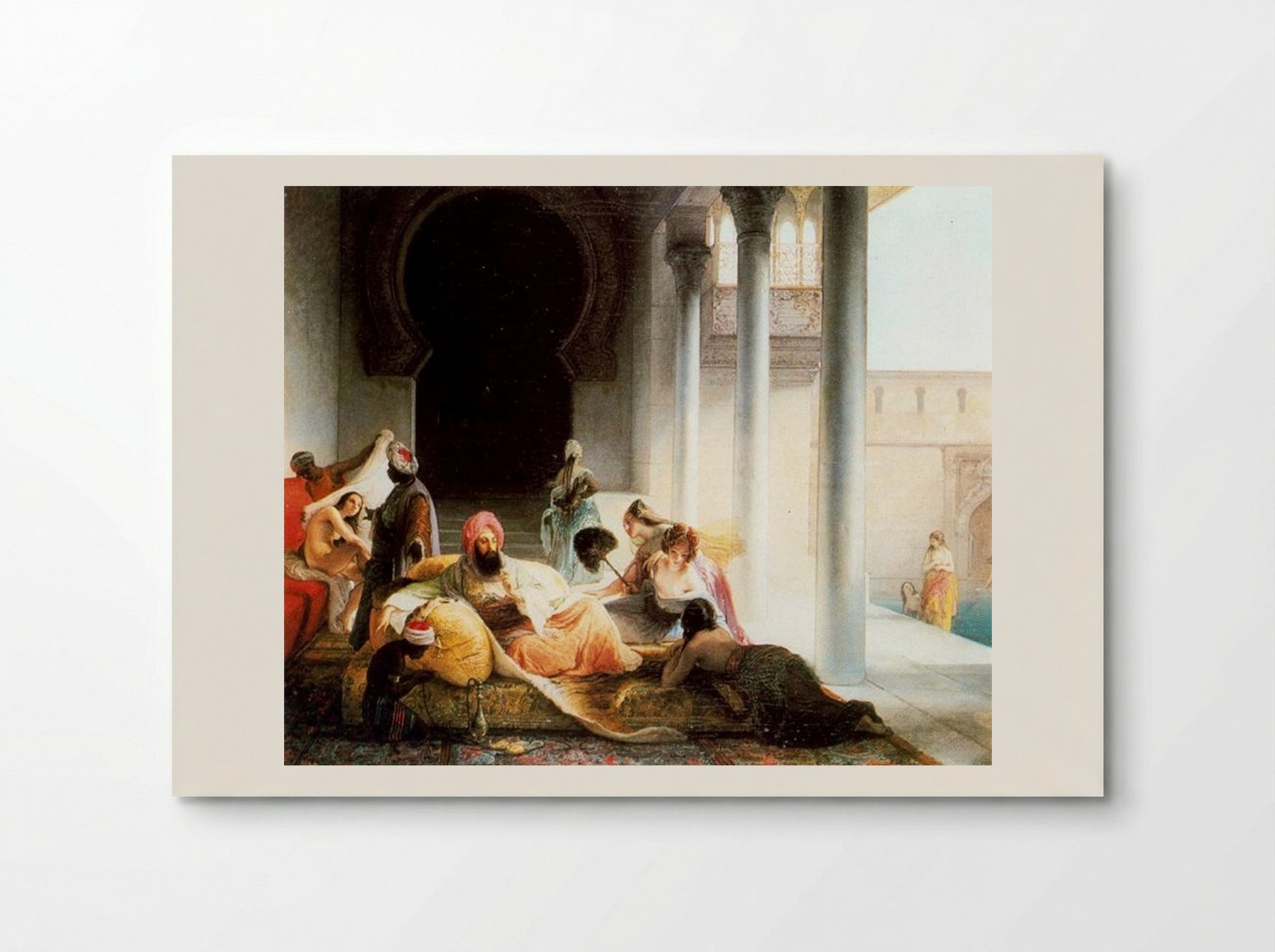
Inside the Harem - Francesco Hayez
Archival giclée
Frames arrive ready to hang
Secure checkout
Made to order
Description
Painted by Francesco Hayez, 'Inside the Harem' is an oil on canvas that reflects the Orientalist fascination prevalent in 19th-century European art. The painting presents a tableau of women within a harem setting.
Francesco Hayez, a leading figure of Italian Romanticism, painted 'Inside the Harem'. The work reflects the Orientalist fascination prevalent in 19th-century European art. This genre often depicted scenes from the 'Orient', reflecting European fantasies and perceptions of Middle Eastern and North African cultures. Hayez, while primarily known for his historical and patriotic paintings, engaged with Orientalism, a common theme among his contemporaries. The painting presents a tableau of women within a harem setting. The composition is arranged to give the viewer a glimpse into this private world, with figures reclining on cushions and engaging in various activities. The architecture, with its arches and columns, suggests an exotic locale. The artist's attention to detail is evident in the rendering of fabrics, textures, and the overall atmosphere of languid luxury. The colour palette is muted, with soft tones that contribute to the dreamlike quality of the scene.
Return policy
Because every print is made to order, we don't offer change-of-mind returns, refunds or exchanges. If your order arrives faulty, damaged or incorrect, we'll replace it free of charge — just contact us within 48 hours of delivery. See our refunds page for full details.
Shipping
We ship worldwide, printing at the production hub nearest to your delivery address. Delivery times and costs vary by destination — you'll see the options available to you at checkout.
Manufacturing
Each print is produced to order using 12-colour giclée printing on FSC-certified archival paper. Designed in Britain and printed at your nearest production hub to reduce waste and speed up delivery.
Inside the Harem - Francesco Hayez

Artist Biography
Francesco Hayez
Hayez was born in Venice in 1791, the youngest of five sons. His father was a fisherman of French origin; his mother came from Murano. The family was poor enough that the boy was placed with an uncle, the antiquarian Giovanni Binasco, who hoped to train him as a restorer. Instead, Hayez won a scholarship to the Accademia di San Luca in Rome in 1809, where he spent long hours studying Raphael in the Vatican Stanze and visiting the workshop of the sculptor Antonio Canova.
He settled in Milan in 1820 and became the leading figure of Italian Romanticism. His large historical paintings, depicting subjects from medieval Italian history, functioned as allegorical commentary on the Risorgimento, the movement for Italian unification. The use of historical costume allowed him to evade Austrian censorship while communicating patriotic ideas that his Milanese audience decoded without difficulty.
In 1850 he became director of the Brera Academy, a position he held for decades. He rarely signed or dated his works, and often painted the same composition multiple times with minimal variation, which has complicated scholarly assessment. He died in Milan in 1882, at ninety, having witnessed the unification he had painted.
Our Features
Designed for Lasting Impact
Specific Features
Every Solis piece is made to order with archival, gallery-quality materials built to last.
- Museum-grade giclée printing for rich, fade-resistant colour
- Archival matte fine-art paper, FSC-certified
- Multiple sizes and framing options available
- Frames in black, natural wood, dark wood or white
- Framed prints arrive ready to hang
Care & Cleaning
To keep your artwork looking its best:
- Dust gently with a soft, dry cloth
- Avoid prolonged direct sunlight
- Never use liquid cleaners on the print or canvas surface
- Keep in a dry, room-temperature space
- Handle prints with clean, dry hands
Materials & Sizing
Museum-grade giclée on FSC-certified archival matte paper, with framed and canvas options.
- Paper sizes: A4, A3, A2, A1, A0 and B2 (50×70 cm)
- Canvas: XS (20×30 cm) to Large (60×90 cm)
- Frames: black, natural wood, dark wood or white
Why Choose Us ?
Damage-free delivery guarantee
Fast Shipping
Museum-Quality Materials
Artist Biography
Francesco Hayez
Hayez was born in Venice in 1791, the youngest of five sons. His father was a fisherman of French origin; his mother came from Murano. The family was poor enough that the boy was placed with an uncle, the antiquarian Giovanni Binasco, who hoped to train him as a restorer. Instead, Hayez won a scholarship to the Accademia di San Luca in Rome in 1809, where he spent long hours studying Raphael in the Vatican Stanze and visiting the workshop of the sculptor Antonio Canova.
He settled in Milan in 1820 and became the leading figure of Italian Romanticism. His large historical paintings, depicting subjects from medieval Italian history, functioned as allegorical commentary on the Risorgimento, the movement for Italian unification. The use of historical costume allowed him to evade Austrian censorship while communicating patriotic ideas that his Milanese audience decoded without difficulty.
In 1850 he became director of the Brera Academy, a position he held for decades. He rarely signed or dated his works, and often painted the same composition multiple times with minimal variation, which has complicated scholarly assessment. He died in Milan in 1882, at ninety, having witnessed the unification he had painted.
You May Also Like