

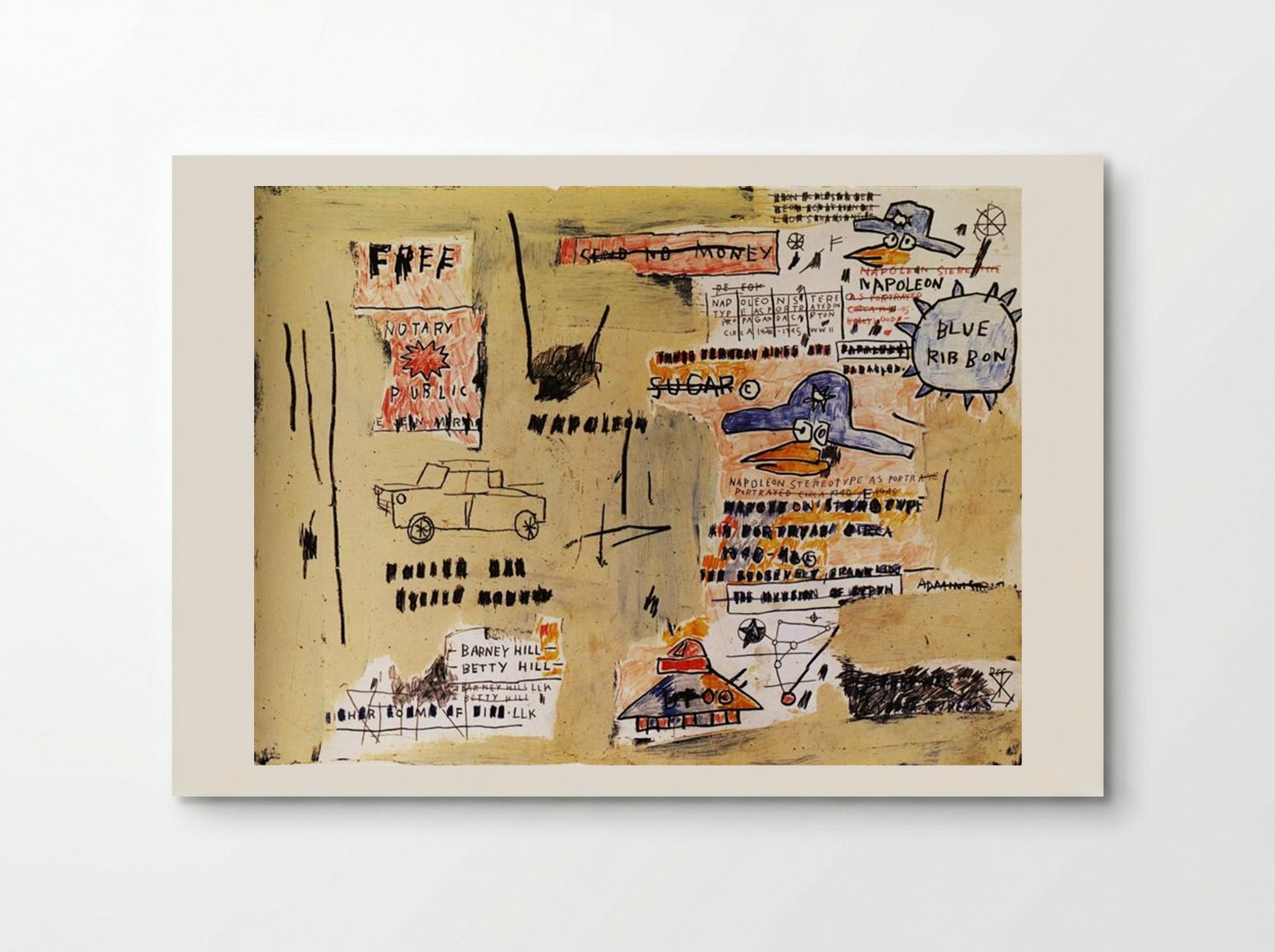
Napoleon Stereotype as Portrayed - Jean-Michel Basquiat
Archival giclée
Frames arrive ready to hang
Secure checkout
Made to order
Description
A 1983 work by Jean-Michel Basquiat, this piece uses text and symbolic imagery to critique historical narratives and the construction of public figures.
Jean-Michel Basquiat created Napoleon Stereotype as Portrayed in 1983, a period during which his work frequently engaged with historical figures, cultural icons, and the mechanics of power. The composition functions as a dense field of information, incorporating text, symbols, and schematic drawings that mimic the appearance of archival documents or propaganda posters. Basquiat employs a raw, immediate application of oilstick, creating a surface that feels both urgent and deliberate. The work features recurring motifs, such as the stylised bird figures wearing bicorne hats, which serve as direct visual references to Napoleon Bonaparte. By juxtaposing these historical symbols with contemporary phrases like 'Send No Money' and references to 'Barney Hill and Betty Hill', Basquiat disrupts traditional historical narratives. The text acts as a graphic element, with words crossed out or repeated to suggest the instability of language and the way history is constructed through selective memory and media representation. The colour palette is largely muted, relying on ochre, cream, and charcoal tones, which gives the piece the appearance of aged paper or a weathered wall. This choice of background allows the stark black lines and occasional bursts of colour to command attention. Basquiat uses the canvas to interrogate how stereotypes are manufactured and disseminated, particularly in relation to political authority and public perception. The composition is non-linear, encouraging the viewer to navigate the surface as one might read a collage of disparate sources. Through this layering of imagery, the artist examines the intersection of personal history and broader societal myths, maintaining a critical distance from the subjects he depicts.
Return policy
Because every print is made to order, we don't offer change-of-mind returns, refunds or exchanges. If your order arrives faulty, damaged or incorrect, we'll replace it free of charge — just contact us within 48 hours of delivery. See our refunds page for full details.
Shipping
We ship worldwide, printing at the production hub nearest to your delivery address. Delivery times and costs vary by destination — you'll see the options available to you at checkout.
Manufacturing
Each print is produced to order using 12-colour giclée printing on FSC-certified archival paper. Designed in Britain and printed at your nearest production hub to reduce waste and speed up delivery.
Care and materials
Specific Features
Every Solis piece is made to order with archival, gallery-quality materials built to last.
- Museum-grade giclée printing for rich, fade-resistant colour
- Archival matte fine-art paper, FSC-certified
- Multiple sizes and framing options available
- Frames in black, natural wood, dark wood or white
- Framed prints arrive ready to hang
Care & Cleaning
To keep your artwork looking its best:
- Dust gently with a soft, dry cloth
- Avoid prolonged direct sunlight
- Never use liquid cleaners on the print or canvas surface
- Keep in a dry, room-temperature space
- Handle prints with clean, dry hands
Materials & Sizing
Museum-grade giclée on FSC-certified archival matte paper, with framed and canvas options.
- Paper sizes: A4, A3, A2, A1, A0 and B2 (50×70 cm)
- Canvas: XS (20×30 cm) to Large (60×90 cm)
- Frames: black, natural wood, dark wood or white
Napoleon Stereotype as Portrayed - Jean-Michel Basquiat

Artist Biography
Jean Michel Basquiat
He had no formal art training. He dropped out of school at seventeen and slept on park benches and friends' floors. He sold hand-painted postcards and t-shirts. He gate-crashed a restaurant where the critic Henry Geldzahler was eating with Andy Warhol and handed them a postcard. Warhol bought one. The art world opened.
By twenty-one he was showing in galleries. By twenty-two he was the youngest artist ever invited to Documenta in Kassel. The paintings are dense, layered, furious: text fragments, anatomical drawings, crown symbols, crossed-out words, references to Black history, jazz, boxing, anatomy textbooks, and street signage. They look unplanned but they are not. The crossed-out words are deliberate. He wanted you to read them, then register the erasure.
He and Warhol collaborated on a series of paintings in 1984 and 1985. The relationship was complicated by the art market's tendency to treat Basquiat as Warhol's protege rather than his peer, and by the fact that Warhol, older and more established, got better reviews for the joint work. Basquiat pulled away.
He died of a heroin overdose in 1988, at twenty-seven. His paintings now sell for over 100 million dollars. He would have found that both satisfying and absurd.
Why Choose Us ?
Damage-free delivery guarantee
Fast Shipping
Museum-Quality Materials
You May Also Like