

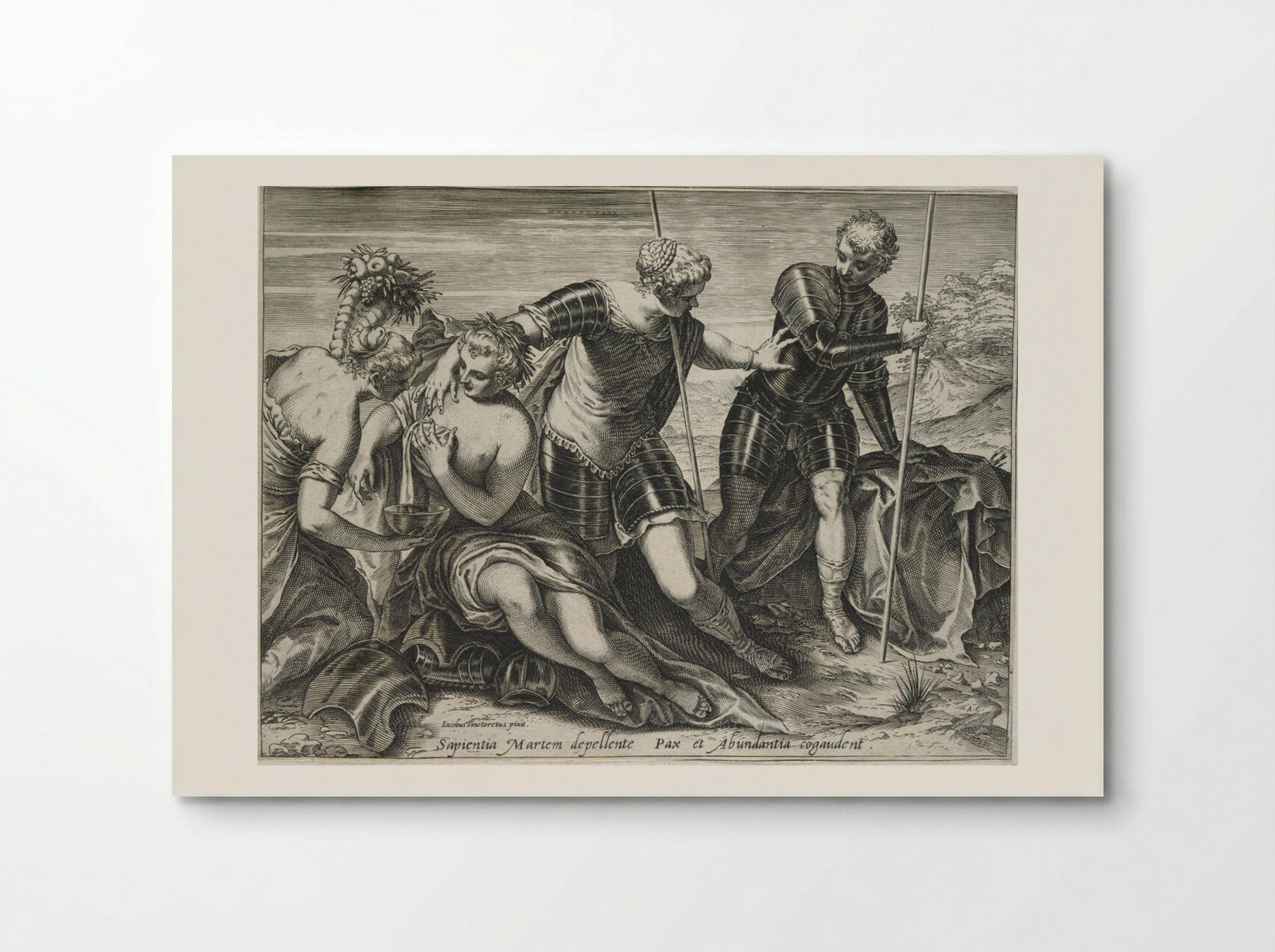
Mars Driven Away From Peace and Abundance by Minerva - Agostino Carracci
Archival giclée
Frames arrive ready to hang
Secure checkout
Made to order
Description
An engraving by Agostino Carracci, 'Mars Driven Away From Peace and Abundance by Minerva' depicts Minerva driving away Mars, with Peace and Abundance represented by female figures. The scene is rendered with precise lines and careful shading, typical of Carracci's engraving technique.
This engraving by Agostino Carracci (1557-1602) depicts a scene of Minerva, the Roman goddess of wisdom and strategic warfare, driving Mars, the god of war, away from Peace and Abundance. Carracci was an Italian painter, printmaker, and draughtsman. Along with his brother Annibale Carracci and cousin Ludovico Carracci, he was one of the founders of the Accademia degli Incamminati in Bologna. This academy was influential in the development of Baroque art. Carracci's work is characterised by its classical style and attention to detail. The composition shows Minerva, in armour, forcefully pushing Mars away. Peace and Abundance are represented by female figures, one holding a cornucopia overflowing with fruit, symbolising prosperity. The scene is rendered with precise lines and careful shading, typical of Carracci's engraving technique. The figures are muscular and posed dramatically, reflecting the influence of classical sculpture. The print is a fine example of late Mannerist art, blending classical ideals with a dynamic and expressive style.
Return policy
Because every print is made to order, we don't offer change-of-mind returns, refunds or exchanges. If your order arrives faulty, damaged or incorrect, we'll replace it free of charge — just contact us within 48 hours of delivery. See our refunds page for full details.
Shipping
We ship worldwide, printing at the production hub nearest to your delivery address. Delivery times and costs vary by destination — you'll see the options available to you at checkout.
Manufacturing
Each print is produced to order using 12-colour giclée printing on FSC-certified archival paper. Designed in Britain and printed at your nearest production hub to reduce waste and speed up delivery.
Care and materials
Specific Features
Every Solis piece is made to order with archival, gallery-quality materials built to last.
- Museum-grade giclée printing for rich, fade-resistant colour
- Archival matte fine-art paper, FSC-certified
- Multiple sizes and framing options available
- Frames in black, natural wood, dark wood or white
- Framed prints arrive ready to hang
Care & Cleaning
To keep your artwork looking its best:
- Dust gently with a soft, dry cloth
- Avoid prolonged direct sunlight
- Never use liquid cleaners on the print or canvas surface
- Keep in a dry, room-temperature space
- Handle prints with clean, dry hands
Materials & Sizing
Museum-grade giclée on FSC-certified archival matte paper, with framed and canvas options.
- Paper sizes: A4, A3, A2, A1, A0 and B2 (50×70 cm)
- Canvas: XS (20×30 cm) to Large (60×90 cm)
- Frames: black, natural wood, dark wood or white
Mars Driven Away From Peace and Abundance by Minerva - Agostino Carracci

Artist Biography
Agostino Carracci
His masterpiece as a painter, The Last Communion of Saint Jerome (1592), hangs in the Pinacoteca Nazionale di Bologna. The composition is controlled and deeply felt, with the dying saint receiving the sacrament in a soft, Correggesque light that reveals Agostino's careful study of the Parma master. He also contributed to major fresco cycles at Palazzo Fava (1584, Lives of Jason and Medea) and Palazzo Magnani (1590-92, Scenes from the Foundation of Rome), working alongside Annibale on both.
The engraving work that critics sometimes dismissed as mere reproduction turns out to have had an unexpectedly long legacy. His print after Paolo Fiammingo's Love in the Golden Age is recorded as a direct source for Matisse's Le bonheur de vivre (1905-06), connecting a Bologna workshop of the 1580s to Fauvist Paris three centuries later. Agostino died in Parma in March 1602, at forty-four, leaving a son, Antonio, who also became a painter.
Why Choose Us ?
Damage-free delivery guarantee
Fast Shipping
Museum-Quality Materials
You May Also Like