

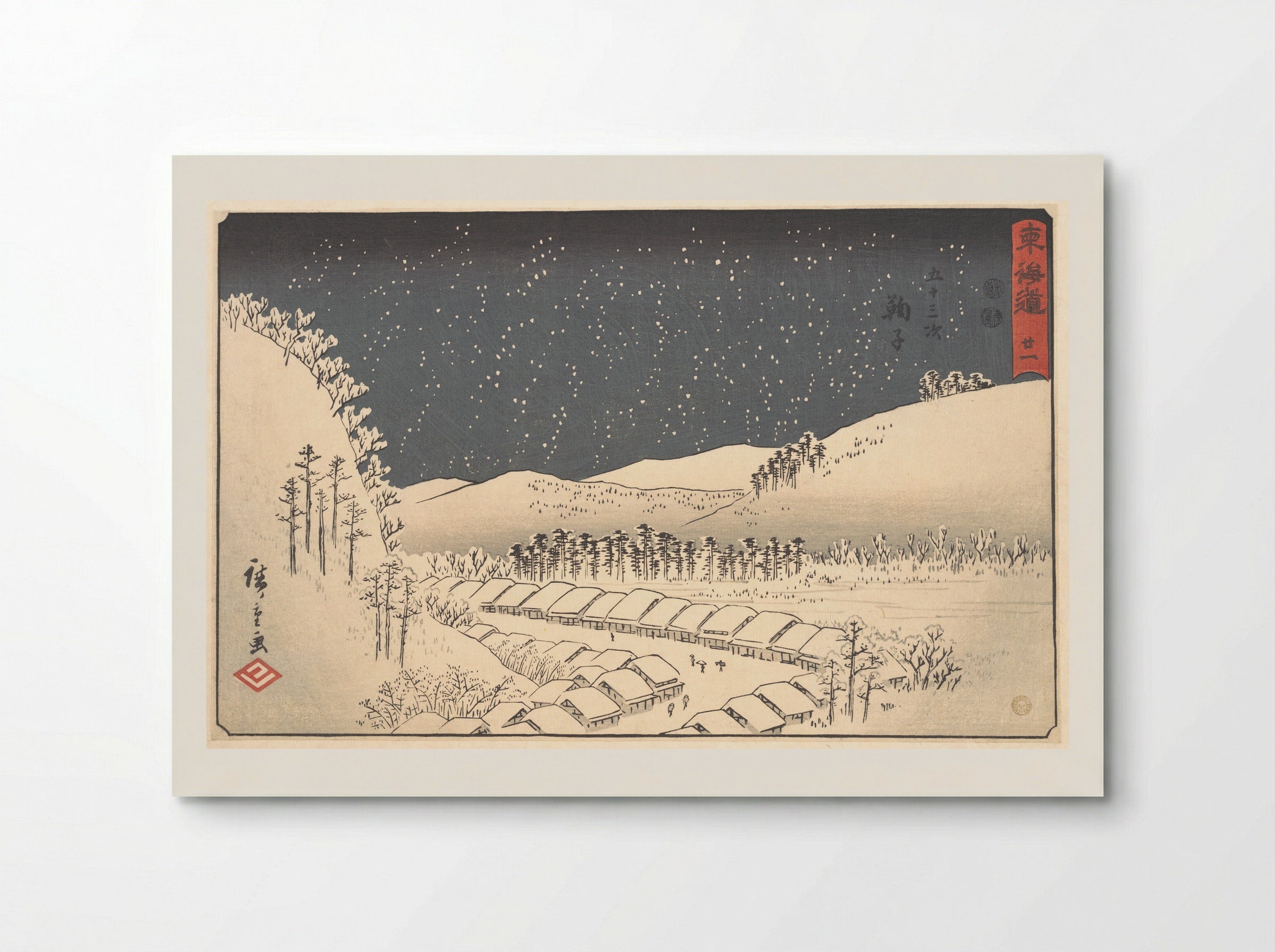
Mariko - Utagawa Hiroshige
Archival giclée
Frames arrive ready to hang
Secure checkout
Made to order
Description
A winter scene from Hiroshige's Reisho Tokaido series, depicting the village of Mariko under falling snow. This woodblock print uses a muted palette of indigo and white to capture a quiet night.
Utagawa Hiroshige produced several series documenting the Tokaido road, the coastal route connecting Edo and Kyoto. This specific print belongs to the Reisho Tokaido set, named after the formal clerical script (reisho) used in the title cartouche. Mariko was the twentieth station on the journey. Unlike the more famous Hoeido edition of the same series, this version presents a quiet, nocturnal atmosphere. The composition depicts the village of Mariko under a heavy snowfall. White flakes fall against a dark, indigo sky, created using the bokashi technique of graduated colour. The thatched roofs of the houses are thick with snow, forming a rhythmic pattern of white shapes across the lower half of the image. Small figures move through the village, their presence indicated by simple black strokes. Hiroshige used a limited palette of blue and grey tones alongside white to convey the cold temperature of a winter night. The mountains in the background are rendered with soft outlines, suggesting they are partially obscured by the weather. The artist avoided complex details in favour of broad areas of colour and clear silhouettes. This approach creates a sense of stillness and isolation common in his later landscape works. The Reisho Tokaido series was published by Maruya Seijiro between 1847 and 1852. It is distinguished by its horizontal format and the use of the reisho script in the red title panel. In this scene, the artist captures the specific geography of the Mariko station, which was located in a narrow valley. The steep hills on either side of the village are simplified into large, flat planes of colour, emphasising the verticality of the terrain. The use of negative space is a defining characteristic of this print. By allowing the natural colour of the paper to represent the snow on the ground and roofs, Hiroshige creates a high contrast with the dark sky. This technique was a standard practice in Japanese printmaking but is used here with particular effectiveness to suggest the silence of a winter evening. The small red seal in the lower left corner provides a sharp point of contrast to the otherwise cool colour scheme.
Return policy
Because every print is made to order, we don't offer change-of-mind returns, refunds or exchanges. If your order arrives faulty, damaged or incorrect, we'll replace it free of charge — just contact us within 48 hours of delivery. See our refunds page for full details.
Shipping
We ship worldwide, printing at the production hub nearest to your delivery address. Delivery times and costs vary by destination — you'll see the options available to you at checkout.
Manufacturing
Each print is produced to order using 12-colour giclée printing on FSC-certified archival paper. Designed in Britain and printed at your nearest production hub to reduce waste and speed up delivery.
Care and materials
Specific Features
Every Solis piece is made to order with archival, gallery-quality materials built to last.
- Museum-grade giclée printing for rich, fade-resistant colour
- Archival matte fine-art paper, FSC-certified
- Multiple sizes and framing options available
- Frames in black, natural wood, dark wood or white
- Framed prints arrive ready to hang
Care & Cleaning
To keep your artwork looking its best:
- Dust gently with a soft, dry cloth
- Avoid prolonged direct sunlight
- Never use liquid cleaners on the print or canvas surface
- Keep in a dry, room-temperature space
- Handle prints with clean, dry hands
Materials & Sizing
Museum-grade giclée on FSC-certified archival matte paper, with framed and canvas options.
- Paper sizes: A4, A3, A2, A1, A0 and B2 (50×70 cm)
- Canvas: XS (20×30 cm) to Large (60×90 cm)
- Frames: black, natural wood, dark wood or white
Mariko - Utagawa Hiroshige
Why Choose Us ?
Damage-free delivery guarantee
Fast Shipping
Museum-Quality Materials
You May Also Like