

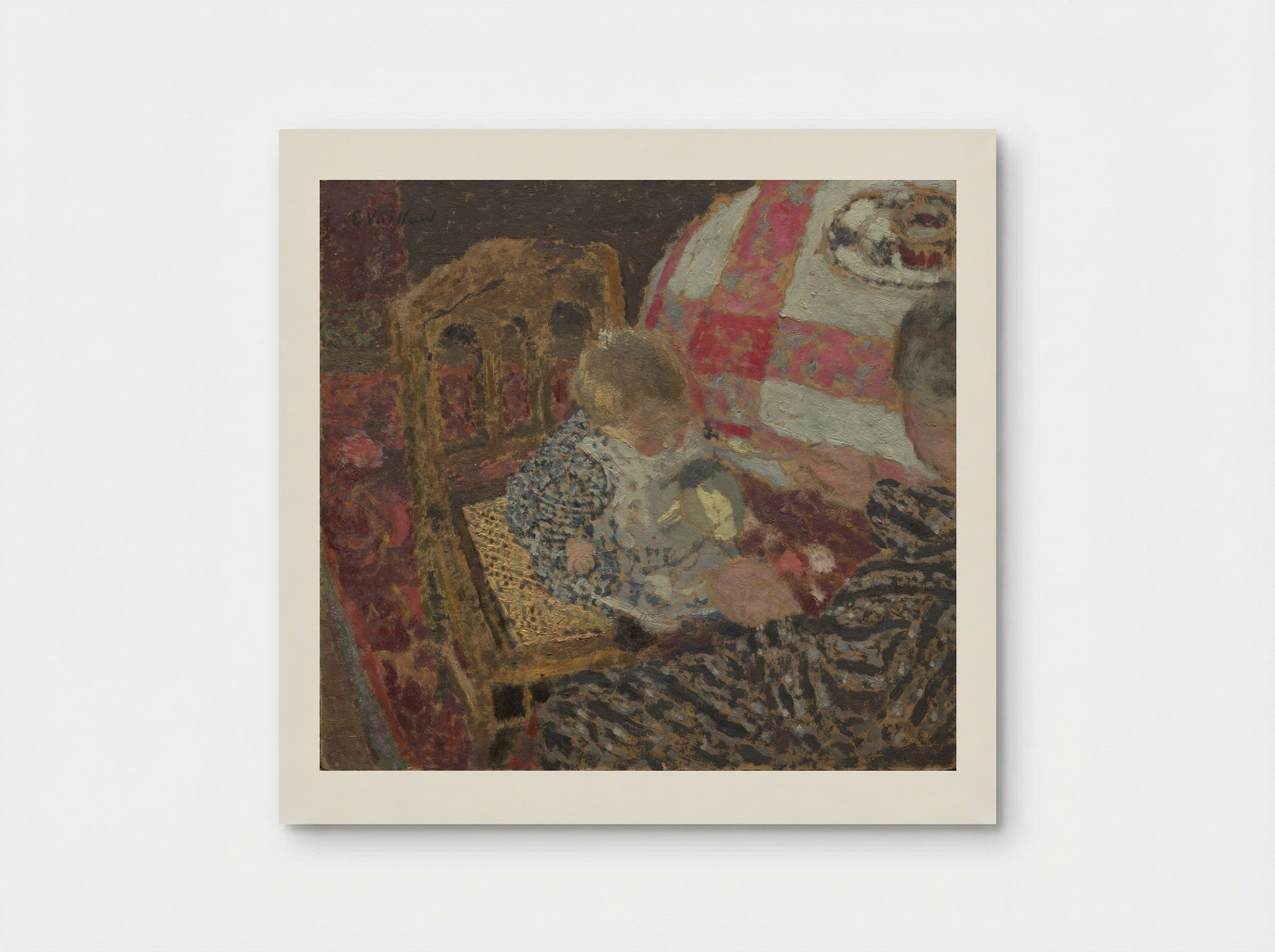
Luncheon (Annette and Her Grandmother) - Édouard Vuillard
Archival giclée
Frames arrive ready to hang
Secure checkout
Made to order
Description
A quintessential example of Intimisme, this work by Édouard Vuillard captures a quiet, domestic moment between a child and her grandmother through textured brushwork and a flattened, decorative perspective.
Édouard Vuillard was a central figure of the Nabis, a group of post-impressionist artists who prioritised decorative qualities and subjective expression over strict naturalism. This work, painted on cardboard, exemplifies the style known as Intimisme, which focused on the quiet, domestic life of the French bourgeoisie. In this scene, Vuillard captures a private moment between a young child, Annette, and her grandmother. The composition is flattened, with the figures and the surrounding interior space merging into a unified pattern of textures and muted tones. The artist uses short, broken brushstrokes to build up the surface, creating a sense of tactile depth that is characteristic of his mature period. The focus is not on the narrative of the meal, but on the atmosphere of the room and the relationship between the two figures. Vuillard often used his own family members as subjects, allowing him to observe them with a familiarity that translates into the relaxed, unposed nature of the scene. The colour palette is restrained, relying on earthy browns, soft pinks, and muted blues to create a sense of warmth and enclosure. The cane chair, the patterned fabric of the tablecloth, and the clothing of the figures are treated with equal attention, turning the domestic environment into a complex arrangement of shapes and colours. By avoiding traditional perspective, Vuillard draws the viewer into the immediate, physical reality of the space. This approach reflects the Nabis interest in the decorative potential of painting, where the surface of the work is as important as the subject matter itself. The result is a quiet, contemplative image that captures the essence of a fleeting, everyday interaction within the home.
Return policy
Because every print is made to order, we don't offer change-of-mind returns, refunds or exchanges. If your order arrives faulty, damaged or incorrect, we'll replace it free of charge — just contact us within 48 hours of delivery. See our refunds page for full details.
Shipping
We ship worldwide, printing at the production hub nearest to your delivery address. Delivery times and costs vary by destination — you'll see the options available to you at checkout.
Manufacturing
Each print is produced to order using 12-colour giclée printing on FSC-certified archival paper. Designed in Britain and printed at your nearest production hub to reduce waste and speed up delivery.
Care and materials
Specific Features
Every Solis piece is made to order with archival, gallery-quality materials built to last.
- Museum-grade giclée printing for rich, fade-resistant colour
- Archival matte fine-art paper, FSC-certified
- Multiple sizes and framing options available
- Frames in black, natural wood, dark wood or white
- Framed prints arrive ready to hang
Care & Cleaning
To keep your artwork looking its best:
- Dust gently with a soft, dry cloth
- Avoid prolonged direct sunlight
- Never use liquid cleaners on the print or canvas surface
- Keep in a dry, room-temperature space
- Handle prints with clean, dry hands
Materials & Sizing
Museum-grade giclée on FSC-certified archival matte paper, with framed and canvas options.
- Paper sizes: A4, A3, A2, A1, A0 and B2 (50×70 cm)
- Canvas: XS (20×30 cm) to Large (60×90 cm)
- Frames: black, natural wood, dark wood or white
Luncheon (Annette and Her Grandmother) - Édouard Vuillard

Artist Biography
Edouard Vuillard
He joined the Nabis in the early 1890s, a group of young painters who took their name from the Hebrew word for prophets. The others (Bonnard, Denis, Serusier) were drawn to mysticism and esoteric philosophy. Vuillard was drawn to the interior. His mother's workroom, with its bolts of fabric, wallpaper patterns, and women in patterned dresses, became his subject. The paintings flatten space: the figure merges with the wallpaper, the dress dissolves into the upholstery, the room becomes a single surface of competing patterns. Critics called the approach Intimism.
He painted almost exclusively domestic scenes: rooms, tables, women sewing, women reading. The scale is modest. The colours are muted. There is no drama, no allegory, no mythology. The work assumes that a woman sitting in a chair in a room with good light is enough to make a painting, which it is.
He never married. He lived with his mother until she died and then lived alone. In the late twentieth century, historians began to reassess his decorative work (screens, murals, theatre sets for Lugne-Poe's Theatre de l'Oeuvre) and recognised that the small domestic paintings were not minor work but a deliberate programme: the interior as a subject equal to landscape or history.
Why Choose Us ?
Damage-free delivery guarantee
Fast Shipping
Museum-Quality Materials
You May Also Like