

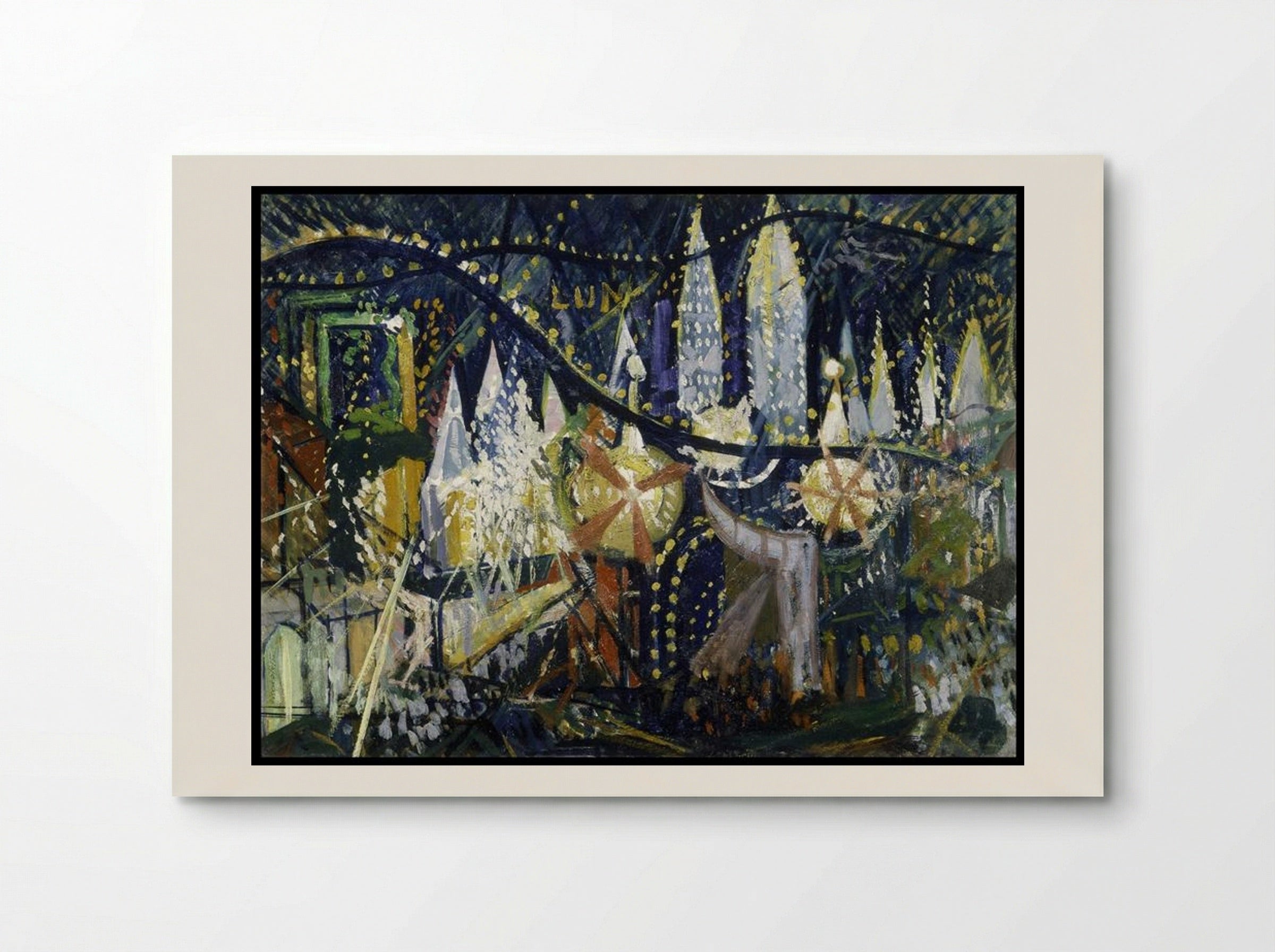
Luna Park - Joseph Stella
Archival giclée
Frames arrive ready to hang
Secure checkout
Made to order
Description
Joseph Stella's 'Luna Park' captures the chaotic energy of Coney Island through bold colours and fractured forms, reflecting the Futurist fascination with modernity and urban dynamism.
Joseph Stella, an Italian-American Futurist painter, created 'Luna Park' as an interpretation of the famous Coney Island amusement park in Brooklyn, New York. Stella was drawn to the dynamism of modern urban life, and Coney Island, with its electric lights and chaotic energy, provided a subject that aligned with Futurist principles. The Futurists aimed to capture the speed, technology, and energy of the modern world. Stella's work reflects this fascination with modernity. In 'Luna Park', Stella uses bold colours and fractured forms to convey the sensory overload of the amusement park. The canvas is filled with a jumble of shapes and lines, suggesting the whirling rides, bright lights, and crowds of people. Dominating the composition are the park's structures, rendered as angular, almost crystalline forms that reach towards the night sky. Dabs of yellow paint evoke the electric lights that illuminated the park. The painting captures the excitement and chaos of early 20th-century urban amusement.
Return policy
Because every print is made to order, we don't offer change-of-mind returns, refunds or exchanges. If your order arrives faulty, damaged or incorrect, we'll replace it free of charge — just contact us within 48 hours of delivery. See our refunds page for full details.
Shipping
We ship worldwide, printing at the production hub nearest to your delivery address. Delivery times and costs vary by destination — you'll see the options available to you at checkout.
Manufacturing
Each print is produced to order using 12-colour giclée printing on FSC-certified archival paper. Designed in Britain and printed at your nearest production hub to reduce waste and speed up delivery.
Care and materials
Specific Features
Every Solis piece is made to order with archival, gallery-quality materials built to last.
- Museum-grade giclée printing for rich, fade-resistant colour
- Archival matte fine-art paper, FSC-certified
- Multiple sizes and framing options available
- Frames in black, natural wood, dark wood or white
- Framed prints arrive ready to hang
Care & Cleaning
To keep your artwork looking its best:
- Dust gently with a soft, dry cloth
- Avoid prolonged direct sunlight
- Never use liquid cleaners on the print or canvas surface
- Keep in a dry, room-temperature space
- Handle prints with clean, dry hands
Materials & Sizing
Museum-grade giclée on FSC-certified archival matte paper, with framed and canvas options.
- Paper sizes: A4, A3, A2, A1, A0 and B2 (50×70 cm)
- Canvas: XS (20×30 cm) to Large (60×90 cm)
- Frames: black, natural wood, dark wood or white
Luna Park - Joseph Stella

Artist Biography
Joseph Stella
He was born Giuseppe Michele Stella in Muro Lucano, near Potenza, Italy, in 1877. His father and grandfather were attorneys. In 1896 he emigrated to New York to study medicine, following his older brother, a doctor, but abandoned that plan almost immediately and enrolled at the Art Students League, then studied under William Merritt Chase. A return trip to Europe in 1909 exposed him to Fauvism, Cubism and Futurism at exactly the right moment.
The Brooklyn Bridge became his obsession. He first painted it in 1919 after standing alone on the promenade late at night, listening to what he described as "the underground tumult of the trains in perpetual motion" and "the shrill sulphurous voice of the trolley wires". He later wrote that he felt "as if on the threshold of a new religion". His Brooklyn Bridge paintings, of which he made several versions over two decades, use Futurist fragmentation and Gothic verticality to transform an engineering structure into something approaching the sacred.
He was never fully at home in America. He spent long periods in Europe, North Africa and the Caribbean, producing collages from urban ephemera (paper scraps, wrappers with visible branding, bits of street life) that were never exhibited in his lifetime and only discovered by his circle after his death. He died in New York in 1946, at sixty-nine.
Why Choose Us ?
Damage-free delivery guarantee
Fast Shipping
Museum-Quality Materials
You May Also Like