

Le Stryge - Charles Meryon
Archival giclée
Frames arrive ready to hang
Secure checkout
Made to order
Description
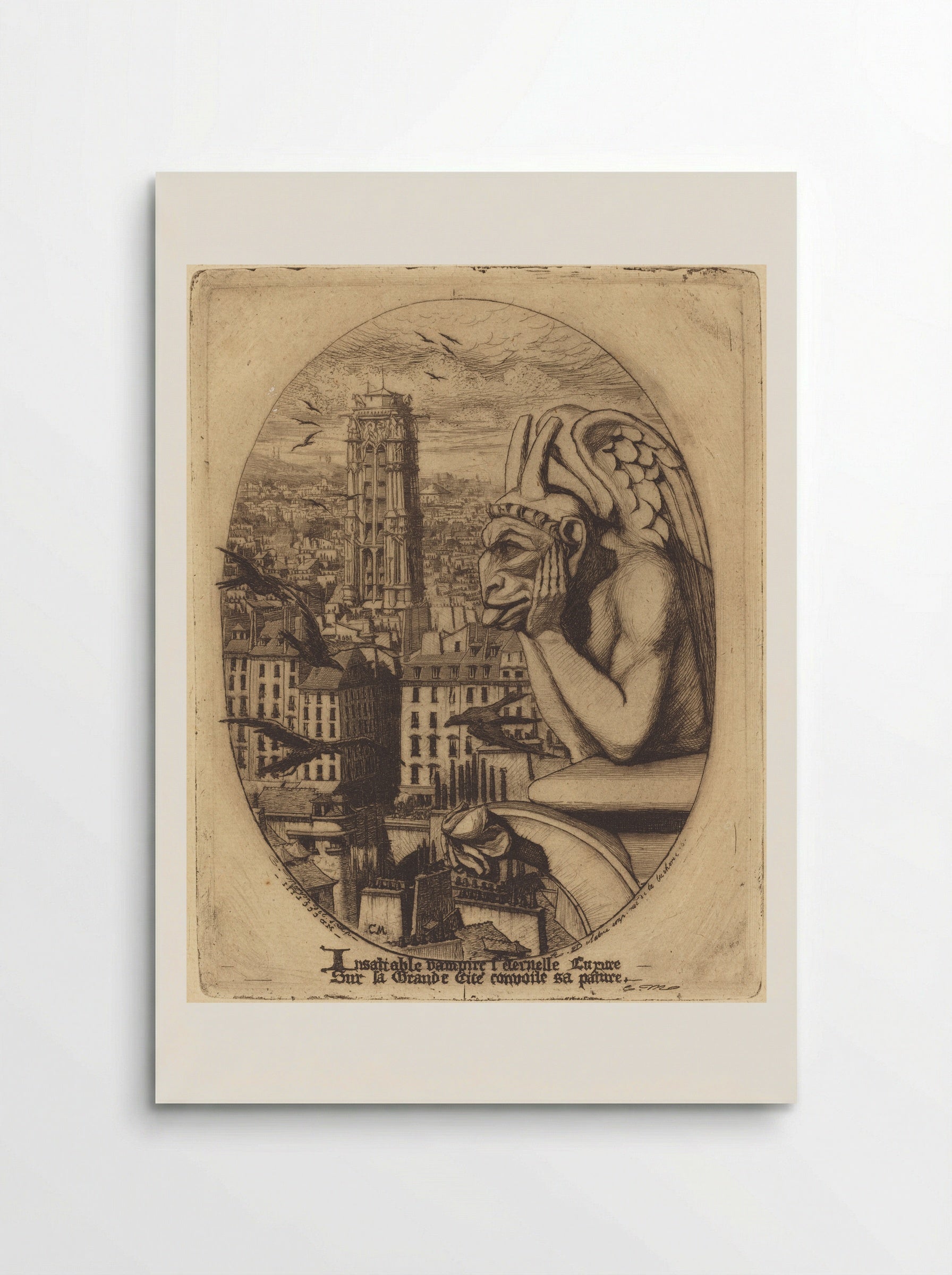
A classic 1853 etching by Charles Meryon, depicting a stone gargoyle overlooking the rooftops of Paris.
Le Stryge is a seminal etching by Charles Meryon, produced as part of his series Eaux-fortes sur Paris. The composition features a stone gargoyle, or stryge, perched upon the balustrade of Notre-Dame de Paris. The creature rests its chin upon its hands, gazing out over the sprawling urban expanse of nineteenth-century Paris. In the background, the tower of Saint-Jacques rises above the dense rooftops of the city, while birds circle in the sky, adding to the atmosphere of the scene. Meryon employed precise, controlled lines to render the textures of the stone, the architectural details of the cathedral, and the distant city buildings. The contrast between the dark, brooding figure of the gargoyle and the lighter, more distant cityscape creates a sense of depth and psychological weight. The work is framed within an oval, which focuses the viewer's attention on the interaction between the mythical stone guardian and the modernising city below. At the base of the print, Meryon included an inscription in French, which translates to: Insatiable vampire, the eternal lust, covets its prey over the great city. This text provides a commentary on the social and moral state of Paris during the period of rapid urban transformation under Baron Haussmann. Meryon was deeply affected by the destruction of old Parisian neighbourhoods, and his work often reflects a melancholic attachment to the city's medieval past. The etching is celebrated for its technical mastery and its ability to capture the specific mood of the French capital during the mid-nineteenth century. It remains a primary example of the revival of etching as a medium for artistic expression, demonstrating how Meryon utilised the copper plate to convey complex narratives and personal observations.
Return policy
Because every print is made to order, we don't offer change-of-mind returns, refunds or exchanges. If your order arrives faulty, damaged or incorrect, we'll replace it free of charge — just contact us within 48 hours of delivery. See our refunds page for full details.
Shipping
We ship worldwide, printing at the production hub nearest to your delivery address. Delivery times and costs vary by destination — you'll see the options available to you at checkout.
Manufacturing
Each print is produced to order using 12-colour giclée printing on FSC-certified archival paper. Designed in Britain and printed at your nearest production hub to reduce waste and speed up delivery.
Care and materials
Specific Features
Every Solis piece is made to order with archival, gallery-quality materials built to last.
- Museum-grade giclée printing for rich, fade-resistant colour
- Archival matte fine-art paper, FSC-certified
- Multiple sizes and framing options available
- Frames in black, natural wood, dark wood or white
- Framed prints arrive ready to hang
Care & Cleaning
To keep your artwork looking its best:
- Dust gently with a soft, dry cloth
- Avoid prolonged direct sunlight
- Never use liquid cleaners on the print or canvas surface
- Keep in a dry, room-temperature space
- Handle prints with clean, dry hands
Materials & Sizing
Museum-grade giclée on FSC-certified archival matte paper, with framed and canvas options.
- Paper sizes: A4, A3, A2, A1, A0 and B2 (50×70 cm)
- Canvas: XS (20×30 cm) to Large (60×90 cm)
- Frames: black, natural wood, dark wood or white
Le Stryge - Charles Meryon
Why Choose Us ?
Damage-free delivery guarantee
Fast Shipping
Museum-Quality Materials
You May Also Like