

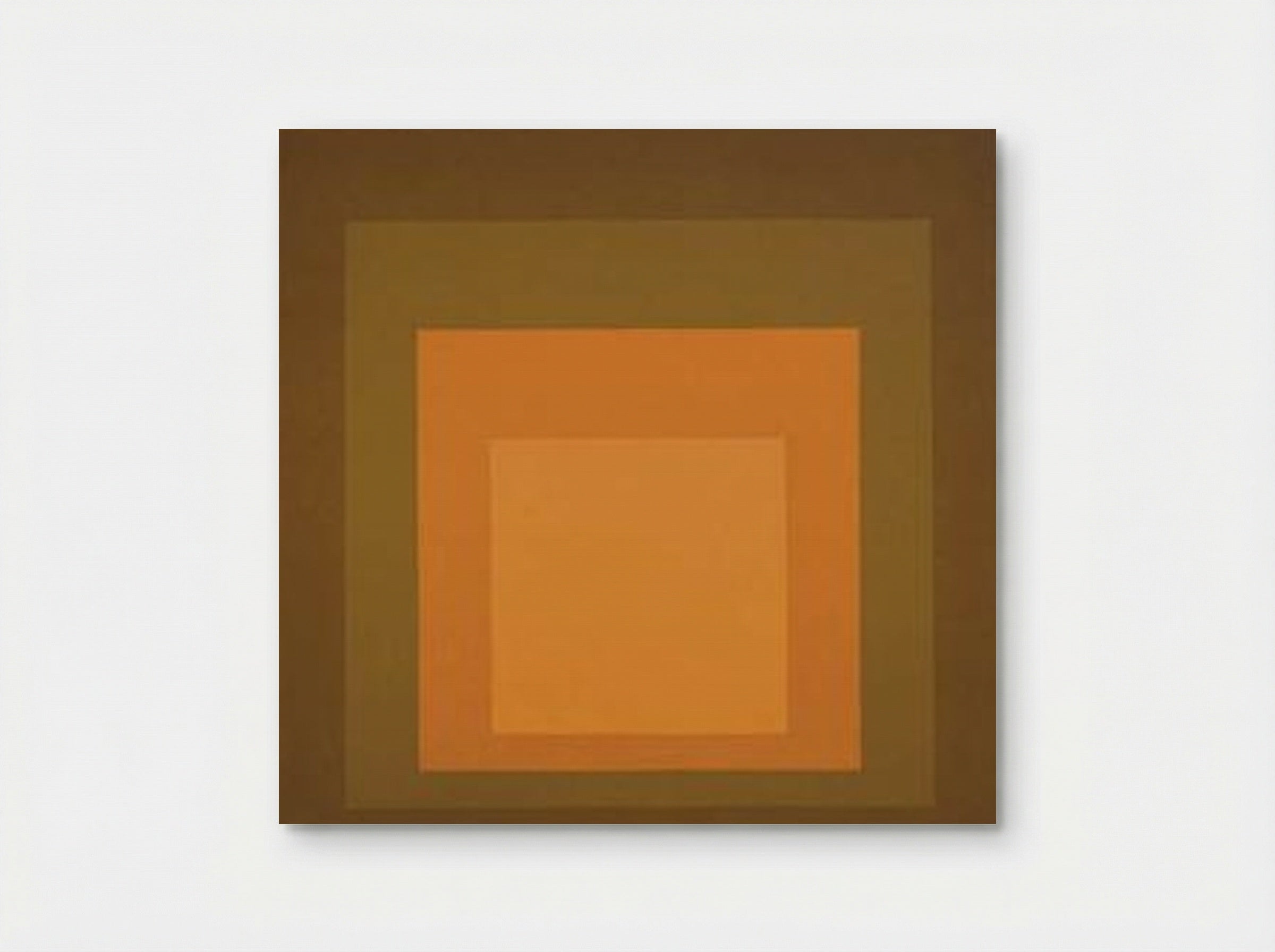
Homage to the Square: Autumn Climax - Josef Albers
Archival giclée
Frames arrive ready to hang
Secure checkout
Made to order
Description
A classic example of Josef Albers's Homage to the Square series, exploring the optical interaction of autumnal colours through nested geometric forms.
Josef Albers began his Homage to the Square series in 1950, continuing the project until his death in 1976. This specific work, Autumn Climax, demonstrates his rigorous investigation into the interaction of colour. The composition consists of three nested squares, arranged to create a sense of spatial depth through the manipulation of hue, saturation, and value. Albers applied the paint directly from the tube onto the masonite surface, using a palette knife to ensure a flat, uniform application that avoids visible brushwork. The choice of autumnal tones creates a specific optical effect. The outer square, a deep, earthy brown, provides a heavy frame for the lighter, warmer shades within. As the eye moves toward the centre, the colours shift from a muted ochre to a brighter, more luminous orange. This progression forces the viewer to perceive the squares as advancing or receding in space, despite the physical flatness of the surface. Albers intended for these works to function as a laboratory for visual perception, where the viewer observes how adjacent colours alter one another. Albers, a former teacher at the Bauhaus, maintained a disciplined approach to his practice. He rejected the emotional expressionism common in the mid-twentieth century, preferring a systematic method that prioritised the mechanics of sight. By limiting his formal vocabulary to the square, he removed distractions, allowing the viewer to focus entirely on the relationships between the chosen pigments. This print captures the precise colour transitions of the original, maintaining the integrity of Albers's chromatic theory. It is a study in balance, restraint, and the physical properties of light as represented through paint.
You might also like
Return policy
Because every print is made to order, we don't offer change-of-mind returns, refunds or exchanges. If your order arrives faulty, damaged or incorrect, we'll replace it free of charge — just contact us within 48 hours of delivery. See our refunds page for full details.
Shipping
We ship worldwide, printing at the production hub nearest to your delivery address. Delivery times and costs vary by destination — you'll see the options available to you at checkout.
Manufacturing
Each print is produced to order using 12-colour giclée printing on FSC-certified archival paper. Designed in Britain and printed at your nearest production hub to reduce waste and speed up delivery.
Homage to the Square: Autumn Climax - Josef Albers
Our Features
Designed for Lasting Impact
Specific Features
Every Solis piece is made to order with archival, gallery-quality materials built to last.
- Museum-grade giclée printing for rich, fade-resistant colour
- Archival matte fine-art paper, FSC-certified
- Multiple sizes and framing options available
- Frames in black, natural wood, dark wood or white
- Framed prints arrive ready to hang
Care & Cleaning
To keep your artwork looking its best:
- Dust gently with a soft, dry cloth
- Avoid prolonged direct sunlight
- Never use liquid cleaners on the print or canvas surface
- Keep in a dry, room-temperature space
- Handle prints with clean, dry hands
Materials & Sizing
Museum-grade giclée on FSC-certified archival matte paper, with framed and canvas options.
- Paper sizes: A4, A3, A2, A1, A0 and B2 (50×70 cm)
- Canvas: XS (20×30 cm) to Large (60×90 cm)
- Frames: black, natural wood, dark wood or white
Why Choose Us ?
Damage-free delivery guarantee
Fast Shipping
Museum-Quality Materials

Artist Biography
Josef Albers
He was born in 1888 in Bottrop, Westphalia, into a Roman Catholic craftsman's family. He worked as a schoolteacher for five years before deciding to study art, joining the Bauhaus as a student in 1920 and becoming a faculty member by 1922. He married Anni Fleischmann, a Bauhaus textile student, in 1925.
At Black Mountain, his students included Robert Rauschenberg, Cy Twombly, Ruth Asawa, and Ray Johnson. He left in 1950 to head the Department of Design at Yale, where he taught until retirement in 1958. The teaching produced Interaction of Color (1963), a text arguing that colour can only be understood in context, never in isolation. It remains a standard reference.
The Homage to the Square series occupied the rest of his life: nested squares of colour, painted obsessively, with every pigment and proportion meticulously recorded. The paintings look simple. The colour relationships within them are not. He died in 1976.
You May Also Like