

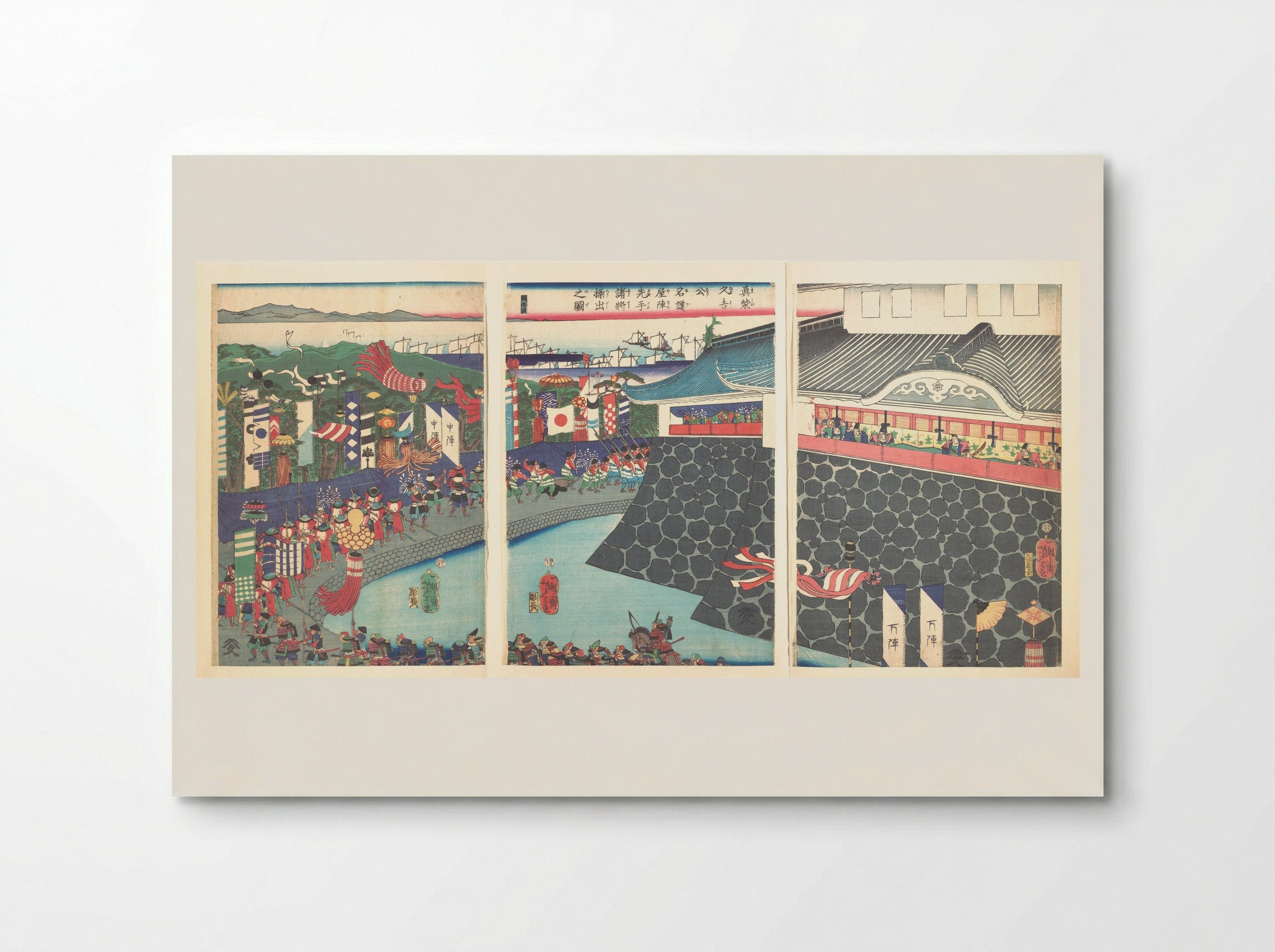
Hideyoshi and His Troops Leaving Nagoya Camp - Tsukioka Yoshitoshi
Archival giclée
Frames arrive ready to hang
Secure checkout
Made to order
Description
A detailed woodblock triptych by Tsukioka Yoshitoshi depicting the historical military procession of Toyotomi Hideyoshi from his Nagoya encampment.
This triptych by Tsukioka Yoshitoshi depicts the historical mobilisation of Toyotomi Hideyoshi and his military forces from the Nagoya camp. As a prominent figure in the final generation of Ukiyo-e artists, Yoshitoshi maintained the traditional woodblock format while incorporating elements of the changing aesthetic climate of the Meiji era. The composition spans three sheets, creating a wide panoramic view of the encampment, the stone fortifications, and the orderly procession of soldiers. The scene captures the scale of the military operation with precision. On the left and centre panels, troops move across a bridge, carrying banners and standards that identify various units. The architecture of the castle walls, rendered with distinct stone-patterning, provides a solid structural anchor for the movement of the figures. In the background, ships are visible upon the water, suggesting the maritime logistics required for such a campaign. Yoshitoshi employs a clear, graphic line quality, typical of his mid-career work, which allows for the legibility of the numerous figures and heraldic designs present in the scene. Yoshitoshi was a student of Utagawa Kuniyoshi, and this print reflects the influence of his master in the treatment of historical subjects and the use of dynamic, multi-panel layouts. The colour palette is balanced, utilising traditional pigments that have retained their clarity. The print serves as a record of the visual culture surrounding the depiction of samurai history during the nineteenth century. By focusing on the logistics of the departure, the artist provides a view into the organisation of the feudal military structure. This work is a representative example of the historical genre that remained popular throughout the transition from the Edo period to the modern era in Japan.
Return policy
Because every print is made to order, we don't offer change-of-mind returns, refunds or exchanges. If your order arrives faulty, damaged or incorrect, we'll replace it free of charge — just contact us within 48 hours of delivery. See our refunds page for full details.
Shipping
We ship worldwide, printing at the production hub nearest to your delivery address. Delivery times and costs vary by destination — you'll see the options available to you at checkout.
Manufacturing
Each print is produced to order using 12-colour giclée printing on FSC-certified archival paper. Designed in Britain and printed at your nearest production hub to reduce waste and speed up delivery.
Care and materials
Specific Features
Every Solis piece is made to order with archival, gallery-quality materials built to last.
- Museum-grade giclée printing for rich, fade-resistant colour
- Archival matte fine-art paper, FSC-certified
- Multiple sizes and framing options available
- Frames in black, natural wood, dark wood or white
- Framed prints arrive ready to hang
Care & Cleaning
To keep your artwork looking its best:
- Dust gently with a soft, dry cloth
- Avoid prolonged direct sunlight
- Never use liquid cleaners on the print or canvas surface
- Keep in a dry, room-temperature space
- Handle prints with clean, dry hands
Materials & Sizing
Museum-grade giclée on FSC-certified archival matte paper, with framed and canvas options.
- Paper sizes: A4, A3, A2, A1, A0 and B2 (50×70 cm)
- Canvas: XS (20×30 cm) to Large (60×90 cm)
- Frames: black, natural wood, dark wood or white
Hideyoshi and His Troops Leaving Nagoya Camp - Tsukioka Yoshitoshi

Artist Biography
Yoshitoshi
Yoshitoshi's art is characterised by its dramatic intensity and historical themes. He was fascinated by the supernatural, often depicting ghosts, demons, and scenes of violence. His mentor was Utagawa Kuniyoshi, who also explored similar themes. Yoshitoshi's skill in portraying emotion and movement, combined with his mastery of colour and composition, made his prints stand out. His work reflects a turbulent period in Japanese history, capturing the anxieties and uncertainties of a society undergoing rapid change.
Collectors are drawn to Yoshitoshi's prints for their striking imagery and historical value. His works offer a glimpse into a transitional period in Japan, blending traditional artistic techniques with modern sensibilities. His prints appeal to those who appreciate art that is both visually stunning and intellectually stimulating, preserving a vital part of Japanese cultural heritage.
Why Choose Us ?
Damage-free delivery guarantee
Fast Shipping
Museum-Quality Materials
You May Also Like