

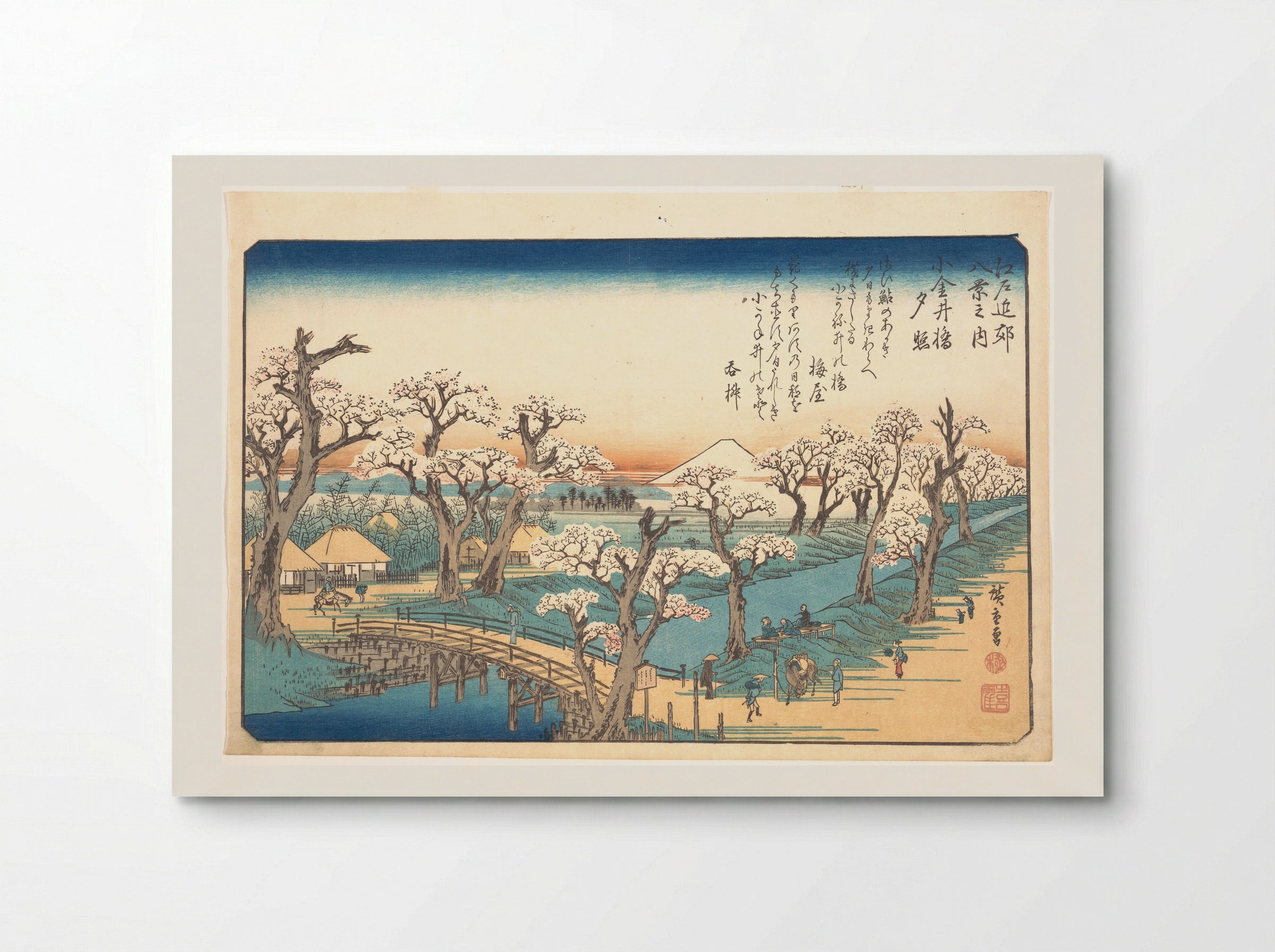
Evening Glow at Koganei Bridge - Utagawa Hiroshige
Archival giclée
Frames arrive ready to hang
Secure checkout
Made to order
Description
A woodblock print by Utagawa Hiroshige depicting the Koganei Bridge during sunset. Part of the Eight Views of the Environs of Edo series, it features cherry blossoms and Mount Fuji.
Hiroshige produced this woodblock print as part of his Eight Views of the Environs of Edo series during the late 1830s. The series adapts a classical Chinese poetic theme to the outskirts of the Tokugawa capital. This specific plate depicts the Koganei Bridge, a site known for its cherry blossoms along the Tamagawa Aqueduct. The Tamagawa Aqueduct was a primary water source for Edo, and the planting of cherry trees along its banks was a deliberate effort to stabilise the soil and provide a recreational space for city dwellers. Hiroshige captures this social aspect by including various figures engaged in travel and leisure. The composition features a wooden bridge spanning the water in the lower left. Figures move across the path, including a traveller on horseback and pedestrians in traditional dress. To the left, thatched-roof houses sit behind a fence. The banks of the canal are lined with cherry trees in full bloom, their white blossoms contrasting with the dark trunks. In the distance, the symmetrical cone of Mount Fuji rises above the horizon. Hiroshige used the bokashi technique to create the horizontal bands of colour in the sky, transitioning from a pale orange at the horizon to a deep blue at the top. This method suggests the fading light of dusk. The water also shows a graded blue tone, providing a sense of depth to the canal. The Eight Views of the Environs of Edo (Edo kinkō hakkei no uchi) was commissioned by a poetry club, which explains the prominent placement of the kyōka (comic poem) on the page. The collaboration between the artist and the poets was a common feature of ukiyo-e production. The technical execution of the print required multiple woodblocks, one for each colour, with precise registration to ensure the lines and tones aligned correctly. The blue pigment used is likely Prussian blue, which became widely available in Japan during the 1830s and transformed the palette of landscape prints.
Return policy
Because every print is made to order, we don't offer change-of-mind returns, refunds or exchanges. If your order arrives faulty, damaged or incorrect, we'll replace it free of charge — just contact us within 48 hours of delivery. See our refunds page for full details.
Shipping
We ship worldwide, printing at the production hub nearest to your delivery address. Delivery times and costs vary by destination — you'll see the options available to you at checkout.
Manufacturing
Each print is produced to order using 12-colour giclée printing on FSC-certified archival paper. Designed in Britain and printed at your nearest production hub to reduce waste and speed up delivery.
Evening Glow at Koganei Bridge - Utagawa Hiroshige
Our Features
Designed for Lasting Impact
Specific Features
Every Solis piece is made to order with archival, gallery-quality materials built to last.
- Museum-grade giclée printing for rich, fade-resistant colour
- Archival matte fine-art paper, FSC-certified
- Multiple sizes and framing options available
- Frames in black, natural wood, dark wood or white
- Framed prints arrive ready to hang
Care & Cleaning
To keep your artwork looking its best:
- Dust gently with a soft, dry cloth
- Avoid prolonged direct sunlight
- Never use liquid cleaners on the print or canvas surface
- Keep in a dry, room-temperature space
- Handle prints with clean, dry hands
Materials & Sizing
Museum-grade giclée on FSC-certified archival matte paper, with framed and canvas options.
- Paper sizes: A4, A3, A2, A1, A0 and B2 (50×70 cm)
- Canvas: XS (20×30 cm) to Large (60×90 cm)
- Frames: black, natural wood, dark wood or white
Why Choose Us ?
Damage-free delivery guarantee
Fast Shipping
Museum-Quality Materials
Artist Biography
Utagawa Hiroshige
You May Also Like