

Chushingura: Act X of The Storehouse of Loyalty - Kitagawa Utamaro
Archival giclée
Frames arrive ready to hang
Secure checkout
Made to order
Description
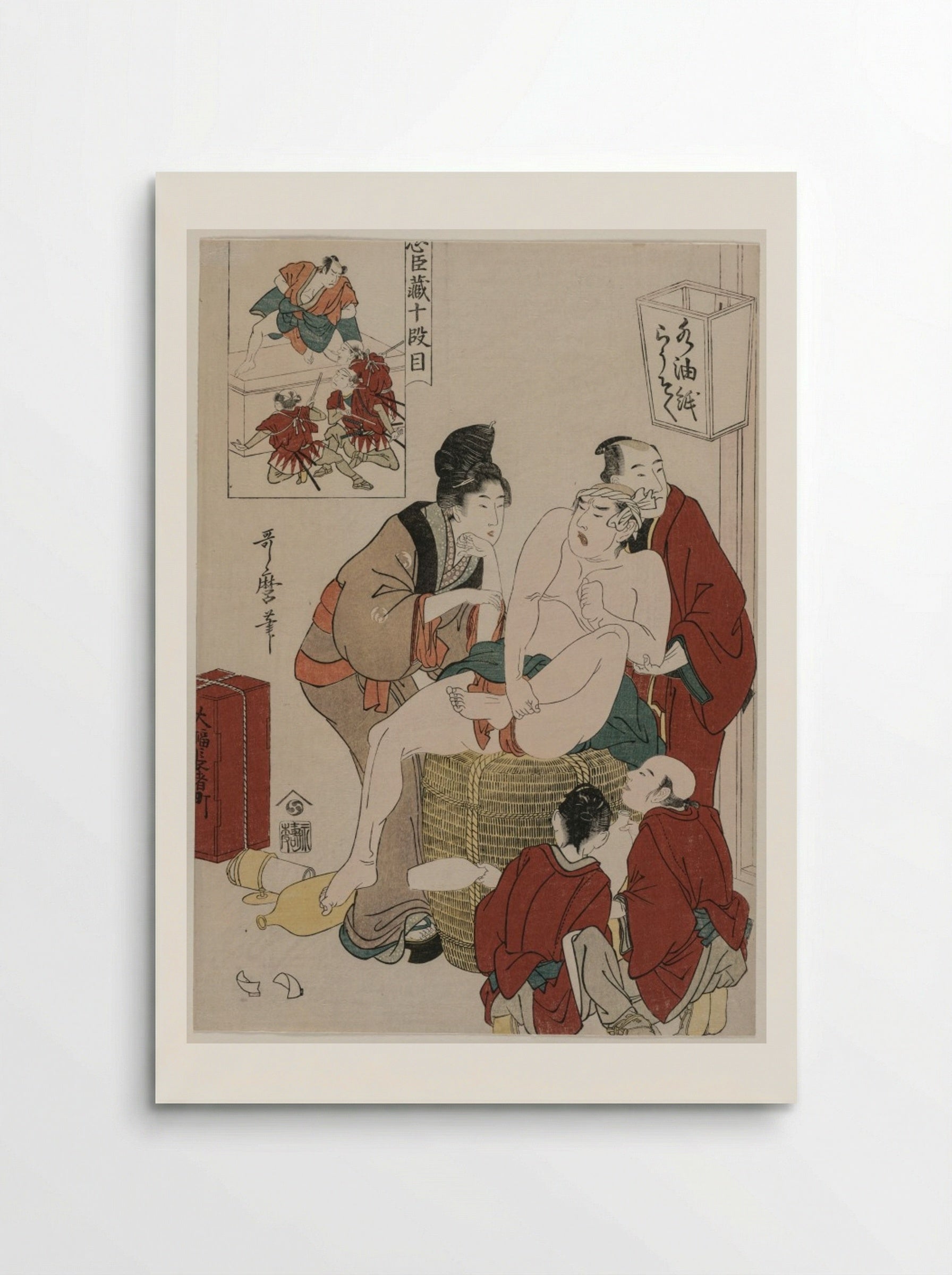
A classic ukiyo-e woodblock print by Kitagawa Utamaro, depicting an intimate scene from the legendary Chushingura narrative.
This woodblock print by Kitagawa Utamaro depicts a scene from the famous Chushingura narrative, specifically the tenth act of the tale concerning the forty-seven ronin. Utamaro, a master of the ukiyo-e genre, is widely recognised for his ability to capture human emotion and physical form with precision. In this composition, he focuses on the domestic and personal aspects of the legendary story, moving away from the typical battle scenes associated with the epic. The print features a central figure seated upon a large woven container, surrounded by attendants and a woman who observes the scene with a contemplative expression. The artist employs a controlled line quality to define the figures, while the colour palette remains restrained, relying on muted earth tones and deep reds to direct the viewer's attention. The inclusion of a smaller inset scene at the top left provides narrative context, linking the intimate interior moment to the broader events of the Chushingura saga. Utamaro’s work often explored the lives of people within the pleasure districts of Edo, and his approach to this historical subject retains that characteristic sensitivity to gesture and posture. The composition is balanced, with the figures arranged to create a sense of narrative flow. The use of negative space and the placement of objects, such as the lantern and the discarded vessel, contribute to the overall structure of the print. This piece offers a glimpse into the way historical narratives were adapted and consumed through the medium of woodblock printing during the late eighteenth century. It remains a clear example of the technical skill involved in the production of ukiyo-e prints, from the initial drawing to the final application of ink on paper.
Return policy
Because every print is made to order, we don't offer change-of-mind returns, refunds or exchanges. If your order arrives faulty, damaged or incorrect, we'll replace it free of charge — just contact us within 48 hours of delivery. See our refunds page for full details.
Shipping
We ship worldwide, printing at the production hub nearest to your delivery address. Delivery times and costs vary by destination — you'll see the options available to you at checkout.
Manufacturing
Each print is produced to order using 12-colour giclée printing on FSC-certified archival paper. Designed in Britain and printed at your nearest production hub to reduce waste and speed up delivery.
Chushingura: Act X of The Storehouse of Loyalty - Kitagawa Utamaro

Artist Biography
Kitagawa Utamaro
Almost nothing is certain about his early life. He was born around 1753, possibly in Edo, possibly in Kyoto, possibly in Kawagoe. He began publishing prints in the 1770s under the guidance of the publisher Tsutaya Juzaburo, who recognised what Utamaro could do with a portrait of a woman.
What he could do was unprecedented. He invented the okubi-e format: large head-and-shoulders portraits of individual women, mostly from the Yoshiwara pleasure district, printed in close-up with minimal background. Before Utamaro, bijin-ga (pictures of beautiful women) showed groups of figures in full length. He isolated the face, the tilt of the head, the expression. The prints are psychologically specific in a way that had not existed in Japanese printmaking.
He also published books of insect studies and volumes of shunga (erotica), and he made portraits of ordinary town women, not just courtesans. Ohisa and Okita, two shopgirls who appeared in his Three Beauties of the Present Day, became famous across Edo because of his prints. He turned real people into celebrities, which may be the first documented instance of an artist functioning as a kind of media platform.
Tsutaya Juzaburo died in 1797. Utamaro was reportedly devastated. Some critics feel his work never reached the same level afterward. He produced over two thousand prints in his career.
Our Features
Designed for Lasting Impact
Specific Features
Every Solis piece is made to order with archival, gallery-quality materials built to last.
- Museum-grade giclée printing for rich, fade-resistant colour
- Archival matte fine-art paper, FSC-certified
- Multiple sizes and framing options available
- Frames in black, natural wood, dark wood or white
- Framed prints arrive ready to hang
Care & Cleaning
To keep your artwork looking its best:
- Dust gently with a soft, dry cloth
- Avoid prolonged direct sunlight
- Never use liquid cleaners on the print or canvas surface
- Keep in a dry, room-temperature space
- Handle prints with clean, dry hands
Materials & Sizing
Museum-grade giclée on FSC-certified archival matte paper, with framed and canvas options.
- Paper sizes: A4, A3, A2, A1, A0 and B2 (50×70 cm)
- Canvas: XS (20×30 cm) to Large (60×90 cm)
- Frames: black, natural wood, dark wood or white
Why Choose Us ?
Damage-free delivery guarantee
Fast Shipping
Museum-Quality Materials
Artist Biography
Kitagawa Utamaro
Almost nothing is certain about his early life. He was born around 1753, possibly in Edo, possibly in Kyoto, possibly in Kawagoe. He began publishing prints in the 1770s under the guidance of the publisher Tsutaya Juzaburo, who recognised what Utamaro could do with a portrait of a woman.
What he could do was unprecedented. He invented the okubi-e format: large head-and-shoulders portraits of individual women, mostly from the Yoshiwara pleasure district, printed in close-up with minimal background. Before Utamaro, bijin-ga (pictures of beautiful women) showed groups of figures in full length. He isolated the face, the tilt of the head, the expression. The prints are psychologically specific in a way that had not existed in Japanese printmaking.
He also published books of insect studies and volumes of shunga (erotica), and he made portraits of ordinary town women, not just courtesans. Ohisa and Okita, two shopgirls who appeared in his Three Beauties of the Present Day, became famous across Edo because of his prints. He turned real people into celebrities, which may be the first documented instance of an artist functioning as a kind of media platform.
Tsutaya Juzaburo died in 1797. Utamaro was reportedly devastated. Some critics feel his work never reached the same level afterward. He produced over two thousand prints in his career.
You May Also Like